Influence of rescuer position and arm angle on chest compression quality: An international multicentric randomized crossover simulation trial
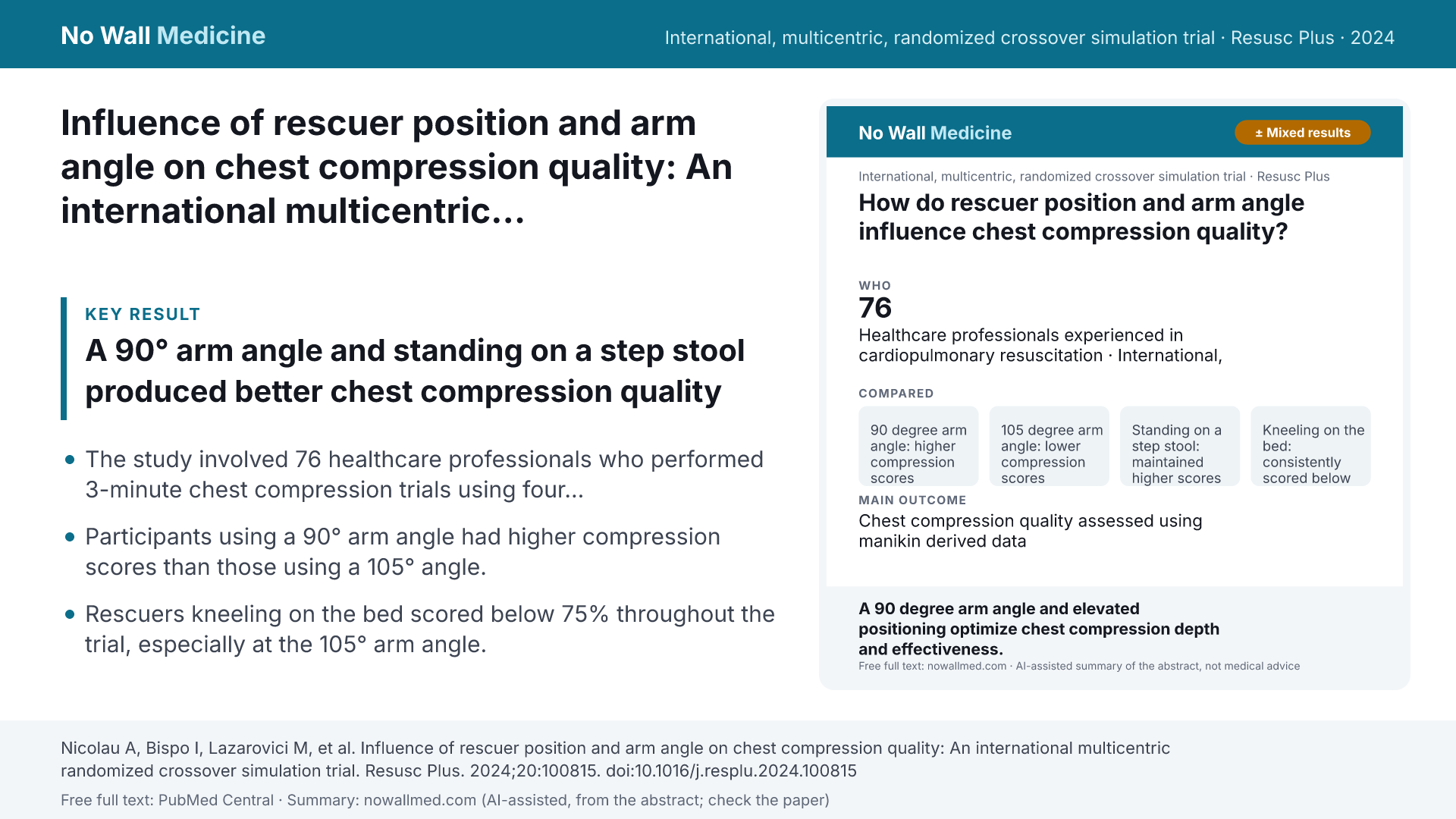
Key result: A 90° arm angle and standing on a step stool produced better chest compression quality
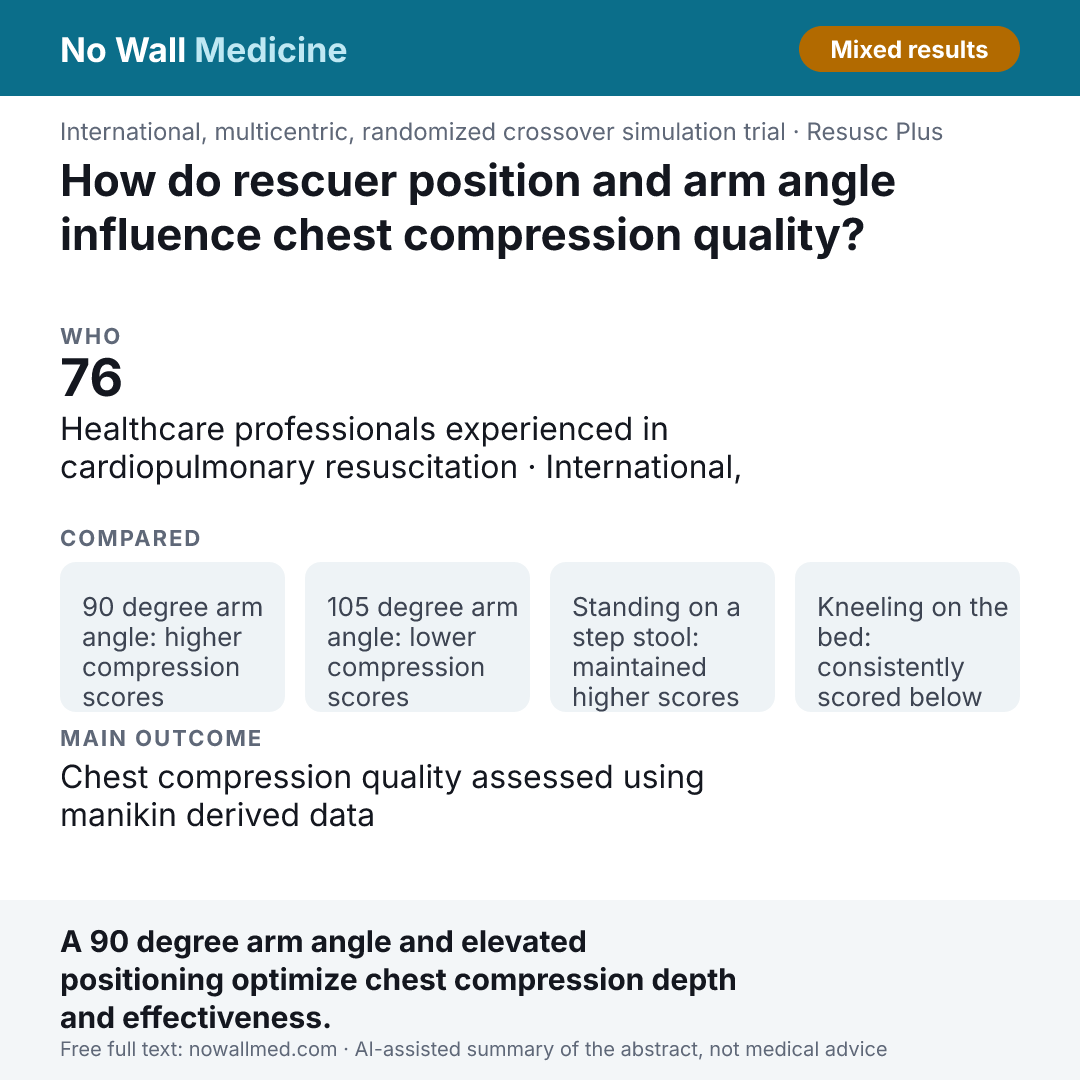
International, multicentric, randomized crossover simulation trialMixed results
How do rescuer position and arm angle influence chest compression quality?
Who
76
Healthcare professionals experienced in cardiopulmonary resuscitation · International, multicentric
Compared
90 degree arm angle: higher compression scores
105 degree arm angle: lower compression scores
Standing on a step stool: maintained higher scores over time
Kneeling on the bed: consistently scored below 75%
Main outcome
Chest compression quality assessed using manikin derived data
Bottom line: A 90 degree arm angle and elevated positioning optimize chest compression depth and effectiveness.
Resusc Plus · 2024-10-29 · Save PNG
Key points
- The study involved 76 healthcare professionals who performed 3-minute chest compression trials using four different positions and two different arm angles.
- Participants using a 90° arm angle had higher compression scores than those using a 105° angle.
- Rescuers kneeling on the bed scored below 75% throughout the trial, especially at the 105° arm angle.
Discussion prompts
- Would these patients look like yours? Who was left out?
- Is the main outcome one that matters to patients?
- Is the difference large enough to change what you do?
Cite: Nicolau A, Bispo I, Lazarovici M, et al. Influence of rescuer position and arm angle on chest compression quality: An international multicentric randomized crossover simulation trial. Resusc Plus. 2024;20:100815. doi:10.1016/j.resplu.2024.100815
Free full text: PubMed Central · Summary and visual abstract: nowallmed.com/a/influence-of-rescuer-position-and-arm-angle-on-chest-compression-1byq32f/ (AI-assisted from the abstract; check the paper before relying on it).