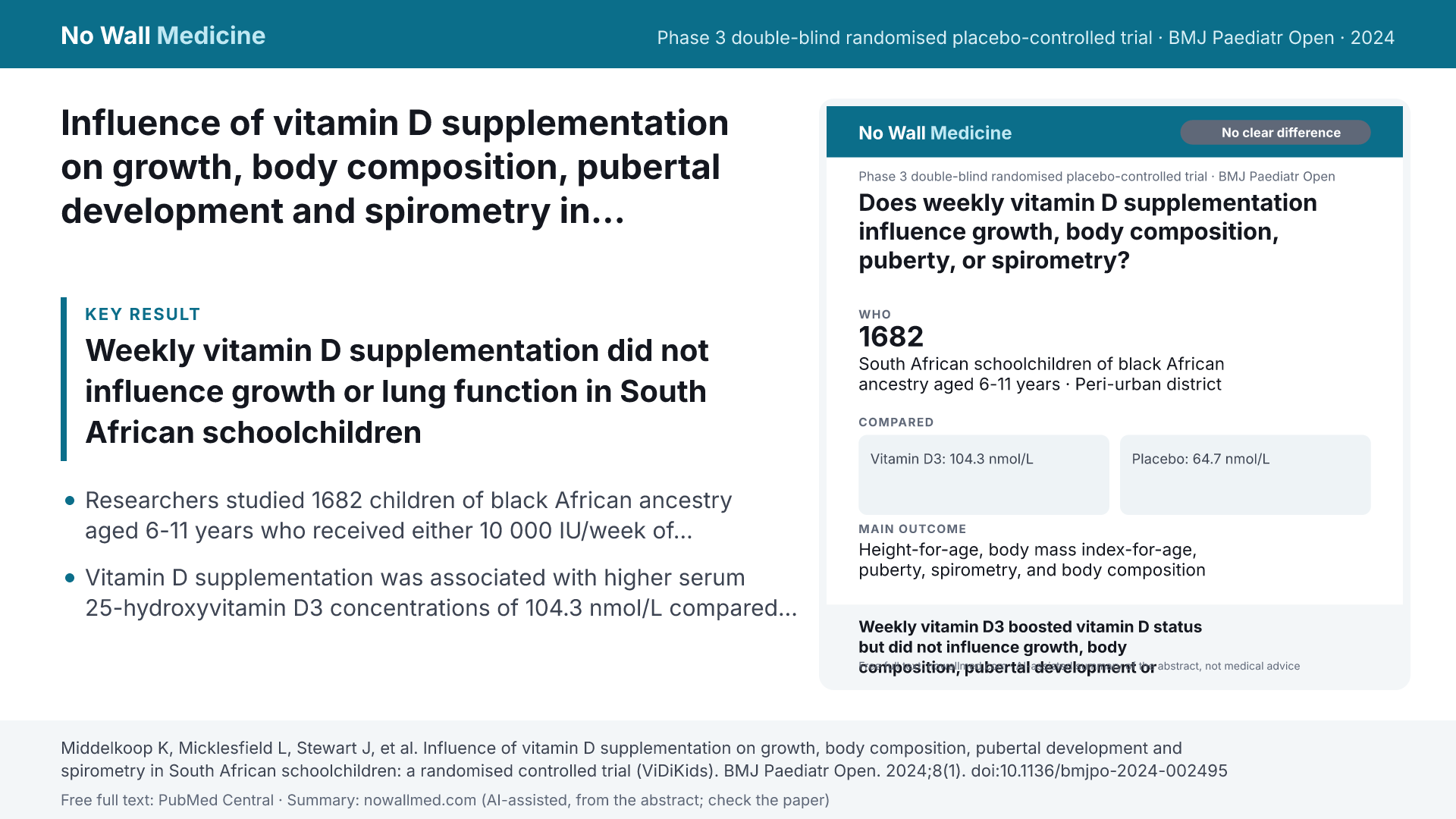
Weekly vitamin D supplementation did not influence growth or lung function in South African schoolchildren
Influence of vitamin D supplementation on growth, body composition, pubertal development and spirometry in South African schoolchildren: a randomised controlled trial (ViDiKids)
Phase 3 double-blind randomised placebo-controlled trialNo clear difference
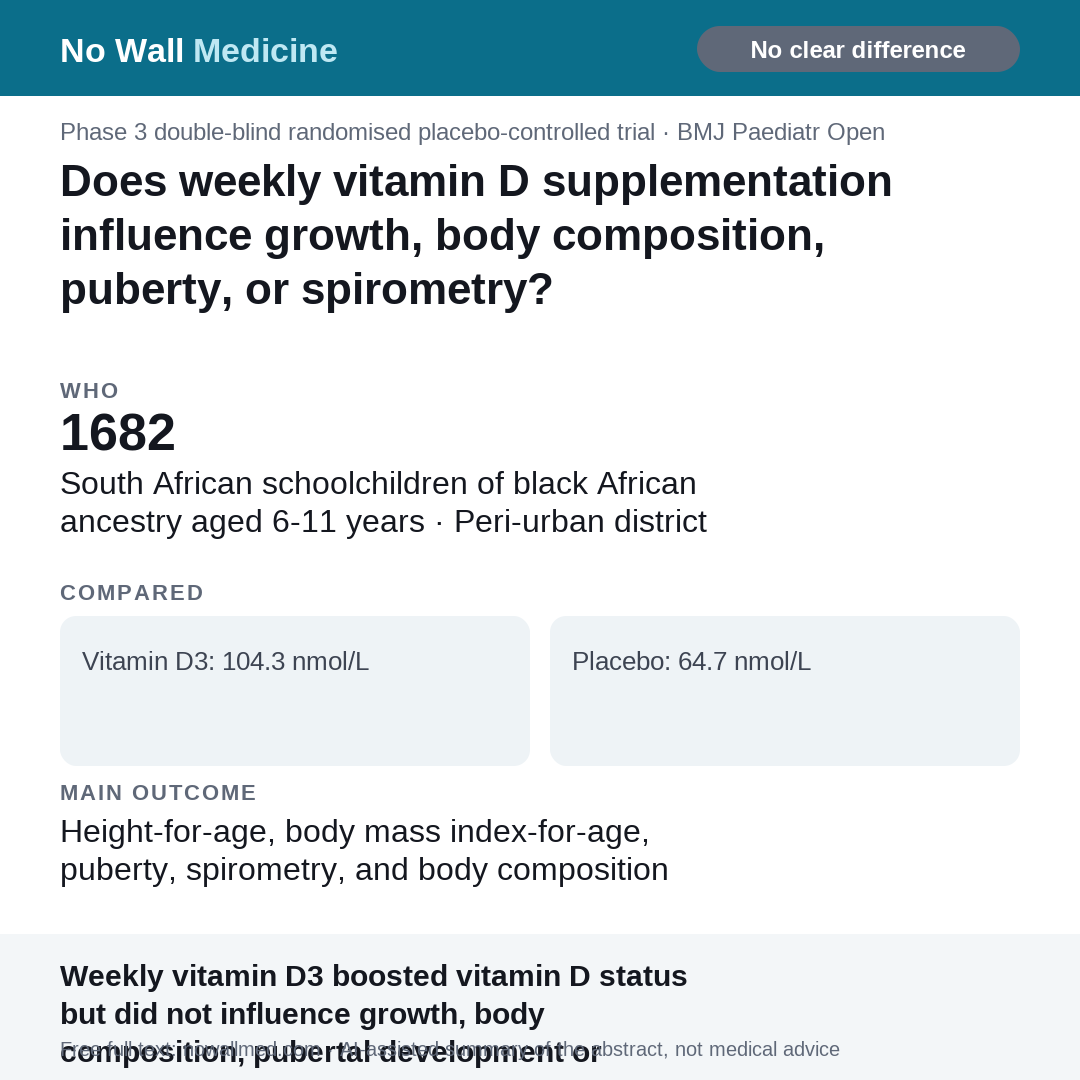
Does weekly vitamin D supplementation influence growth, body composition, puberty, or spirometry?
Who
1682
South African schoolchildren of black African ancestry aged 6-11 years · Peri-urban district of Cape Town, South Africa
Compared
Vitamin D3: 104.3 nmol/L
Placebo: 64.7 nmol/L
Main outcome
Height-for-age, body mass index-for-age, puberty, spirometry, and body composition
Result: adjusted mean difference -0.08 (95% CI -0.19 to 0.03) for height-for-age
Bottom line: Weekly vitamin D3 boosted vitamin D status but did not influence growth, body composition, pubertal development or spirometric outcomes.
BMJ Paediatr Open · 2024-04-10Download image
Clinical question: Does weekly vitamin D supplementation influence growth, body composition, puberty, or spirometry?
Key points
- Researchers studied 1682 children of black African ancestry aged 6-11 years who received either 10 000 IU/week of vitamin D3 or a placebo for 3 years.
- Vitamin D supplementation was associated with higher serum 25-hydroxyvitamin D3 concentrations of 104.3 nmol/L compared to 64.7 nmol/L in the placebo group.
- No statistically significant differences were found in height-for-age z-score, body mass index-for-age z-score, pubertal development, lung volumes, or body composition.
Headline and key points written with AI from the paper’s abstract, with every number checked against it. Read the paper before relying on them.
Was this summary helpful?
Abstract
Objective
To determine whether weekly oral vitamin D supplementation influences growth, body composition, pubertal development or spirometric outcomes in South African schoolchildren. Design
Phase 3 double-blind randomised placebo-controlled trial. Setting
Socioeconomically disadvantaged peri-urban district of Cape Town, South Africa. Participants
1682 children of black African ancestry attending government primary schools and aged 6-11 years at baseline. Interventions
Oral vitamin D3 (10 000 IU/week) versus placebo for 3 years. Main outcome measures
Height-for-age and body mass index-for-age, measured in all participants; Tanner scores for pubertal development, spirometric lung volumes and body composition, measured in a subset of 450 children who additionally took part in a nested substudy. Results
Mean serum 25-hydroxyvitamin D3 concentration at 3-year follow-up was higher among children randomised to receive vitamin D versus placebo (104.3 vs 64.7 nmol/L, respectively; mean difference (MD) 39.7 nmol/L, 95% CI 37.6 to 41.9 nmol/L). No statistically significant differences in height-for-age z-score (adjusted MD (aMD) -0.08, 95% CI -0.19 to 0.03) or body mass index-for-age z-score (aMD -0.04, 95% CI -0.16 to 0.07) were seen between vitamin D versus placebo groups at follow-up. Among substudy participants, allocation to vitamin D versus placebo did not influence pubertal development scores, % predicted forced expiratory volume in 1 s (FEV1), % predicted forced vital capacity (FVC), % predicted FEV1/FVC, fat mass or fat-free mass. Conclusions
Weekly oral administration of 10 000 IU vitamin D3 boosted vitamin D status but did not influence growth, body composition, pubertal development or spirometric outcomes in South African schoolchildren. Trial registration numbers
ClinicalTrials.gov NCT02880982, South African National Clinical Trials Register DOH-27-0916-5527.
Abstract reproduced under the article’s CC BY licence.
Subject terms
Cite this article
Middelkoop K, Micklesfield L, Stewart J, et al. Influence of vitamin D supplementation on growth, body composition, pubertal development and spirometry in South African schoolchildren: a randomised controlled trial (ViDiKids). BMJ Paediatr Open. 2024;8(1). doi:10.1136/bmjpo-2024-002495
Spotted a mistake? Suggest a correction