Influences of remote ischemic preconditioning on postoperative delirium and cognitive dysfunction in adults after cardiac surgery: a meta-analysis of randomized controlled trials
Meta-analysis of randomized controlled trialsNo clear difference
Does remote ischemic preconditioning affect postoperative delirium and cognitive dysfunction after cardiac surgery?
Who
2303
Adults who received cardiac surgery
Compared
Remote ischemic preconditioning
Control
Main outcome
Postoperative delirium and postoperative cognitive dysfunction
Result: odds ratio 1.07 (95% CI 0.81 to 1.40) for delirium; odds ratio 0.64 (95% CI 0.37 to 1.11) for cognitive dysfunction
Bottom line: Remote ischemic preconditioning did not significantly prevent postoperative delirium or cognitive dysfunction in adults after cardiac surgery.
Limitation: Findings may be validated in large-scale randomized controlled trials.
Perioper Med · 2021-12-10Download image
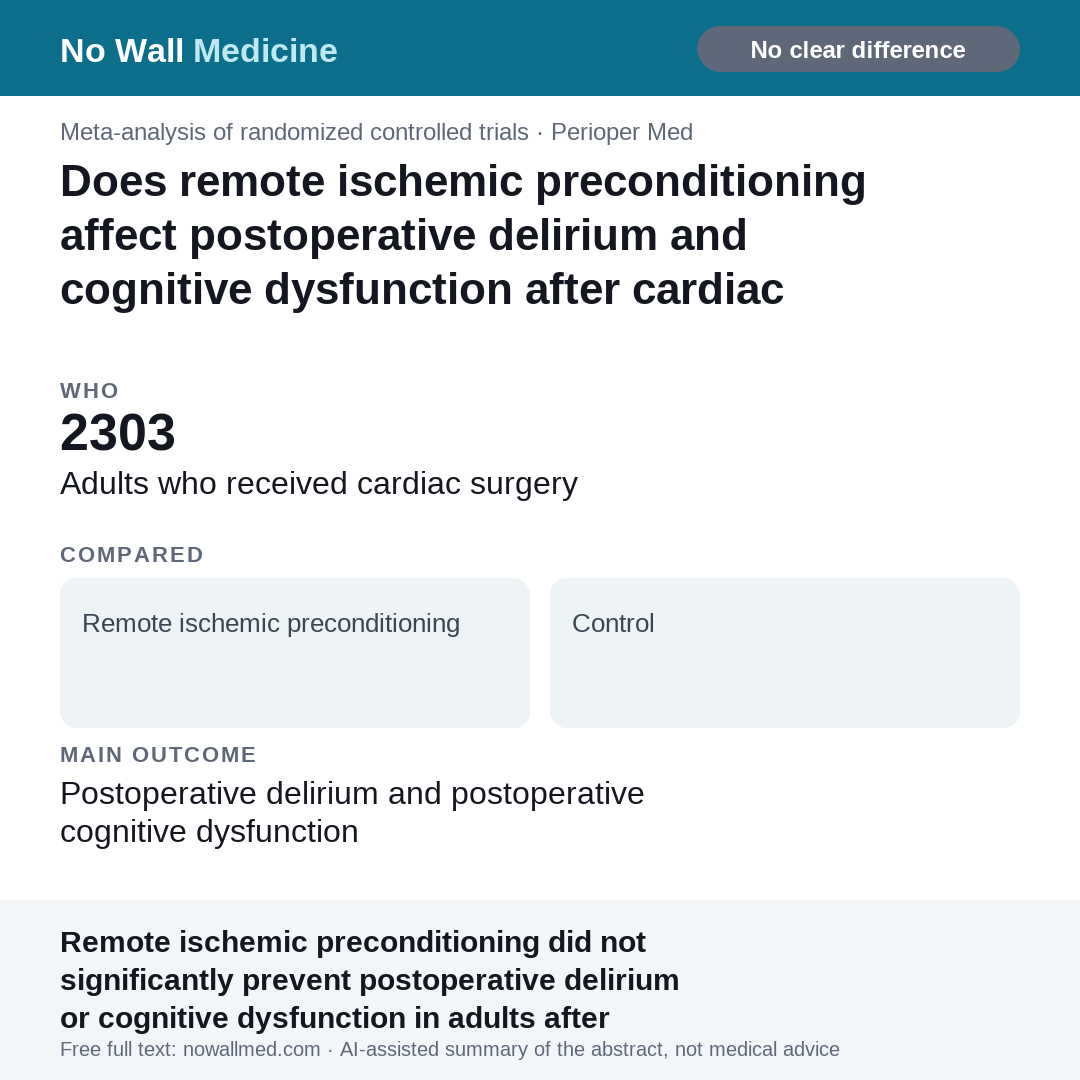
Clinical question: Does remote ischemic preconditioning affect postoperative delirium and cognitive dysfunction after cardiac surgery?
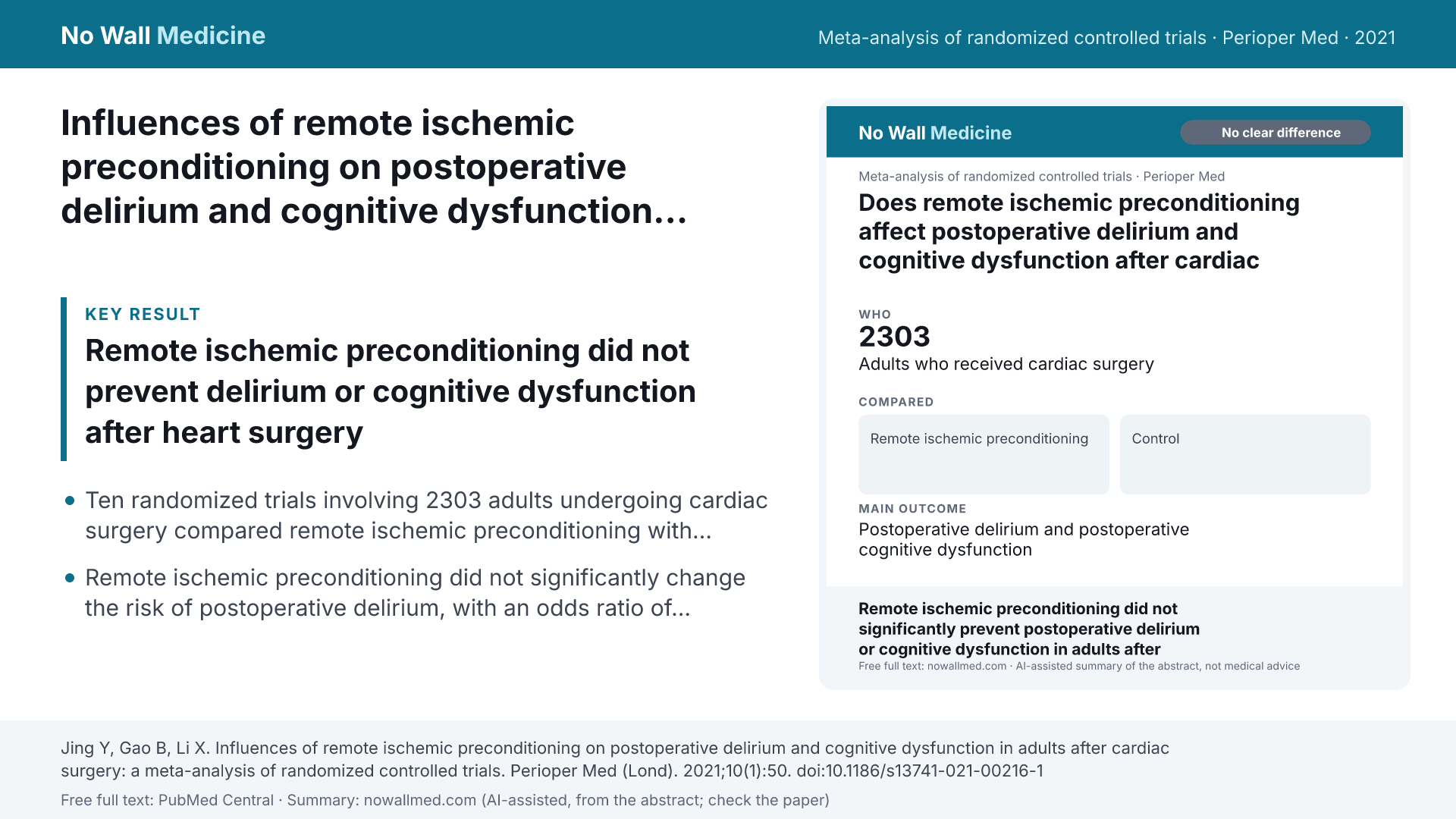
Abstract
Background
Remote ischemic preconditioning (RIPC) has been suggested to confer neuroprotective effect. However, influences of RIPC on postoperative delirium (POD) and cognitive dysfunction (POCD) in adults after cardiac surgery are less known. We performed a meta-analysis of randomized controlled trials (RCTs) to evaluate the effects of RIPC on POD and POCD. Methods
Relevant studies were obtained by search of PubMed, Embase, and Cochrane's Library databases. A random-effect model was used to pool the results. Results
Ten RCTs including 2303 adults who received cardiac surgery were included. Pooled results showed that RIPC did not significantly affect the incidence of POD (six RCTs, odds ratio [OR] 1.07, 95% confidence interval [CI] 0.81 to 1.40, P = 0.65) with no significant heterogeneity (I2 = 0%). In addition, combined results showed that RIPC did not significantly reduce the incidence of POCD either (six RCTs, OR 0.64, 95% CI 0.37 to 1.11, P = 0.11) with moderate heterogeneity (I2 = 44%). Sensitivity analysis by excluding one RCT at a time showed consistent results (P values all > 0.05). Conclusions
Current evidence from RCTs did not support that RIPC could prevent the incidence of POD or POCD in adults after cardiac surgery. Although these findings may be validated in large-scale RCTs, particularly for the results of POCD, based on these findings, RIPC should not be routinely used as a preventative measure for POD and POCD in adult patients after cardiac surgery.
Cite this article
Jing Y, Gao B, Li X. Influences of remote ischemic preconditioning on postoperative delirium and cognitive dysfunction in adults after cardiac surgery: a meta-analysis of randomized controlled trials. Perioper Med. 2021. doi:10.1186/s13741-021-00216-1
Spotted a mistake? Suggest a correction
Top studies every Monday
The week’s key trials and guidelines in your specialties, plus any topics you follow. By email, free.
Get the weekly digest