Influenza Vaccine Immune Response in Patients With High-Risk Cardiovascular Disease: A Secondary Analysis of the INVESTED Randomized Clinical Trial
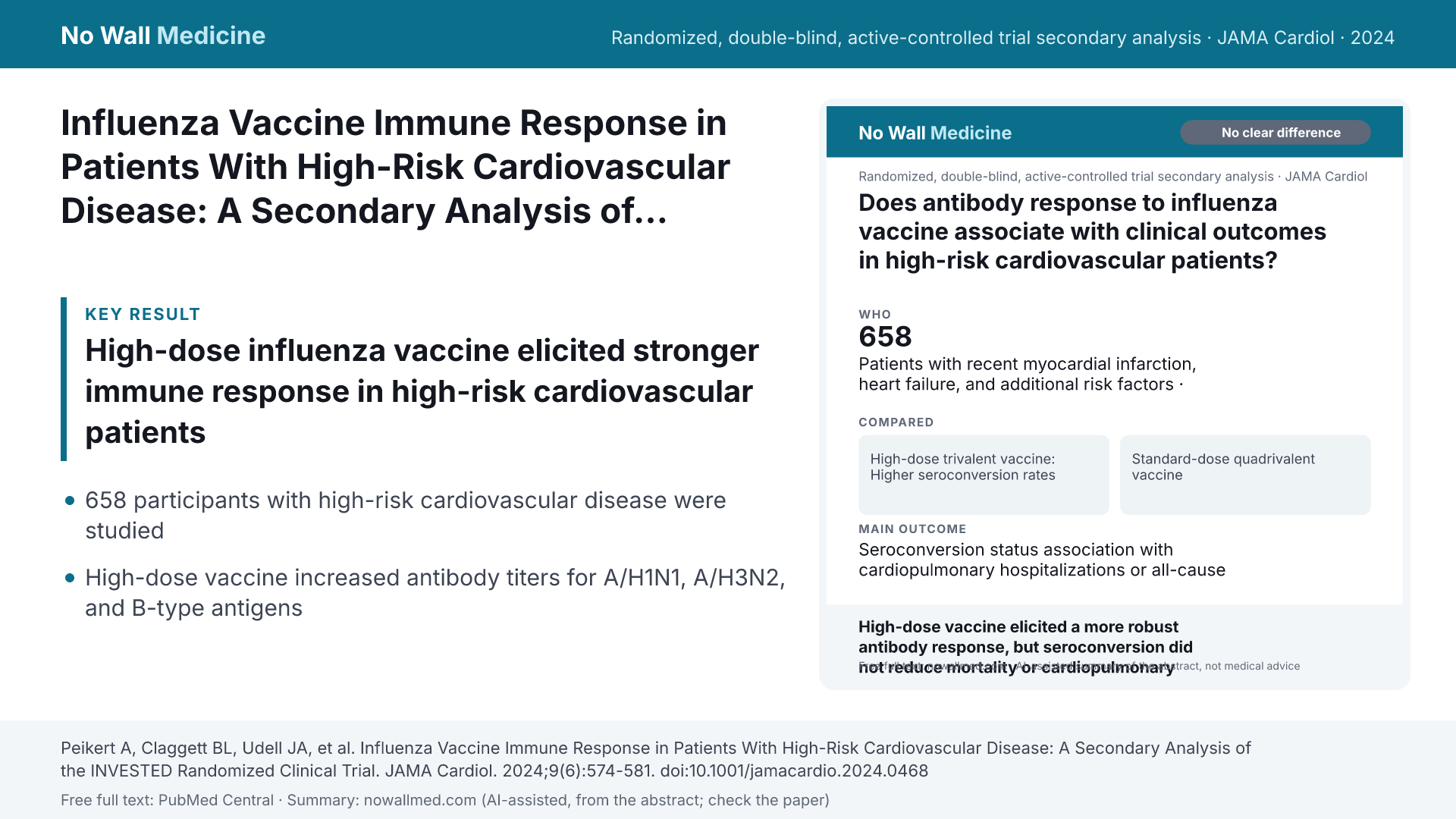
Key result: High-dose influenza vaccine elicited stronger immune response in high-risk cardiovascular patients
Randomized, double-blind, active-controlled trial secondary analysisNo clear difference
Does antibody response to influenza vaccine associate with clinical outcomes in high-risk cardiovascular patients?
Who
658
Patients with recent myocardial infarction, heart failure, and additional risk factors · 157 sites in the United States and Canada
Compared
High-dose trivalent vaccine: Higher seroconversion rates
Standard-dose quadrivalent vaccine
Main outcome
Seroconversion status association with cardiopulmonary hospitalizations or all-cause mortality
Result: hazard ratio 1.09 (95% CI 0.79-1.53)
Bottom line: High-dose vaccine elicited a more robust antibody response, but seroconversion did not reduce mortality or cardiopulmonary hospitalizations.
JAMA Cardiol · 2024-04-07
Key points
- 658 participants with high-risk cardiovascular disease were studied.
- High-dose vaccine increased antibody titers for A/H1N1, A/H3N2, and B-type antigens.
- Seroconversion was not associated with reduced risk for cardiopulmonary hospitalizations or all-cause mortality.
Discussion prompts
- Would these patients look like yours? Who was left out?
- Is the main outcome one that matters to patients?
- Is the difference large enough to change what you do?
Cite: Peikert A, Claggett BL, Udell JA, et al. Influenza Vaccine Immune Response in Patients With High-Risk Cardiovascular Disease: A Secondary Analysis of the INVESTED Randomized Clinical Trial. JAMA Cardiol. 2024;9(6):574-581. doi:10.1001/jamacardio.2024.0468
Free full text: PubMed Central · Summary and visual abstract: nowallmed.com/a/influenza-vaccine-immune-response-in-patients-with-high-risk-4d50x2/ (AI-assisted from the abstract; check the paper before relying on it).