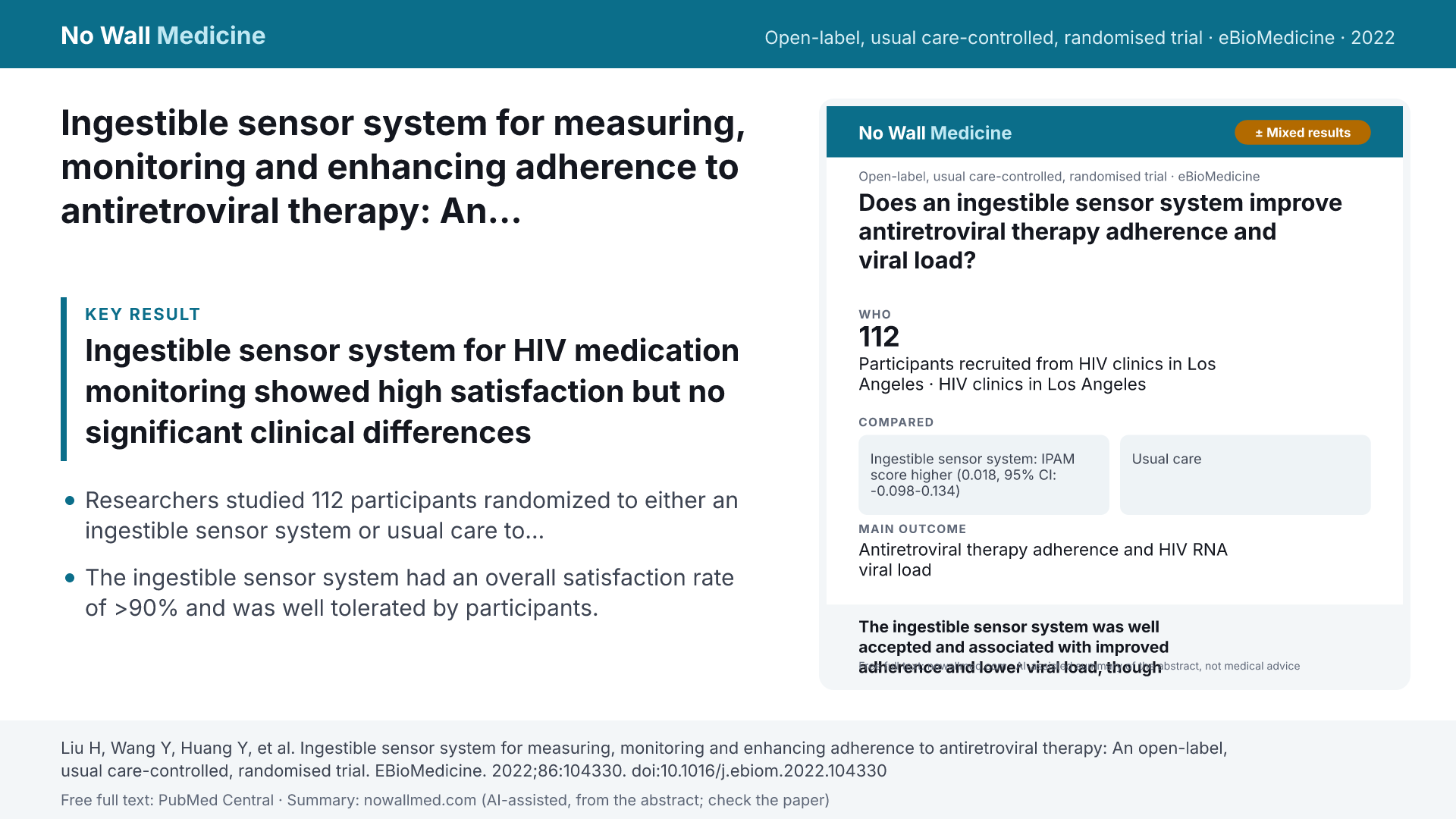
Ingestible sensor system for HIV medication monitoring showed high satisfaction but no significant clinical differences
Ingestible sensor system for measuring, monitoring and enhancing adherence to antiretroviral therapy: An open-label, usual care-controlled, randomised trial
Open-label, usual care-controlled, randomised trialMixed results
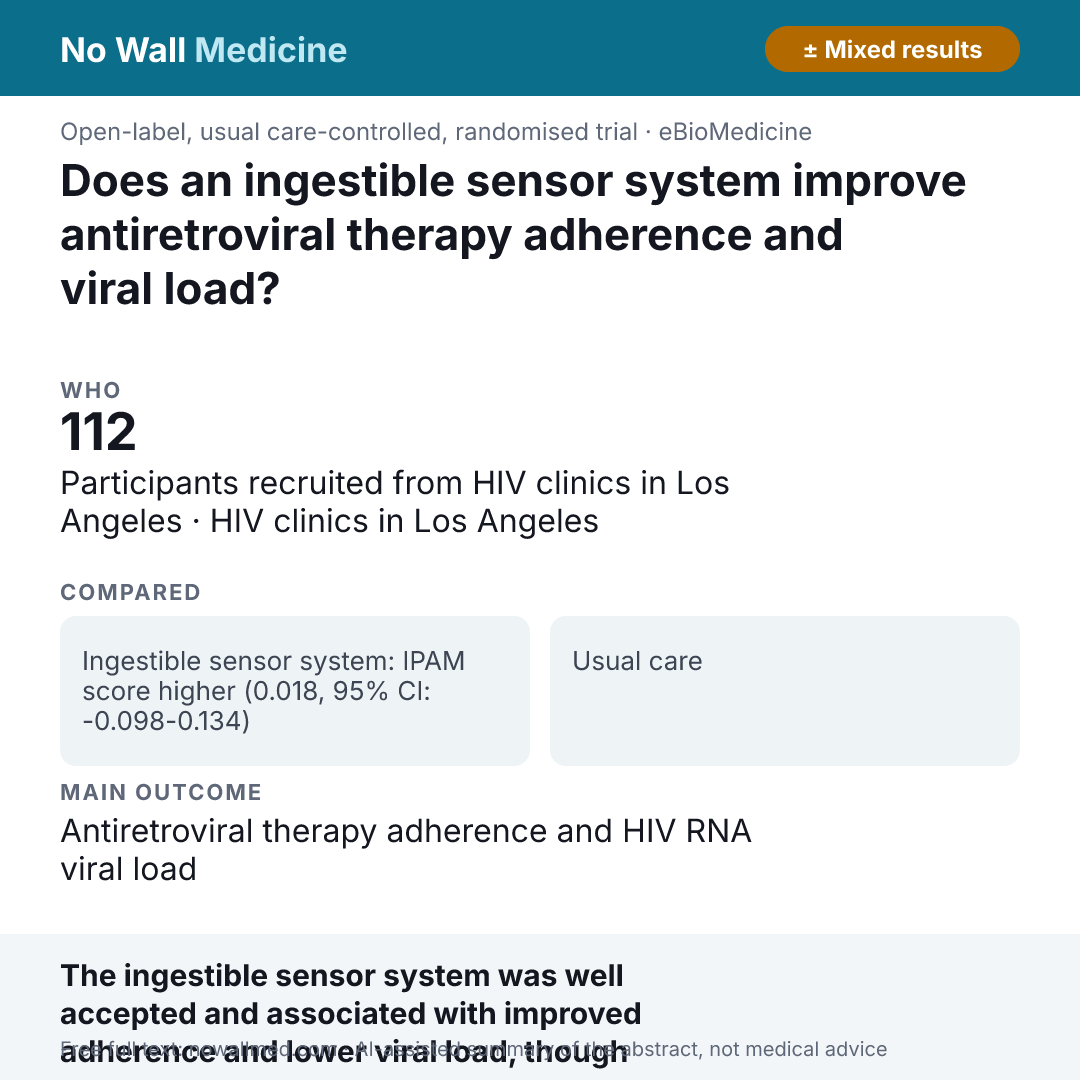
Does an ingestible sensor system improve antiretroviral therapy adherence and viral load?
Who
112
Participants recruited from HIV clinics in Los Angeles · HIV clinics in Los Angeles
Compared
Ingestible sensor system: IPAM score higher (0.018, 95% CI: -0.098-0.134)
Usual care
Main outcome
Antiretroviral therapy adherence and HIV RNA viral load
Result: IPAM score 0.018 (95% CI: -0.098-0.134), viral load decay -0.020 (95% CI: -0.042-0.002)
Bottom line: The ingestible sensor system was well accepted and associated with improved adherence and lower viral load, though results were not statistically significant.
Funded by: National Institute of Mental Health and National Institutes of Health
eBioMedicine · 2022-11-10 · Save PNG
Clinical question: Does an ingestible sensor system improve antiretroviral therapy adherence and viral load?
Key points
- Researchers studied 112 participants randomized to either an ingestible sensor system or usual care to monitor antiretroviral therapy adherence.
- The ingestible sensor system had an overall satisfaction rate of >90% and was well tolerated by participants.
- The sensor group showed a higher integrated pharmacokinetic adherence measure score (0.018, 95% CI: -0.098-0.134, p = 0.75) and faster viral load decay (-0.020, 95% CI: -0.042-0.002, p = 0.08) compared to usual care, but results were not statistically significant.
Headline and key points written with AI from the paper’s abstract, with every number checked against it. Read the paper before relying on them.
Was this summary helpful?
Subject terms
Headline, design, result, key points, caveat and citation as plain text.
Cite this article
Liu H, Wang Y, Huang Y, et al. Ingestible sensor system for measuring, monitoring and enhancing adherence to antiretroviral therapy: An open-label, usual care-controlled, randomised trial. EBioMedicine. 2022;86:104330. doi:10.1016/j.ebiom.2022.104330
Spotted a mistake? Suggest a correction