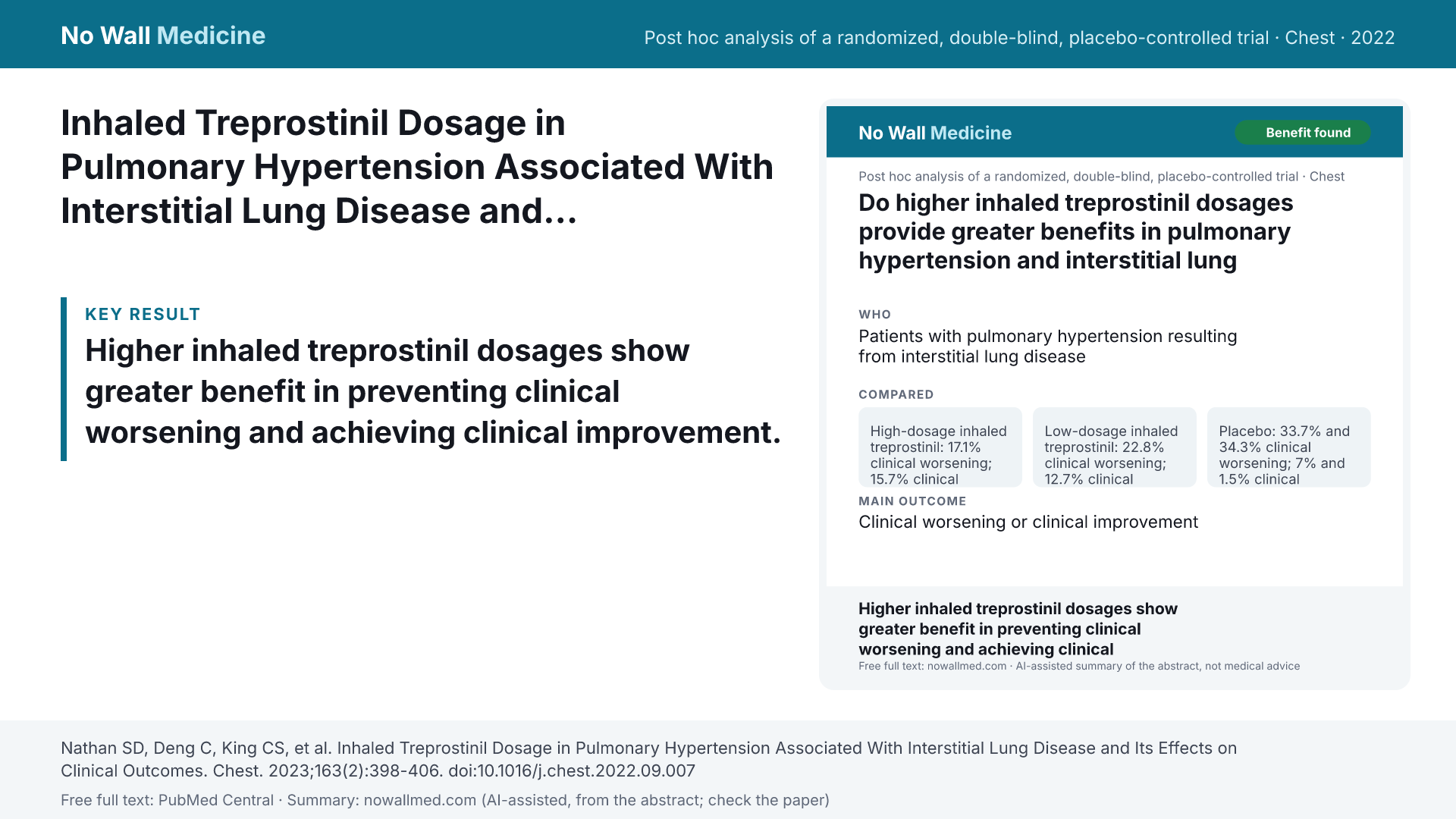
Inhaled Treprostinil Dosage in Pulmonary Hypertension Associated With Interstitial Lung Disease and Its Effects on Clinical Outcomes
Post hoc analysis of a randomized, double-blind, placebo-controlled trialBenefit found
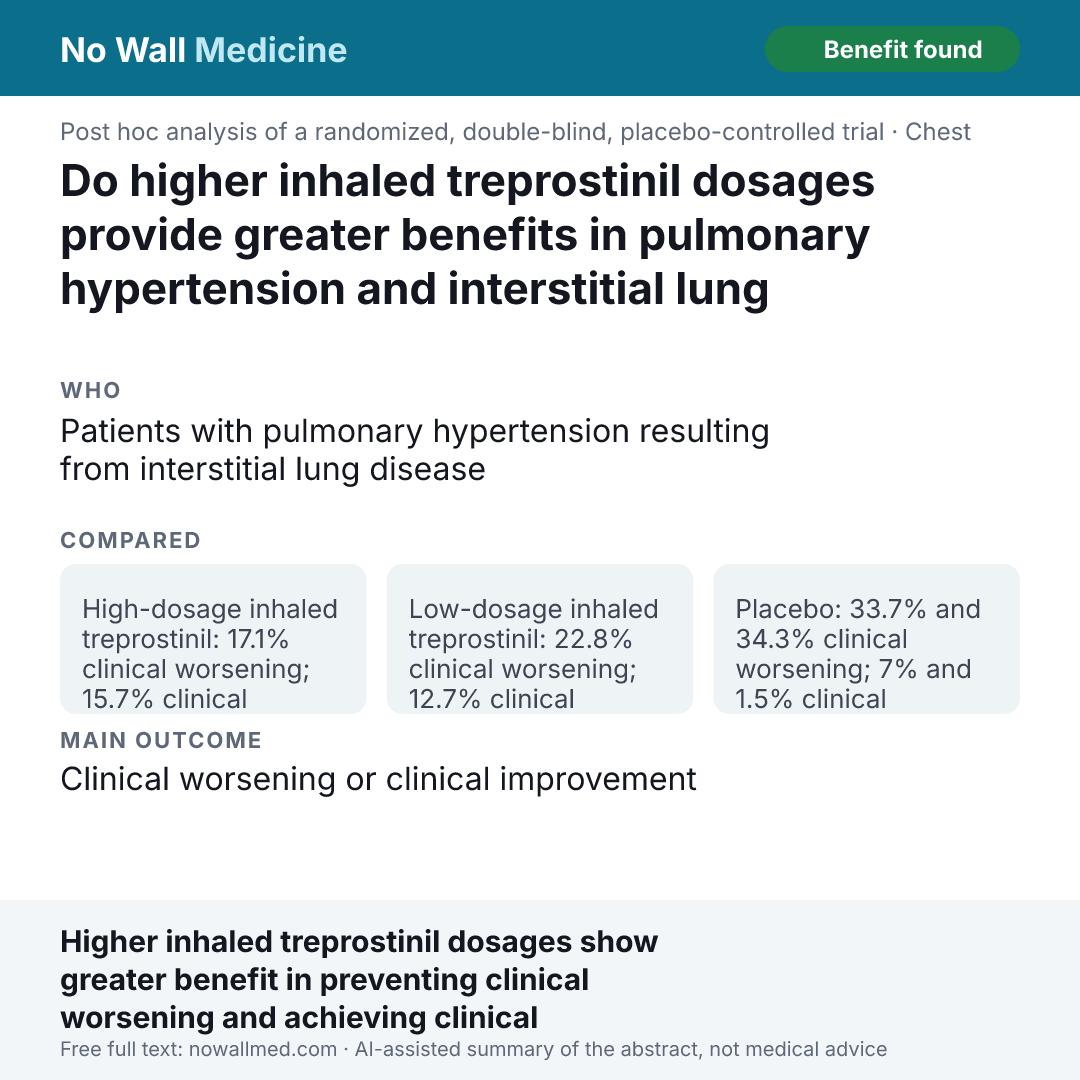
Do higher inhaled treprostinil dosages provide greater benefits in pulmonary hypertension and interstitial lung disease?
Who
Patients with pulmonary hypertension resulting from interstitial lung disease
Compared
High-dosage inhaled treprostinil: 17.1% clinical worsening; 15.7% clinical improvement
Low-dosage inhaled treprostinil: 22.8% clinical worsening; 12.7% clinical improvement
Placebo: 33.7% and 34.3% clinical worsening; 7% and 1.5% clinical improvement
Main outcome
Clinical worsening or clinical improvement
Bottom line: Higher inhaled treprostinil dosages show greater benefit in preventing clinical worsening and achieving clinical improvement.
Chest · 2022-09-15 · Save PNG
Clinical question: Do higher inhaled treprostinil dosages provide greater benefits in pulmonary hypertension and interstitial lung disease?
Abstract
Background
Pulmonary hypertension (PH) complicates the course of many patients with fibrotic interstitial lung disease (ILD). Inhaled treprostinil (iTre) has been shown to improve functional ability and to delay clinical worsening in patients with PH resulting from ILD. Research question
Do higher dosages of iTre have greater benefits in preventing clinical worsening and achieving clinical improvement? Study design and methods
Post hoc analysis of the INCREASE study, a 16-week double-blind, randomized, placebo-controlled trial of iTre in patients with PH resulting from ILD. Four groups were identified based on the number of breaths per session (bps; < 9 and ≥ 9 bps) of active drug or placebo attained at 4 weeks. Patients were evaluated for clinical worsening (15% decrease in 6-min walkdistance, cardiopulmonary hospitalization, lung transplantation, or death) or clinical improvement (15% increase in the six-minute walk distance with a concomitant 30% reduction in N-terminal prohormone of brain natriuretic peptide without any clinical worsening event). Results
At 4 weeks, 70 patients were at a dose of ≥ 9 bps (high-dosage group) and 79 patients were at a dose of < 9 bps (low-dosage group) in the iTre arm vs 86 patients in the high-dose group and 67 patients in the low-dose group in the placebo arm. Between weeks 4 and 16, 17.1% of patients in the high-dose treprostinil group and 22.8% in the low-dose treatment group experienced a clinical worsening event vs 33.7% and 34.3% of patients in the two placebo arms, respectively (P = .006). By week 16, 15.7% and 12.7% of patients in the high- and low-dose iTre groups, respectively, demonstrated clinical improvement vs 7% and 1.5% patients in the placebo arms (P = .003) INTERPRETATION: Higher dosages of iTre overall show greater benefit in terms of preventing clinical worsening and achieving clinical improvement. These data support the early initiation and uptitration of therapy to a dosage of at least 9 bps four times daily in patients with PH resulting from ILD. Trial registry
ClinicalTrials.gov; No.: NCT02630316; URL: www. Clinicaltrials
gov.
Subject terms
Headline, design, result, key points, caveat and citation as plain text.
Cite this article
Nathan SD, Deng C, King CS, et al. Inhaled Treprostinil Dosage in Pulmonary Hypertension Associated With Interstitial Lung Disease and Its Effects on Clinical Outcomes. Chest. 2023;163(2):398-406. doi:10.1016/j.chest.2022.09.007
Spotted a mistake? Suggest a correction