Visual abstractsVisuals
Meta-analysisResuscitation · Jul 27, 2026

Evidence is insufficient to determine the best vascular access method during neonatal resuscitation

Initial vascular access for neonatal resuscitation: a systematic review

Kawakami MD, Kong JY, de Almeida MF, Guinsburg R, Isayama T, Thio M, et al
Critical CarePediatric
Systematic reviewUnclear result
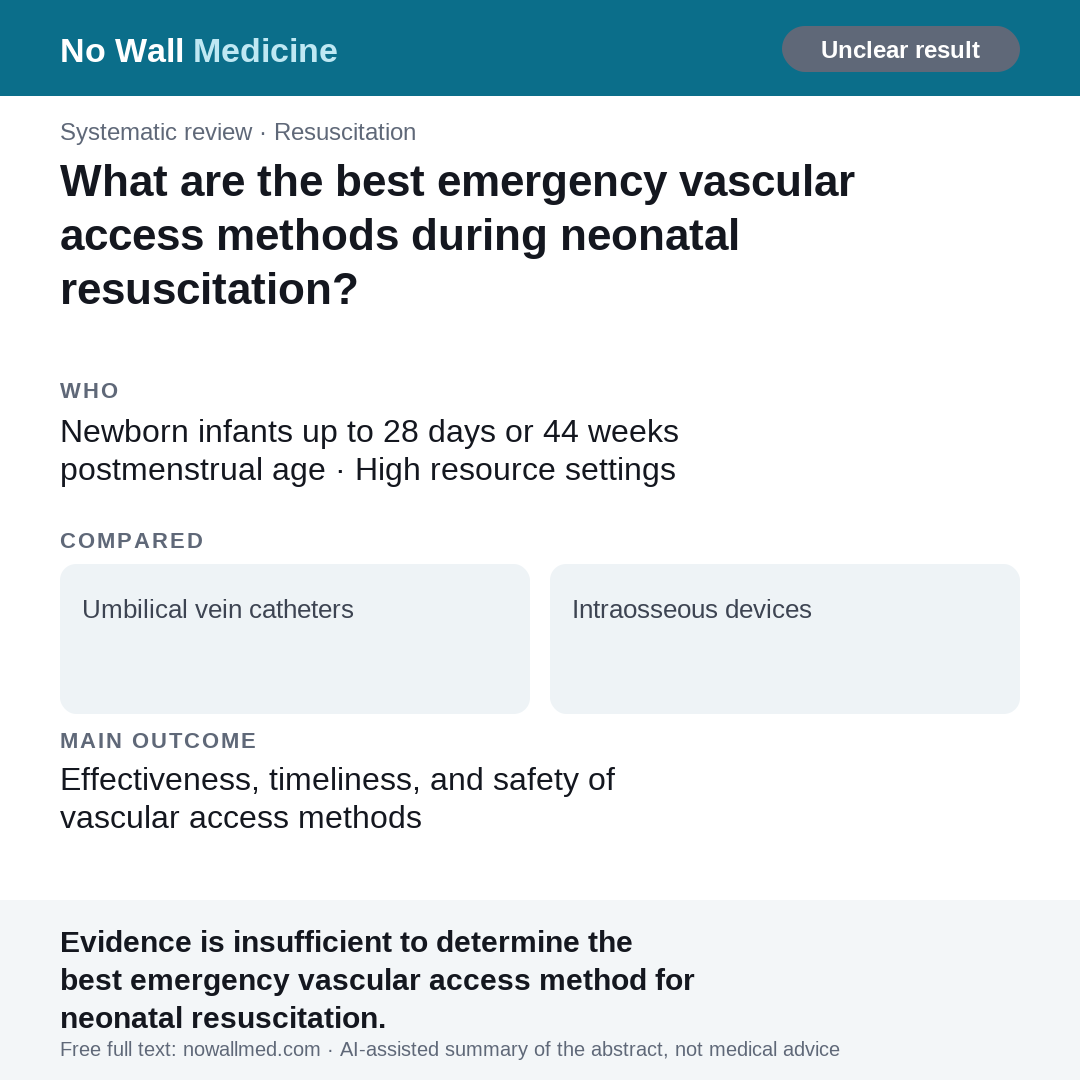
What are the best emergency vascular access methods during neonatal resuscitation?
Who
Newborn infants up to 28 days or 44 weeks postmenstrual age · High resource settings
Compared
Umbilical vein catheters
Intraosseous devices
Main outcome
Effectiveness, timeliness, and safety of vascular access methods
Bottom line: Evidence is insufficient to determine the best emergency vascular access method for neonatal resuscitation.
Limitation: Lack of randomized controlled trials, small sample size, and heterogeneity of studies.
Resuscitation · 2026-07-27Download image

Clinical question: What are the best emergency vascular access methods during neonatal resuscitation?

Why it matters: Doctors need evidence to support the choice between available methods for establishing vascular access during newborn resuscitation or cardiac arrest.

Key points

Limitation the authors note: The authors state that a lack of randomized controlled trials, small sample sizes, and studies limited to high resource settings restrict generalizability.

Headline and key points written with AI from the paper’s abstract, with every number checked against it. Read the paper before relying on them.
Read the full paper free at the publisher ↗

Topics

Humans; Infant, Newborn; Resuscitation; Infusions, Intraosseous; Heart Arrest; Catheterization, Peripheral; Umbilical Veins; Vascular Access Devices

DOI: 10.1016/j.resuscitation.2026.111226 · PubMed: 42508602

Spotted a mistake? Suggest a correction

More in Critical Care

Meta-analysisCrit Care · Nov 19, 2026 · Critical Care

Corticosteroids in sepsis have conflicting mortality conclusions in reviews

Discordant evidence on corticosteroids in sepsis: a meta-research study

ResearchPediatricResuscitation · Nov 17, 2026 · Critical Care

Eighty-nine percent of infants survived 28 days after chest compressions at birth in 2024

Survival after neonatal chest compressions at birth: Temporal trends and prognostic factors in a population-based cohort, Queensland, Australia

ResearchResuscitation · Nov 17, 2026 · Critical Care

Bystanders attaching AEDs had highest 30-day survival rate of 28 percent

Survival after out of hospital cardiac arrest in relation to AED usage in a multi response system including AED equipped drones

ResearchResuscitation · Nov 17, 2026 · Critical Care

Foreign body airway obstruction caused 1.1% of out-of-hospital cardiac arrests

Out-of-hospital cardiac arrests due to foreign body airway obstruction: A CanROC registry, retrospective cohort study

ResearchResuscitation · Nov 17, 2026 · Critical Care

Commercially available multimodal LLMs for EEG-based prognostication after cardiac arrest