Palliative venting gastrostomy and parenteral nutrition are associated with improved quality of life in bowel obstruction
Inoperable malignant bowel obstruction: palliative interventions outcomes - mixed-methods systematic review
Mixed-methods systematic review and narrative synthesisMixed results
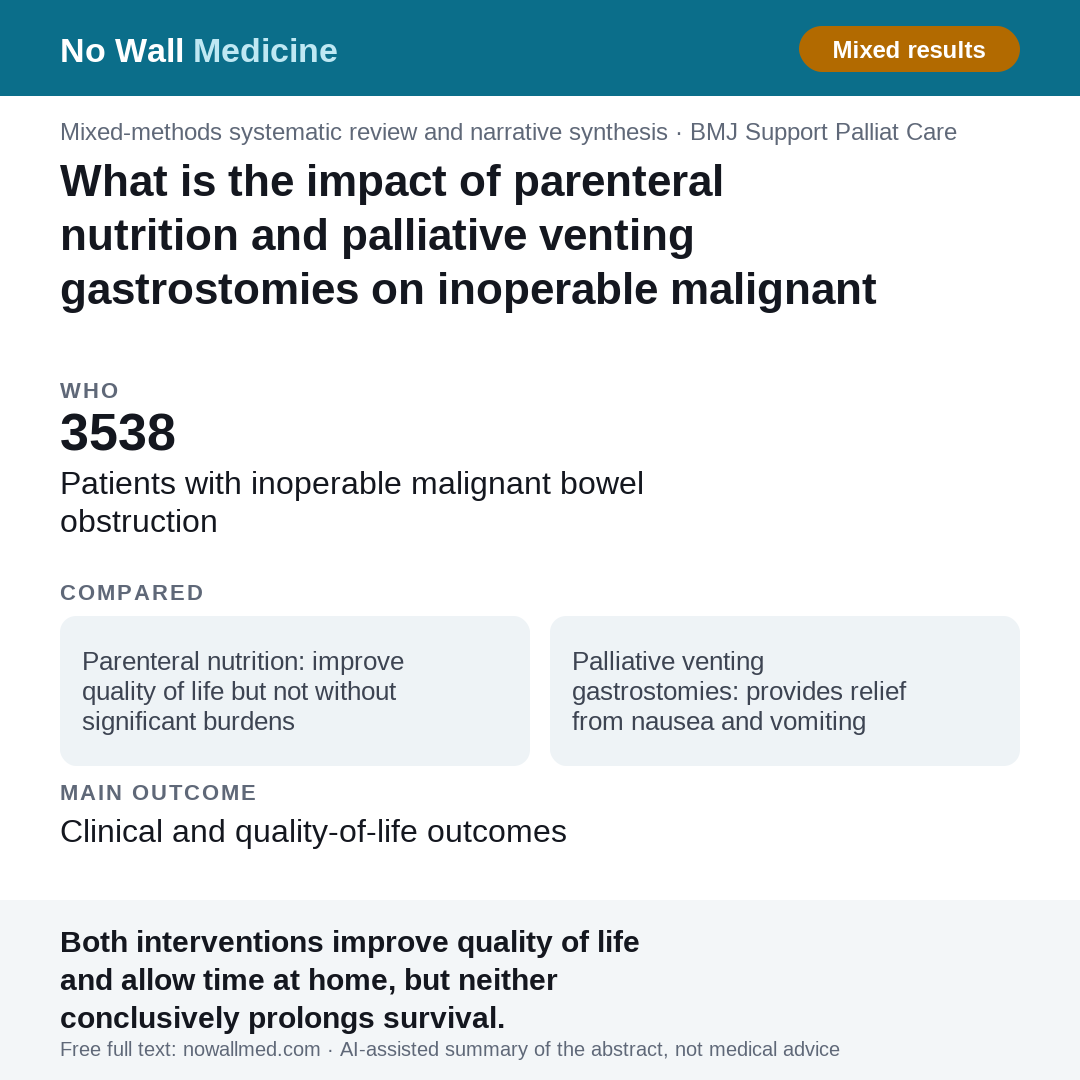
What is the impact of parenteral nutrition and palliative venting gastrostomies on inoperable malignant bowel obstruction?
Who
3538
Patients with inoperable malignant bowel obstruction
Compared
Parenteral nutrition: improve quality of life but not without significant burdens
Palliative venting gastrostomies: provides relief from nausea and vomiting
Main outcome
Clinical and quality-of-life outcomes
Bottom line: Both interventions improve quality of life and allow time at home, but neither conclusively prolongs survival.
Limitation: Lack of randomised controlled trials due to concerns about equipoise
BMJ Support Palliat Care · 2024-01-08Download image
Clinical question: What is the impact of parenteral nutrition and palliative venting gastrostomies on inoperable malignant bowel obstruction?
Why it matters: It is unknown how parenteral nutrition and palliative venting gastrostomy impact clinical and quality-of-life outcomes for patients with inoperable malignant bowel obstruction.
Key points
- Researchers reviewed 47 studies involving 3538 participants to examine the effects of parenteral nutrition (intravenous feeding) and palliative venting gastrostomy (a tube to relieve pressure) on patients with inoperable malignant bowel obstruction.
- Both interventions were associated with improved quality of life and more time at home, though both also carried significant burdens.
- The review found no conclusive evidence that either intervention prolonged survival, despite a firm belief among patients and clinicians that they might.
Headline and key points written with AI from the paper’s abstract, with every number checked against it. Read the paper before relying on them.
Was this summary helpful?
Abstract
Background
Parenteral nutrition (PN) and palliative venting gastrostomies (PVG) are two interventions used clinically to manage inoperable malignant bowel obstruction (MBO); however, little is known about their role in clinical and quality-of-life outcomes to inform clinical decision making. Aim
To examine the impact of PN and PVG on clinical and quality-of-life outcomes in inoperable MBO. Design
A mixed-methods systematic review and narrative synthesis. Data sources
The following databases were searched (from inception to 29 April 2021): MEDLINE, Embase, Cochrane Central Register of Controlled Trials, Web of Science, CINAHL, Bielefeld Academic Search Engine, Health Technology Assessment and CareSearch for qualitative or quantitative studies of MBO, and PN or PVG. Titles, abstracts and papers were independently screened and quality appraised. Results
A total of 47 studies representing 3538 participants were included. Current evidence cannot tell us whether these interventions improve MBO survival, but this was a firm belief by patients and clinicians informing their decision. Both interventions appear to allow patients valuable time at home. PVG provides relief from nausea and vomiting. Both interventions improve quality of life but not without significant burdens. Nutritional and performance status may be maintained or improved with PN. Conclusion
PN and PVG seem to allow valuable time at home. We found no conclusive evidence to show either intervention prolonged survival, due to the lack of randomised controlled trials that have to date not been performed due to concerns about equipoise. Well-designed studies regarding survival for both interventions are needed. Prospero registration number
CRD42020164170.
Abstract reproduced under the article’s CC BY licence.
Subject terms
Cite this article
Patterson M, Greenley S, Ma Y, Bullock A, Curry J, Smithson J. Inoperable malignant bowel obstruction: palliative interventions outcomes - mixed-methods systematic review. BMJ Support Palliat Care. 2024. doi:10.1136/bmjspcare-2021-003492
Spotted a mistake? Suggest a correction
Top studies every Monday
The week’s key trials and guidelines in your specialties, plus any topics you follow. By email, free.
Get the weekly digest