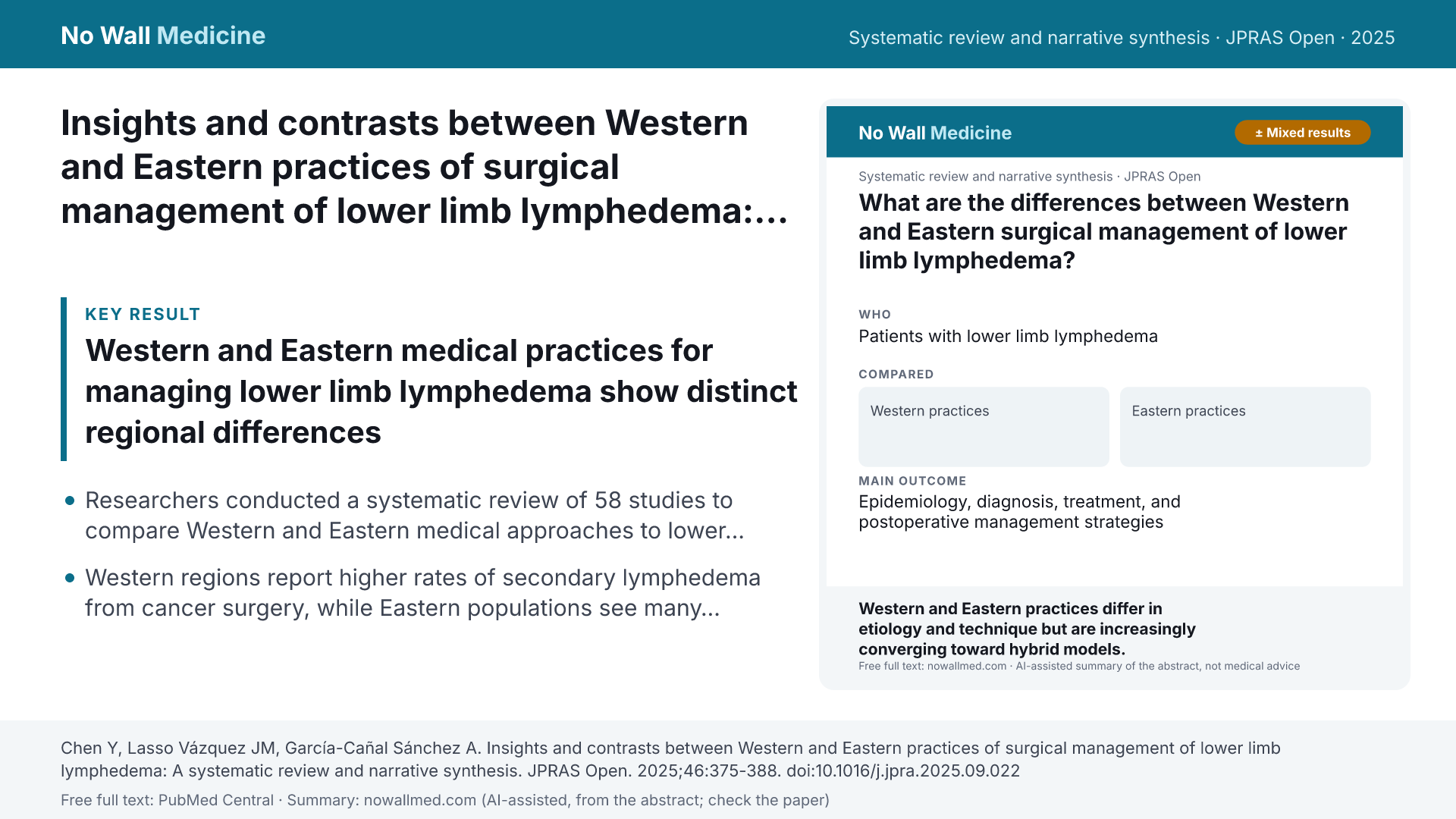
Western and Eastern medical practices for managing lower limb lymphedema show distinct regional differences
Insights and contrasts between Western and Eastern practices of surgical management of lower limb lymphedema: A systematic review and narrative synthesis
Systematic review and narrative synthesisMixed results
What are the differences between Western and Eastern surgical management of lower limb lymphedema?
Who
Patients with lower limb lymphedema
Compared
Western practices
Eastern practices
Main outcome
Epidemiology, diagnosis, treatment, and postoperative management strategies
Bottom line: Western and Eastern practices differ in etiology and technique but are increasingly converging toward hybrid models.
JPRAS Open · 2025-09-27 · Save PNG

Clinical question: What are the differences between Western and Eastern surgical management of lower limb lymphedema?
Why it matters: Medical practices for the diagnosis, surgical treatment, and postoperative management of lower limb lymphedema vary significantly between Western and Eastern regions.
Key points
- Researchers conducted a systematic review of 58 studies to compare Western and Eastern medical approaches to lower limb lymphedema, a condition involving swelling in the legs.
- Western regions report higher rates of secondary lymphedema from cancer surgery, while Eastern populations see many cases related to endemic filariasis, a parasitic infection.
- Western centers favor imaging like magnetic resonance lymphangiography, whereas Eastern centers rely on real-time methods such as indocyanine green lymphography and ultrasound.
Headline and key points written with AI from the paper’s abstract, with every number checked against it. Read the paper before relying on them.
Was this summary helpful?
Headline, design, result, key points, caveat and citation as plain text.
Cite this article
Chen Y, Lasso Vázquez JM, García-Cañal Sánchez A. Insights and contrasts between Western and Eastern practices of surgical management of lower limb lymphedema: A systematic review and narrative synthesis. JPRAS Open. 2025;46:375-388. doi:10.1016/j.jpra.2025.09.022
Spotted a mistake? Suggest a correction