Review of 27 tools for measuring human-robot psychological interactions shows inconsistent psychometric quality
Instruments for Measuring Psychological Dimensions in Human-Robot Interaction: Systematic Review of Psychometric Properties
Digital Health & AIAdult and pediatric
Systematic reviewMixed results
What are the psychometric properties of instruments measuring psychological dimensions in human-robot interaction?
Who
34
Instruments assessing psychological dimensions in social and domestic robot interaction
Compared
Structural validity studies: 24/27 (89%)
Internal consistency studies: 26/27 (96%)
Main outcome
Psychometric properties of instruments for human-robot interaction
Bottom line: Most instruments focus on structural validity and internal consistency, but lack evaluation of measurement error and responsiveness.
Limitation: Included instruments for both social and domestic robots while excluding other specific robot types.
J Med Internet Res · 2024-06-05Download image
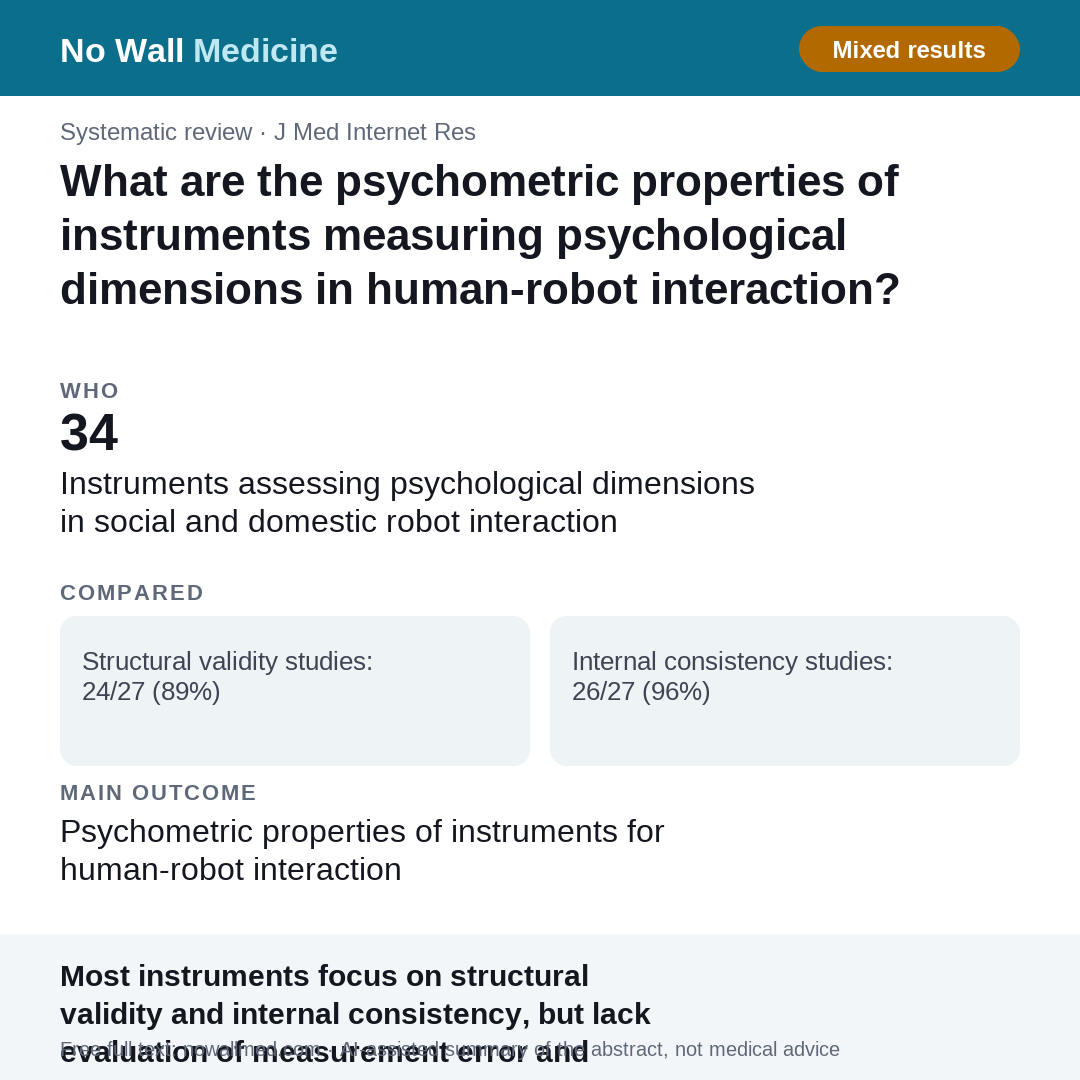
Clinical question: What are the psychometric properties of instruments measuring psychological dimensions in human-robot interaction?
Why it matters: It is unknown if current tools used to assess the psychological relationship between people and social or domestic robots are reliable and valid.
Key points
- Researchers reviewed 34 articles to evaluate 27 instruments used to measure psychological dimensions like attitudes and feelings in human-robot interactions.
- Most studies focused on structural validity (24/27, 89%) and internal consistency (26/27, 96%), but no instrument evaluated measurement error or responsiveness.
- While 17/27, 63% of instruments targeted adults and older adults, there were few tools designed specifically for children or healthcare contexts.
Limitation the authors note: The review included instruments for both social and domestic robots but excluded those for other specific types like industrial robots.
Headline and key points written with AI from the paper’s abstract, with every number checked against it. Read the paper before relying on them.
Was this summary helpful?
Subject terms
Cite this article
Vagnetti R, Camp N, Story M, Ait-Belaid K, Mitra S, Zecca M. Instruments for Measuring Psychological Dimensions in Human-Robot Interaction: Systematic Review of Psychometric Properties. J Med Internet Res. 2024. doi:10.2196/55597
Spotted a mistake? Suggest a correction
Top studies every Monday
The week’s key trials and guidelines in your specialties, plus any topics you follow. By email, free.
Get the weekly digest