Mobile health integrated care did not reduce unplanned hospitalizations in older patients with atrial fibrillation
Integrated care management and comprehensive geriatric assessment using a mHealth-based approach in older multimorbid patients with atrial fibrillation: the AFFIRMO cluster-randomised trial
Multicentre, open-label, cluster-randomised studyNo clear difference
Does a mobile-health structured intervention reduce unplanned hospitalisations in older multimorbid atrial fibrillation patients?
Who
1260
Older patients with atrial fibrillation and multimorbidity · Six European countries
Compared
17.1%intervention (108/634)
18.2%usual care (114/626)
Main outcome
all-cause unplanned hospitalisation
Result: adjusted OR 0.95 (95% CI 0.61-1.49)
Bottom line: The mobile-health integrated care system did not reduce unplanned hospitalisations compared with usual care.
Funded by: European Union's Horizon 2020 Research and Innovation Program
Lancet Reg Health Eur · 2026-08-30Download image
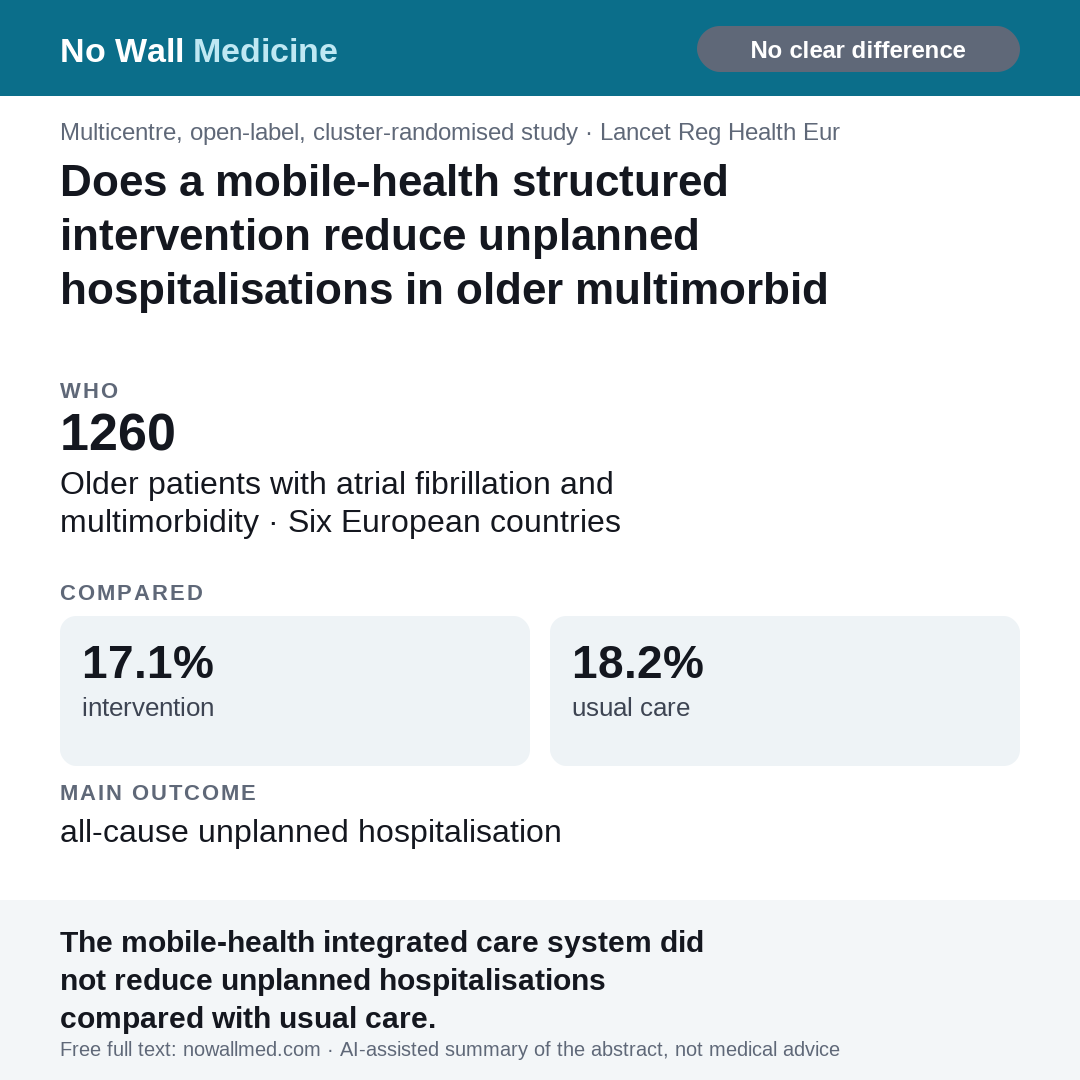
Clinical question: Does a mobile-health structured intervention reduce unplanned hospitalisations in older multimorbid atrial fibrillation patients?
Why it matters: Doctors need to know if mobile health tools can improve holistic management and reduce clinical risks for older patients with atrial fibrillation and multiple comorbidities.
Key points
- Researchers studied 1260 older patients with atrial fibrillation and multiple health conditions across six European countries, comparing a mobile health system to usual care.
- The rate of unplanned hospitalizations was 17.1% in the intervention group and 18.2% in the usual care group, showing no statistically significant difference.
- The use of the mobile application was suboptimal, with 68.5% of patients using it for only one-third of the observation period.
Headline and key points written with AI from the paper’s abstract, with every number checked against it. Read the paper before relying on them.
Spotted a mistake? Suggest a correction