Integrated Clinical-Molecular Classification of Colorectal Liver Metastases: A Biomarker Analysis of the Phase 3 New EPOC Randomized Clinical Trial
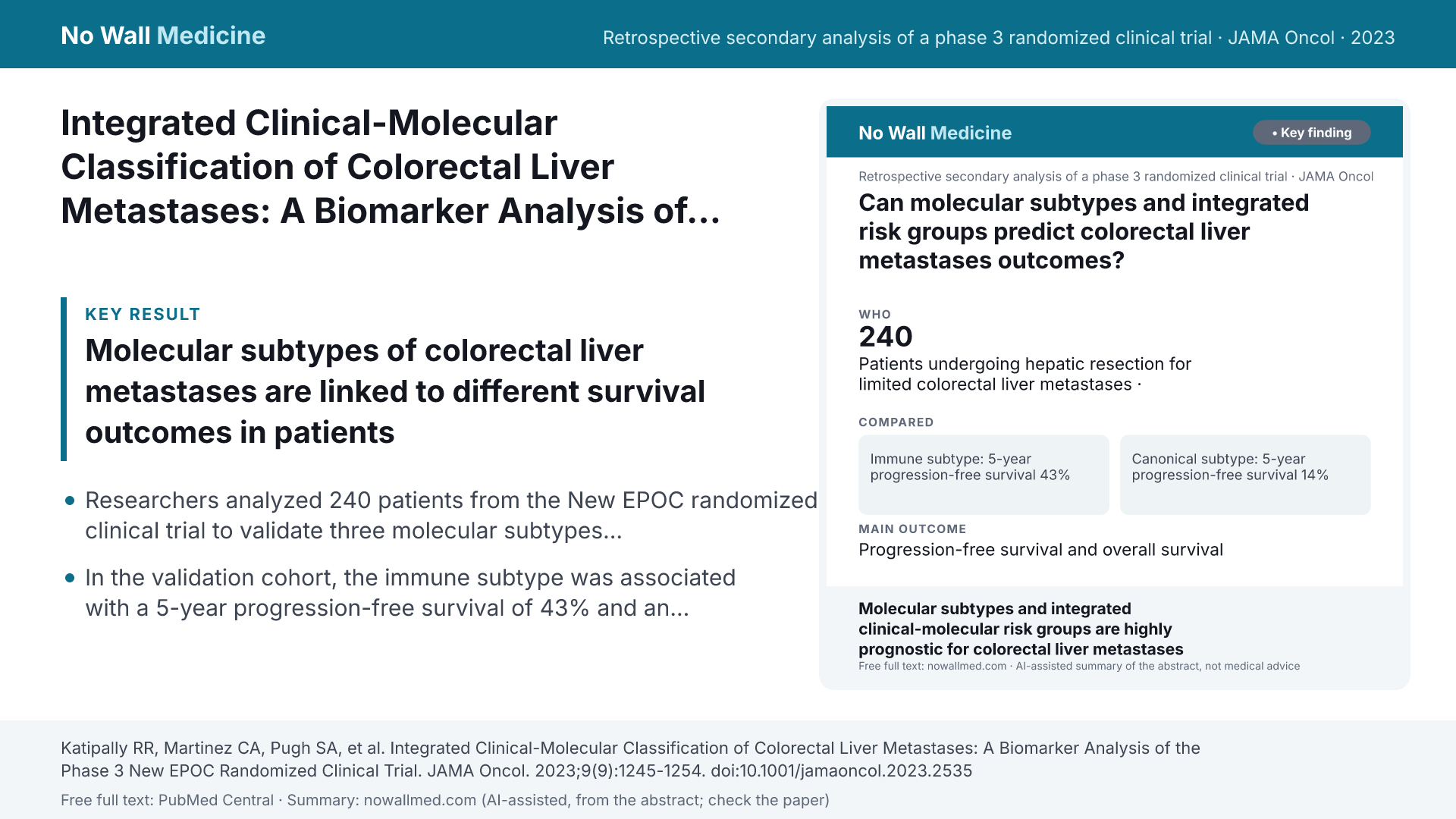
Key result: Molecular subtypes of colorectal liver metastases are linked to different survival outcomes in patients
Retrospective secondary analysis of a phase 3 randomized clinical trialKey finding
Can molecular subtypes and integrated risk groups predict colorectal liver metastases outcomes?
Who
240
Patients undergoing hepatic resection for limited colorectal liver metastases · Bi-institutional discovery cohort and multi-institutional validation cohort
Compared
Immune subtype: 5-year progression-free survival 43%
Canonical subtype: 5-year progression-free survival 14%
Main outcome
Progression-free survival and overall survival
Result: hazard ratio 0.37 (95% CI, 0.20-0.68)
Bottom line: Molecular subtypes and integrated clinical-molecular risk groups are highly prognostic for colorectal liver metastases outcomes.
JAMA Oncol · 2023-07-20
Key points
- Researchers analyzed 240 patients from the New EPOC randomized clinical trial to validate three molecular subtypes of colorectal liver metastases.
- In the validation cohort, the immune subtype was associated with a 5-year progression-free survival of 43% and an overall survival of 63%.
- The canonical subtype was associated with a 5-year progression-free survival of 14% and an overall survival of 43%.
Why it matters: Personalized treatment approaches for patients with limited colorectal cancer that has spread to the liver are critically needed.
Discussion prompts
- Would these patients look like yours? Who was left out?
- Is the main outcome one that matters to patients?
- Is the difference large enough to change what you do?
Cite: Katipally RR, Martinez CA, Pugh SA, et al. Integrated Clinical-Molecular Classification of Colorectal Liver Metastases: A Biomarker Analysis of the Phase 3 New EPOC Randomized Clinical Trial. JAMA Oncol. 2023;9(9):1245-1254. doi:10.1001/jamaoncol.2023.2535
Free full text: PubMed Central · Summary and visual abstract: nowallmed.com/a/integrated-clinical-molecular-classification-of-colorectal-liver-1yoqr19/ (AI-assisted from the abstract; check the paper before relying on it).