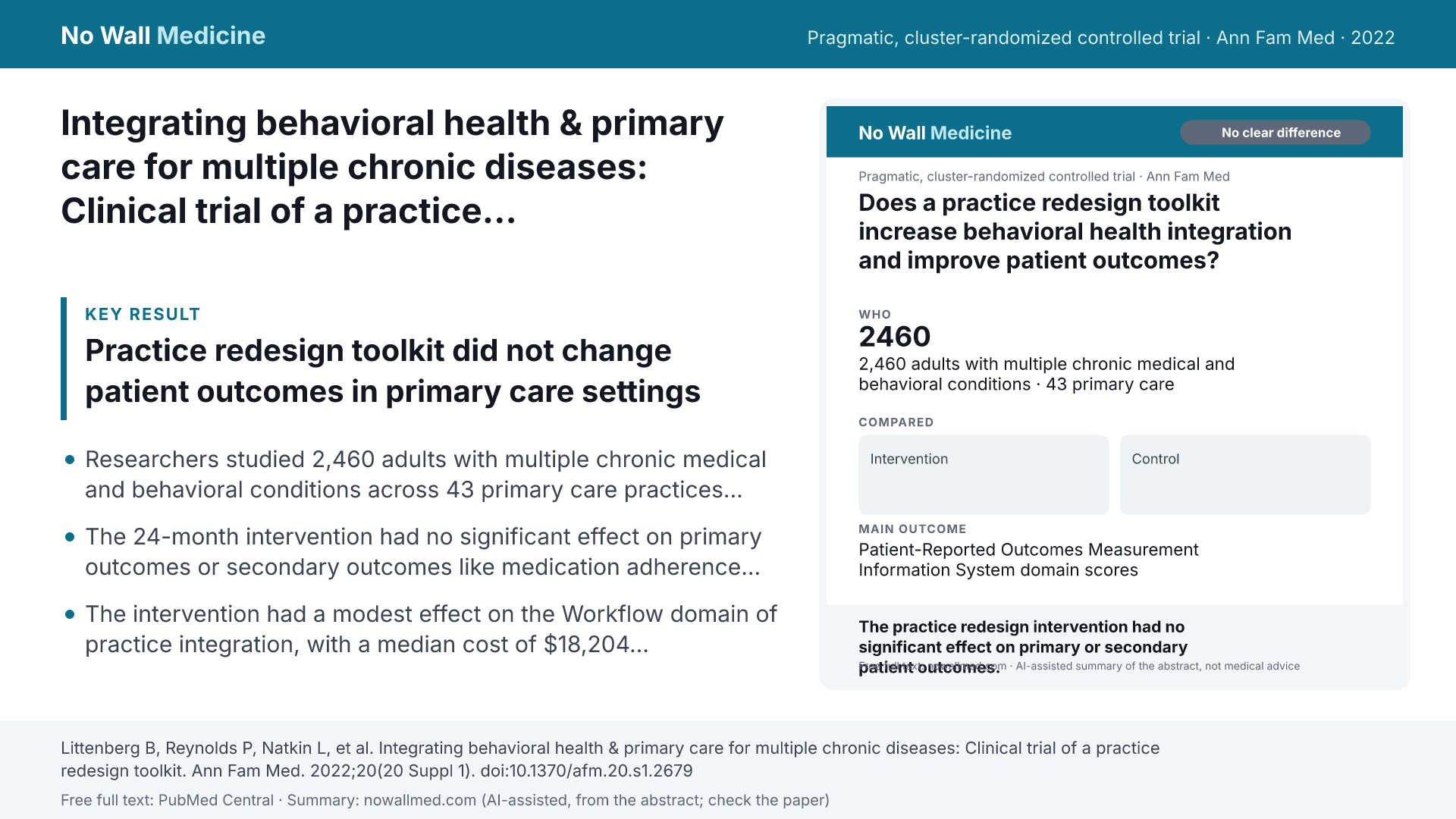
Integrating behavioral health & primary care for multiple chronic diseases: Clinical trial of a practice redesign toolkit
Key result: Practice redesign toolkit did not change patient outcomes in primary care settings
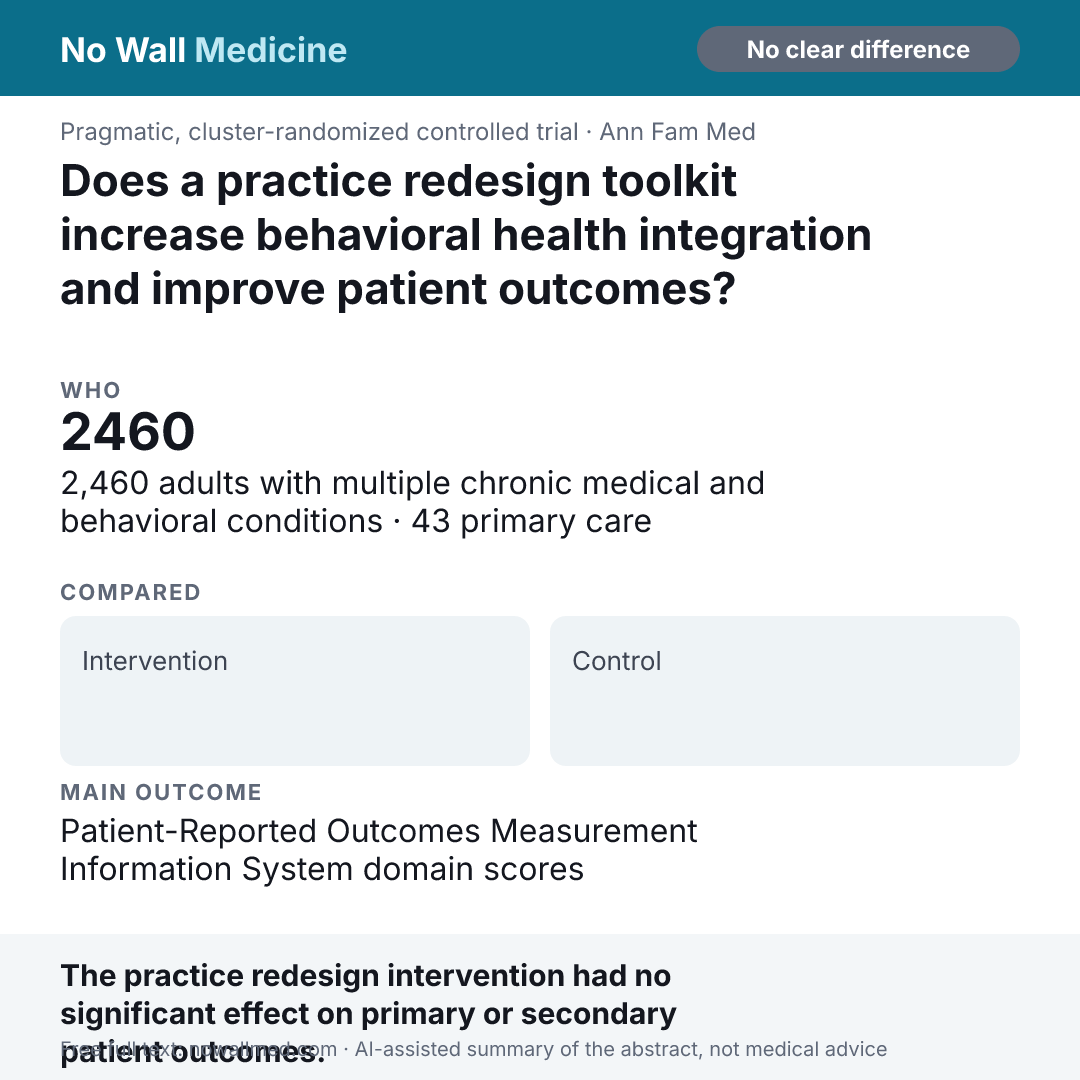
Pragmatic, cluster-randomized controlled trialNo clear difference
Does a practice redesign toolkit increase behavioral health integration and improve patient outcomes?
Who
2460
2,460 adults with multiple chronic medical and behavioral conditions · 43 primary care practices in 13 states
Compared
Intervention
Control
Main outcome
Patient-Reported Outcomes Measurement Information System domain scores
Bottom line: The practice redesign intervention had no significant effect on primary or secondary patient outcomes.
Ann Fam Med · 2022-04-01 · Save PNG
Key points
- Researchers studied 2,460 adults with multiple chronic medical and behavioral conditions across 43 primary care practices in 13 states.
- The 24-month intervention had no significant effect on primary outcomes or secondary outcomes like medication adherence and healthcare utilization.
- The intervention had a modest effect on the Workflow domain of practice integration, with a median cost of $18,204 per practice.
Why it matters: It is difficult to achieve high levels of integration between medical and behavioral health providers within primary care settings.
Discussion prompts
- Would these patients look like yours? Who was left out?
- Is the main outcome one that matters to patients?
- Is the difference large enough to change what you do?
Cite: Littenberg B, Reynolds P, Natkin L, et al. Integrating behavioral health & primary care for multiple chronic diseases: Clinical trial of a practice redesign toolkit. Ann Fam Med. 2022. doi:10.1370/afm.20.s1.2679
Free full text: PubMed Central · Summary and visual abstract: nowallmed.com/a/integrating-behavioral-health-primary-care-for-multiple-chronic-zqctu8/ (AI-assisted from the abstract; check the paper before relying on it).