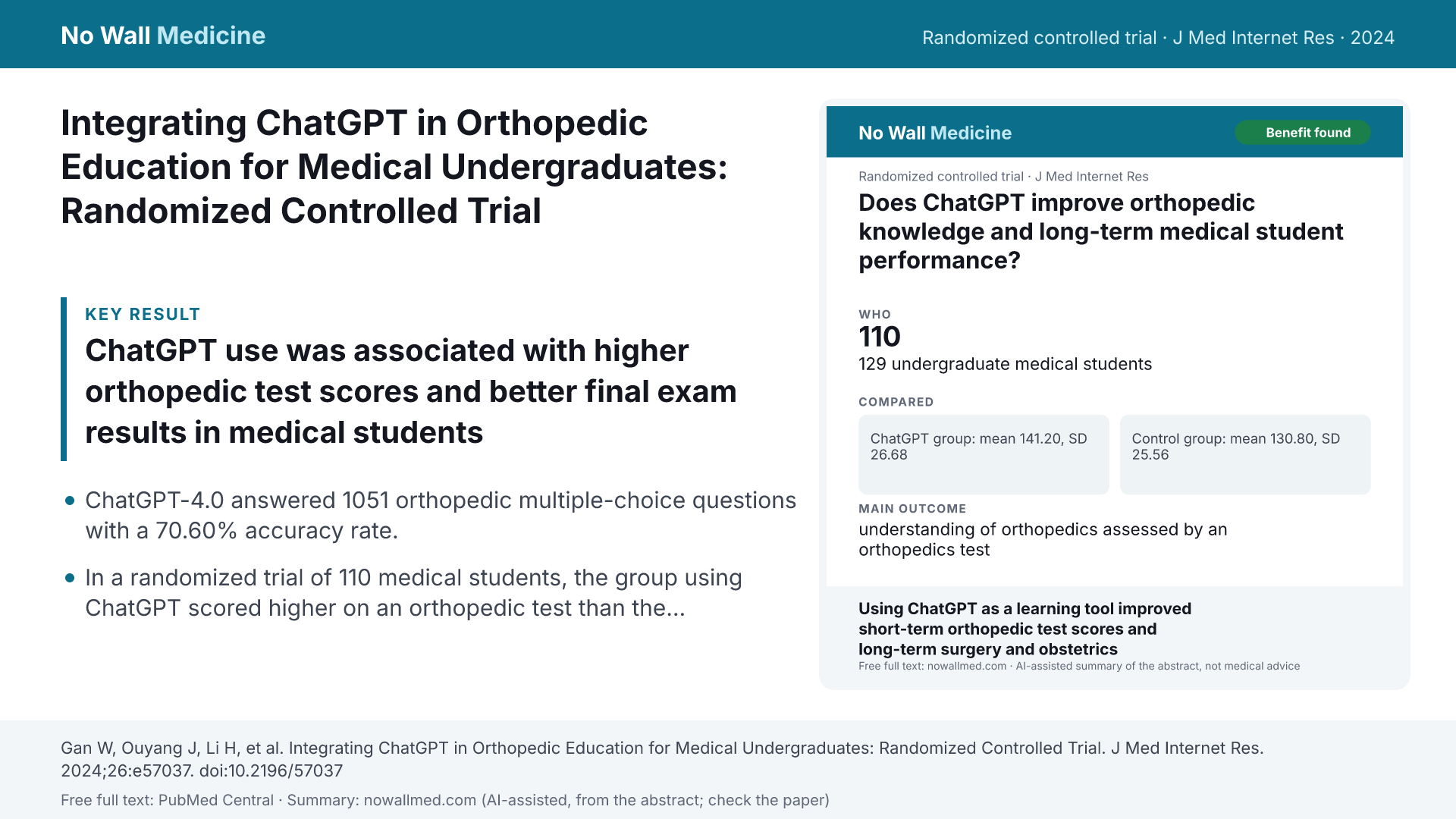
ChatGPT use was associated with higher orthopedic test scores and better final exam results in medical students
Integrating ChatGPT in Orthopedic Education for Medical Undergraduates: Randomized Controlled Trial
Randomized controlled trialBenefit found
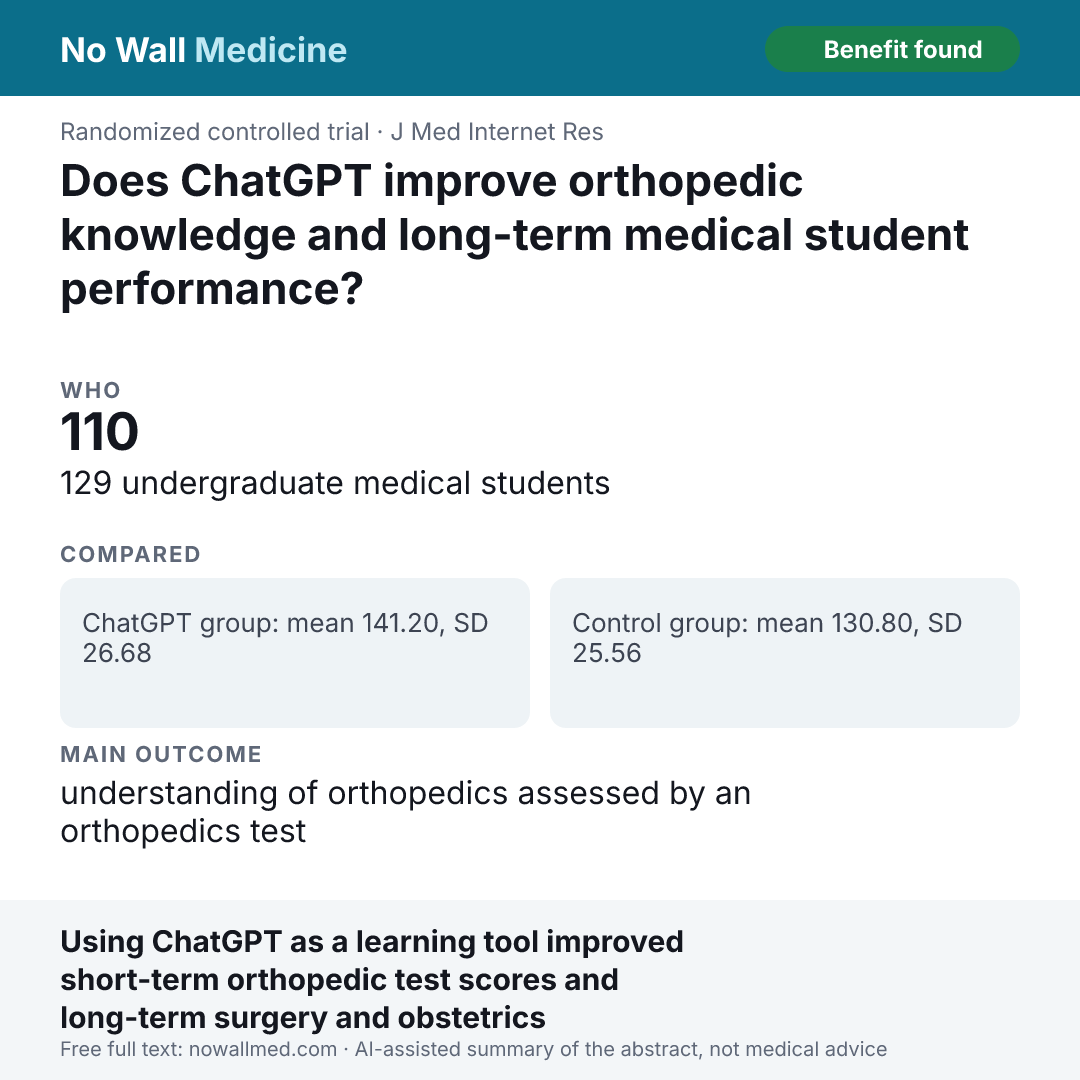
Does ChatGPT improve orthopedic knowledge and long-term medical student performance?
Who
110
129 undergraduate medical students
Compared
ChatGPT group: mean 141.20, SD 26.68
Control group: mean 130.80, SD 25.56
Main outcome
understanding of orthopedics assessed by an orthopedics test
Bottom line: Using ChatGPT as a learning tool improved short-term orthopedic test scores and long-term surgery and obstetrics performance.
Limitation: 19 individuals withdrew from the experiment at various phases
J Med Internet Res · 2024-08-20 · Save PNG
Clinical question: Does ChatGPT improve orthopedic knowledge and long-term medical student performance?
Key points
- ChatGPT-4.0 answered 1051 orthopedic multiple-choice questions with a 70.60% accuracy rate.
- In a randomized trial of 110 medical students, the group using ChatGPT scored higher on an orthopedic test than the control group.
- The ChatGPT group also had higher mean scores on final examinations in surgery and obstetrics and gynecology compared to the control group.
Headline and key points written with AI from the paper’s abstract, with every number checked against it. Read the paper before relying on them.
Was this summary helpful?
Subject terms
Headline, design, result, key points, caveat and citation as plain text.
Cite this article
Gan W, Ouyang J, Li H, et al. Integrating ChatGPT in Orthopedic Education for Medical Undergraduates: Randomized Controlled Trial. J Med Internet Res. 2024;26:e57037. doi:10.2196/57037
Spotted a mistake? Suggest a correction