Digital health tools and multi-month medication dispensing were non-inferior to standard care for HIV treatment
Integrating clinical decision support and mobile health for differentiated HIV service delivery in Lesotho (VITAL): a cluster-randomised non-inferiority trial
Cluster-randomised non-inferiority trialNo clear difference
Does digital health-supported differentiated service delivery improve HIV treatment outcomes in rural Lesotho?
Who
5770
Adults with HIV taking antiretroviral therapy · 18 rural, nurse-led clinics in Lesotho
Compared
77.9%VITAL group
74.3%enhanced standard of care group
Main outcome
Engagement in care with documented viral suppression at 24 months
Result: adjusted odds ratio 1.18 (95% CI 0.95-1.46)
Bottom line: Digital health tools and multi-month dispensing maintained viral suppression levels without increasing adverse outcomes in rural HIV care.
Limitation: Mid-trial changes in national antiretroviral therapy guidelines may have attenuated differences between groups.
Funded by: Moritz Straus-Foundation, Swiss National Science Foundation
eClinicalMedicine · 2026-04-02Download image
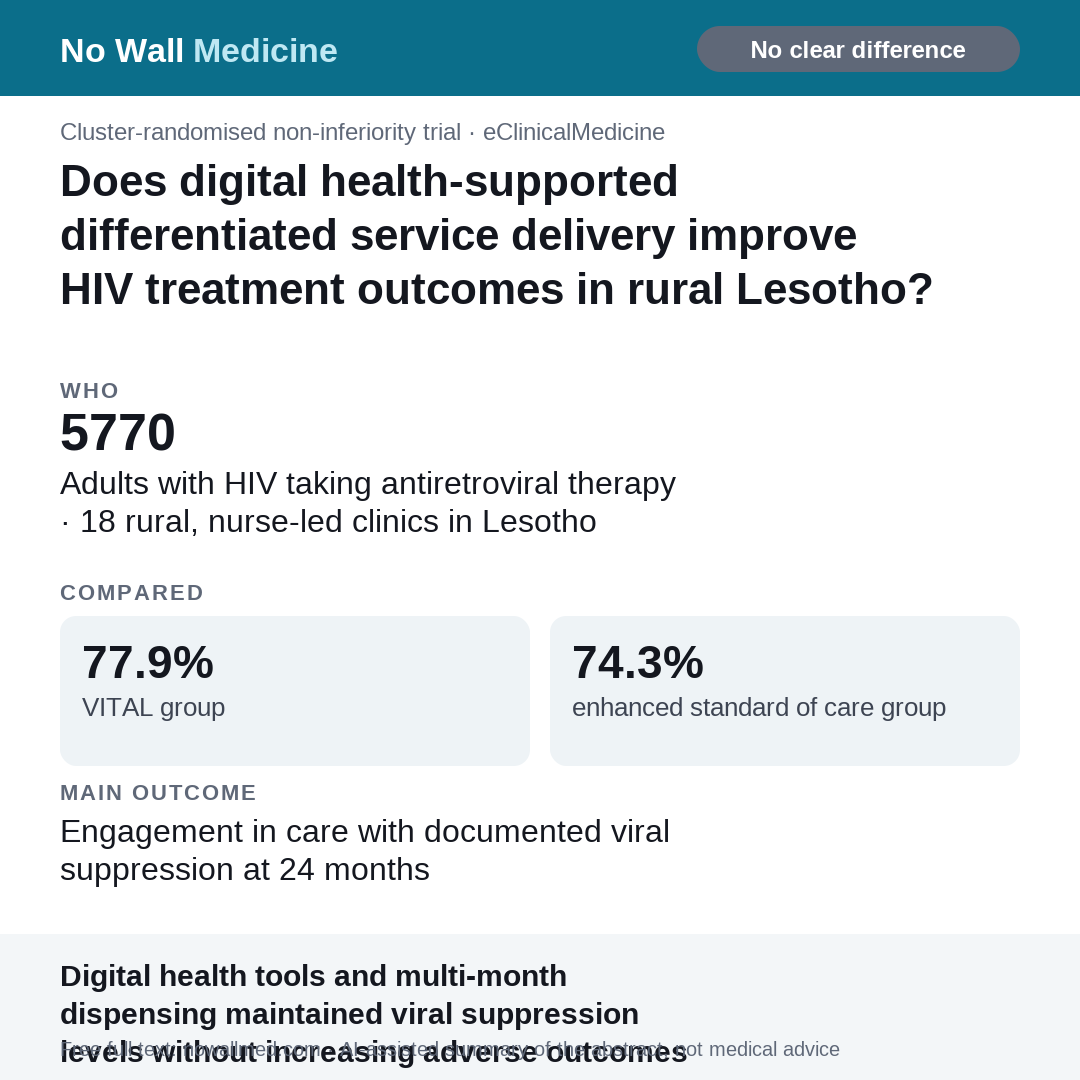
Clinical question: Does digital health-supported differentiated service delivery improve HIV treatment outcomes in rural Lesotho?
Why it matters: There is limited evidence regarding the benefits and harms of digital interventions used to strengthen health systems for HIV treatment.
Key points
- Researchers studied 5770 adults taking antiretroviral therapy at 18 rural clinics in Lesotho, comparing digital health tools and multi-month medication dispensing to enhanced standard care.
- Viral suppression, defined as having fewer than 50 copies of the virus per milliliter of blood, was achieved by 77.9% in the digital group and 74.3% in the standard group.
- Disengagement from care was lower in the digital health group at 4.6% compared to 7.1% in the enhanced standard care group.
Limitation the authors note: Mid-trial changes in national antiretroviral therapy guidelines may have attenuated differences between groups.
Headline and key points written with AI from the paper’s abstract, with every number checked against it. Read the paper before relying on them.
Cite this article
Tschumi N, Lerotholi M, Kopo M, Kao M, Motaboli L, Mokebe M. Integrating clinical decision support and mobile health for differentiated HIV service delivery in Lesotho (VITAL): a cluster-randomised non-inferiority trial. eClinicalMedicine. 2026. doi:10.1016/j.eclinm.2026.103850
Spotted a mistake? Suggest a correction