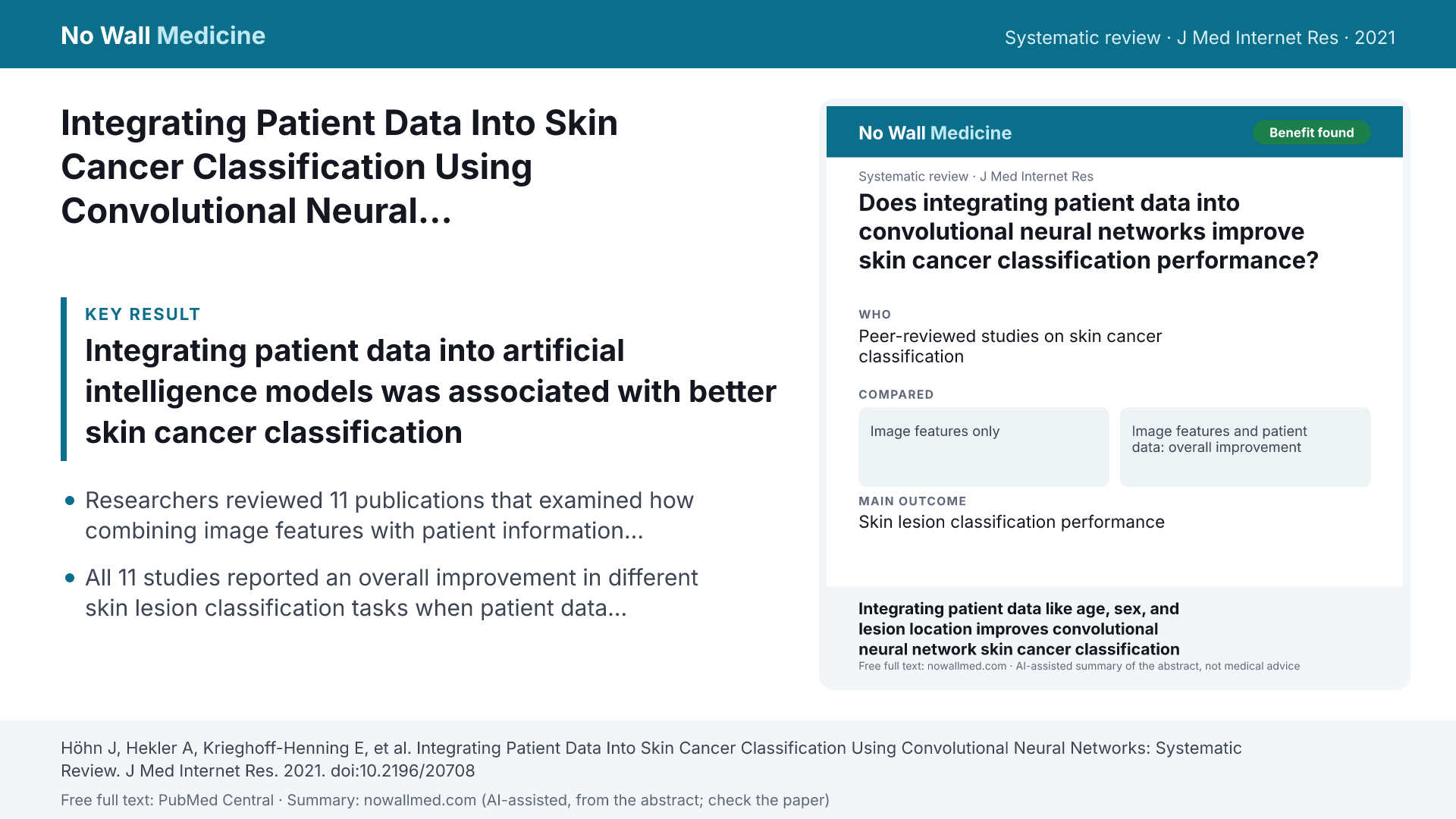
Integrating patient data into artificial intelligence models was associated with better skin cancer classification
Integrating Patient Data Into Skin Cancer Classification Using Convolutional Neural Networks: Systematic Review
Systematic reviewBenefit found
Does integrating patient data into convolutional neural networks improve skin cancer classification performance?
Who
Peer-reviewed studies on skin cancer classification
Compared
Image features only
Image features and patient data: overall improvement
Main outcome
Skin lesion classification performance
Bottom line: Integrating patient data like age, sex, and lesion location improves convolutional neural network skin cancer classification performance.
Limitation: How individual patient data enhance multiclass classification performance remains unclear.
J Med Internet Res · 2021-07-02 · Save PNG

Clinical question: Does integrating patient data into convolutional neural networks improve skin cancer classification performance?
Key points
- Researchers reviewed 11 publications that examined how combining image features with patient information affects convolutional neural networks, which are a type of deep learning computer model.
- All 11 studies reported an overall improvement in different skin lesion classification tasks when patient data were integrated into the models.
- The most frequently used patient information included age, sex, and the location of the skin lesion.
Headline and key points written with AI from the paper’s abstract, with every number checked against it. Read the paper before relying on them.
Was this summary helpful?
Subject terms
Headline, design, result, key points, caveat and citation as plain text.
Cite this article
Höhn J, Hekler A, Krieghoff-Henning E, et al. Integrating Patient Data Into Skin Cancer Classification Using Convolutional Neural Networks: Systematic Review. J Med Internet Res. 2021. doi:10.2196/20708
Spotted a mistake? Suggest a correction