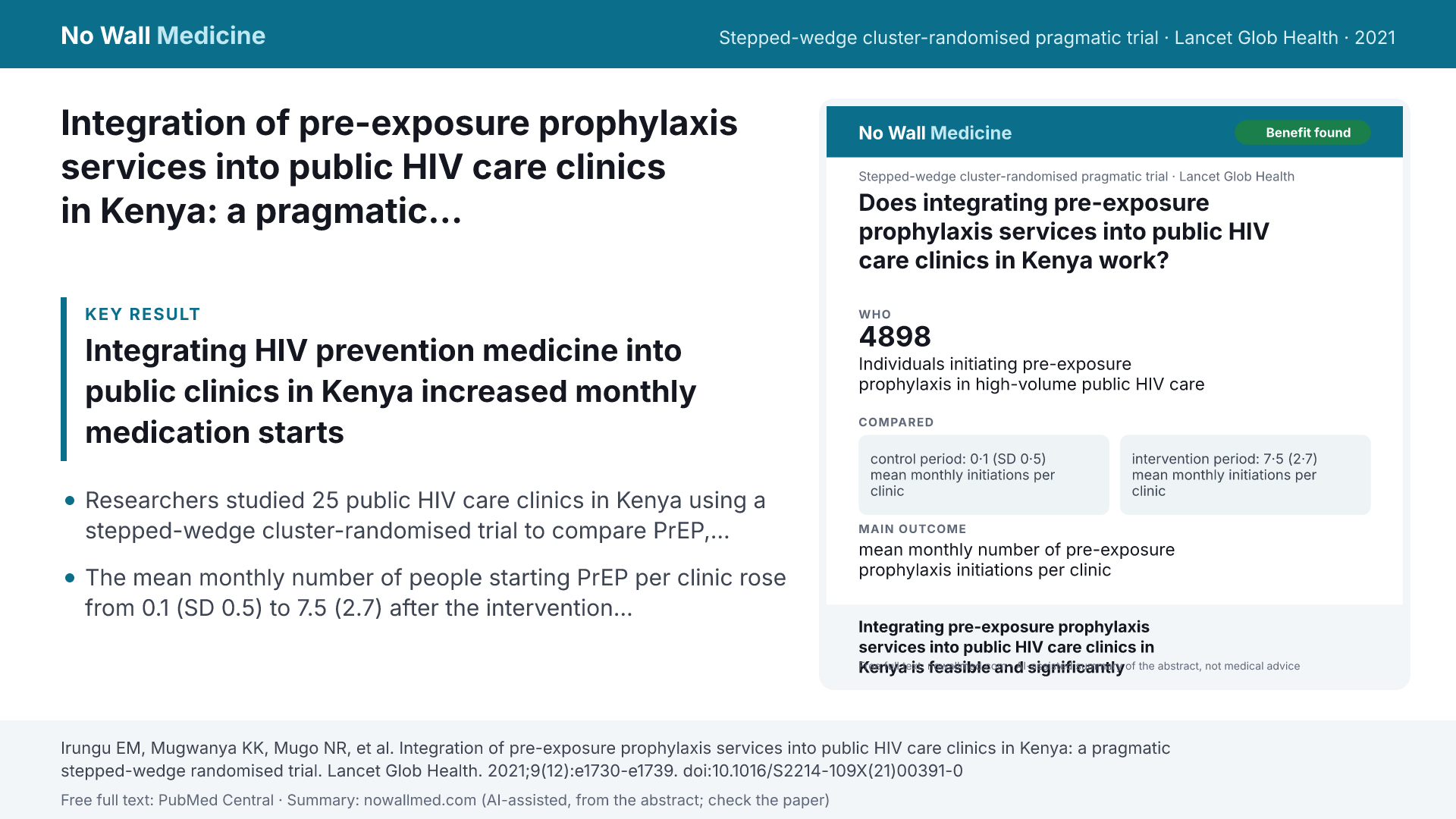
Integrating HIV prevention medicine into public clinics in Kenya increased monthly medication starts
Integration of pre-exposure prophylaxis services into public HIV care clinics in Kenya: a pragmatic stepped-wedge randomised trial
Stepped-wedge cluster-randomised pragmatic trialBenefit found
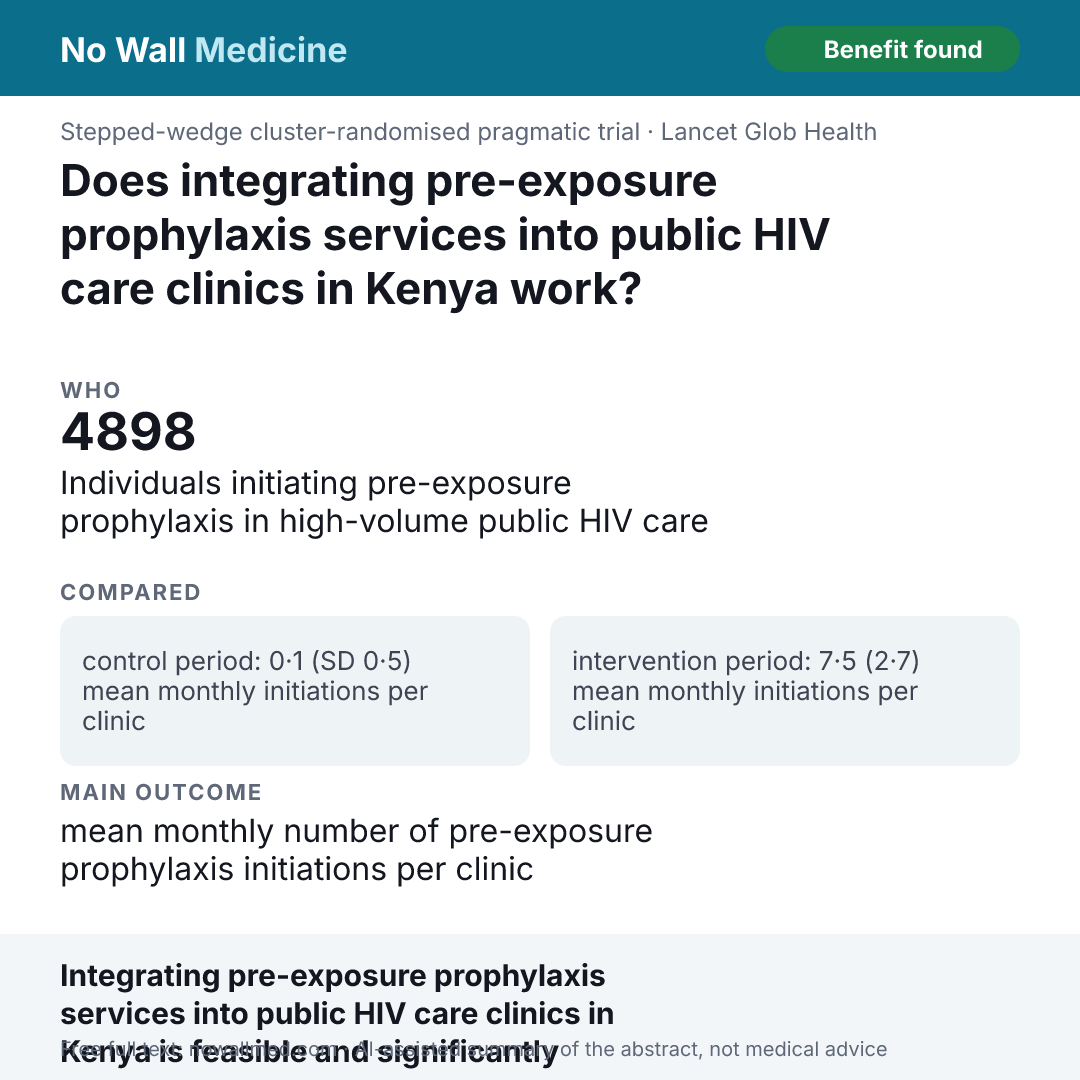
Does integrating pre-exposure prophylaxis services into public HIV care clinics in Kenya work?
Who
4898
Individuals initiating pre-exposure prophylaxis in high-volume public HIV care clinics · 25 public HIV care clinics in Kenya
Compared
control period: 0·1 (SD 0·5) mean monthly initiations per clinic
intervention period: 7·5 (2·7) mean monthly initiations per clinic
Main outcome
mean monthly number of pre-exposure prophylaxis initiations per clinic
Result: rate ratio 23·7, 95% CI 14·2-39·5
Bottom line: Integrating pre-exposure prophylaxis services into public HIV care clinics in Kenya is feasible and significantly increases monthly initiations.
Funded by: National Institute of Mental Health and Bill & Melinda Gates Foundation
Lancet Glob Health · 2021-11-20 · Save PNG
Clinical question: Does integrating pre-exposure prophylaxis services into public HIV care clinics in Kenya work?
Why it matters: Sustainable models for delivering HIV pre-exposure prophylaxis within existing public health systems in Africa are needed.
Key points
- Researchers studied 25 public HIV care clinics in Kenya using a stepped-wedge cluster-randomised trial to compare PrEP, a preventative medication, before and after integration.
- The mean monthly number of people starting PrEP per clinic rose from 0.1 (SD 0.5) to 7.5 (2.7) after the intervention was introduced.
- Among 4898 individuals starting the medication, 54% were women and 84% reported having a partner living with HIV.
Headline and key points written with AI from the paper’s abstract, with every number checked against it. Read the paper before relying on them.
Was this summary helpful?
Abstract
Background
Successful and sustainable models for HIV pre-exposure prophylaxis (PrEP) delivery in public health systems in Africa are needed. We aimed to evaluate the implementation of PrEP delivery integrated in public HIV care clinics in Kenya. Methods
As part of Kenya's national PrEP roll-out, we conducted a stepped-wedge cluster-randomised pragmatic trial to catalyse scale-up of PrEP delivery integrated in 25 public HIV care clinics. We selected high-volume clinics in these regions (ie, those with a high number of people living with HIV enrolled in HIV care and treatment). Clinics (each representing a cluster) were stratified by region and randomly assigned to the order in which clinic staff would receive PrEP training and ongoing technical support using numbered opaque balls picked from a bag. There was no masking. PrEP provision was done by clinic staff without additional financial support. Data were abstracted from records of individuals initiating PrEP. The primary outcome was the number of people initiating PrEP per clinic per month comparing intervention to control periods. Other outcomes included PrEP continuation, adherence, and incident HIV infections. This trial is registered with ClinicalTrials.gov, NCT03052010. Findings
After the baseline period, which started in January, 2017, every month two to six HIV care clinics crossed over from control to intervention, until August, 2017, when all clinics were implementing the intervention. Of 4898 individuals initiating PrEP (27 during the control period and 4871 during the intervention period), 2640 (54%) were women, the median age was 31 years (IQR 25-39), and 4092 (84%) reported having a partner living with HIV. The mean monthly number of PrEP initiations per clinic was 0·1 (SD 0·5) before the intervention and 7·5 (2·7) after intervention introduction (rate ratio 23·7, 95% CI 14·2-39·5, p<0·0001). PrEP continuation was 57% at 1 month, 44% at 3 months, and 34% at 6 months, and 12% of those who missed a refill returned later for PrEP re-initiation. Tenofovir diphosphate was detected in 68 (96%) of 71 blood samples collected from a randomly selected subset of participants. Six HIV infections were observed over 2531 person-years of observation (incidence 0·24 cases per 100 person-years), three of which occurred at the first visit after PrEP initiation. Interpretation
We observed high uptake, reasonable continuation with high adherence, frequent PrEP restarts, and low HIV incidence. Integration of PrEP services within public HIV care clinics in Africa is feasible. Funding
National Institute of Mental Health and Bill & Melinda Gates Foundation.
Abstract reproduced under the article’s CC BY NC ND licence.
Subject terms
Headline, design, result, key points, caveat and citation as plain text.
Cite this article
Irungu EM, Mugwanya KK, Mugo NR, et al. Integration of pre-exposure prophylaxis services into public HIV care clinics in Kenya: a pragmatic stepped-wedge randomised trial. Lancet Glob Health. 2021;9(12):e1730-e1739. doi:10.1016/S2214-109X(21)00391-0
Spotted a mistake? Suggest a correction