Intensive care after vascular surgery: systematic review
Systematic reviewHarm found
Does intensive care admission impact clinical outcomes and costs after vascular surgery?
Who
157 932
Patients undergoing elective and emergency vascular surgery
Compared
Intensive care unit admission: OR 4.14 (95% c.i. 1.65 to 10.41)
Intermediary or ward-based care
Main outcome
30-day or in-hospital mortality
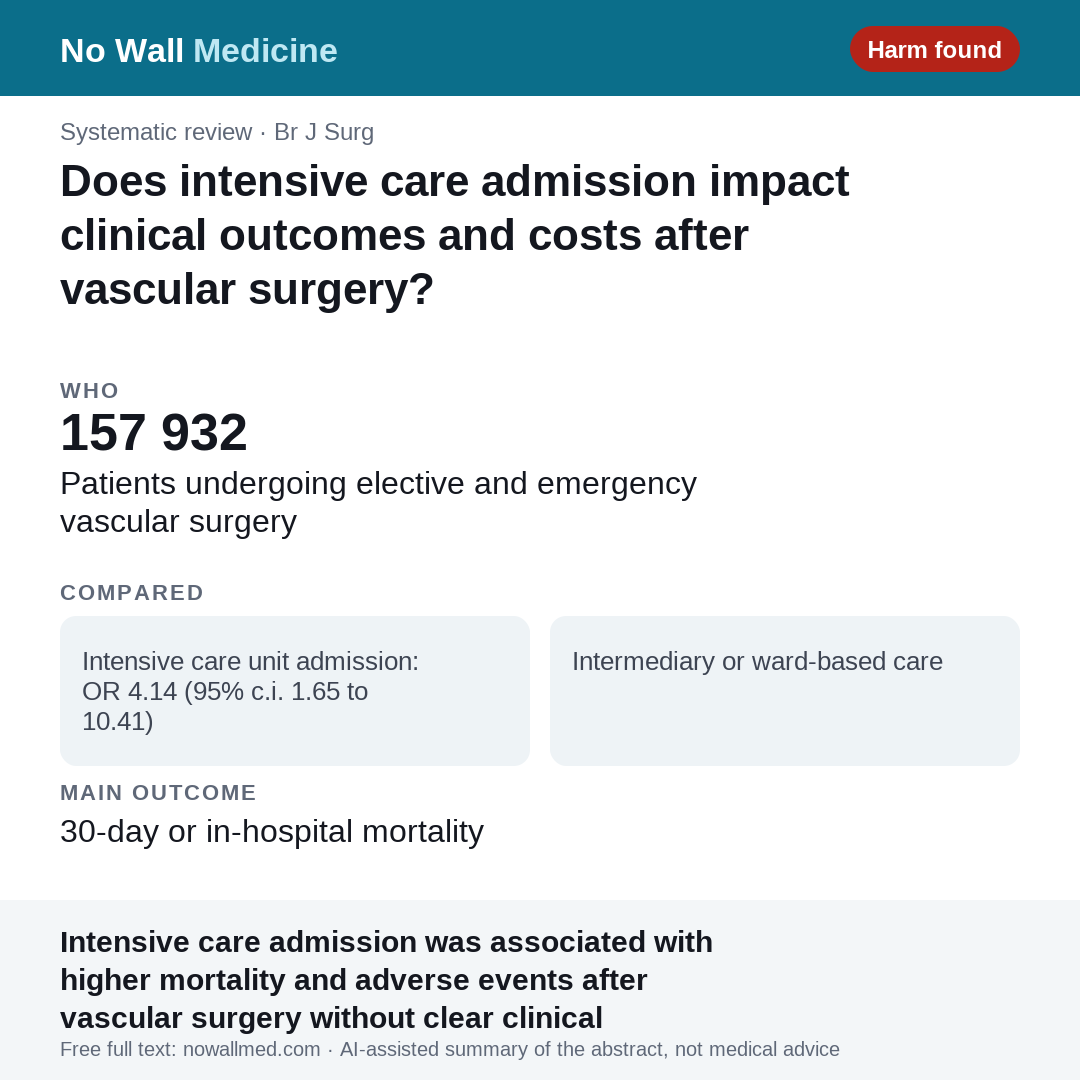
Result: odds ratio 4.14 (95% c.i. 1.65 to 10.41)
Bottom line: Intensive care admission was associated with higher mortality and adverse events after vascular surgery without clear clinical benefit.
Limitation: Potential residual confounding and insufficient risk stratification.
Br J Surg · 2025-08-12Download image
Clinical question: Does intensive care admission impact clinical outcomes and costs after vascular surgery?
Abstract
Background
The optimal use of ICU resources in patients undergoing vascular surgery is unclear. The aim of this systematic review was to evaluate the impact of ICU admission on clinical outcomes and costs after elective and emergency vascular surgery. Methods
MEDLINE, Embase, the Cochrane Library, Cochrane Collaboration Central Register of Controlled Trials (CENTRAL), and trial registry databases were searched in July 2024. Studies comparing ICU care with intermediary or ward-based care for major vascular surgery patients were included. Results
Thirteen studies (11 elective only and 2 including emergencies) involving 157 932 patients met the inclusion criteria. ICU admission was associated with higher adjusted 30-day or in-hospital mortality (OR 4.14 (95% c.i. 1.65 to 10.41), P = 0.003; Grading of Recommendations Assessment, Development, and Evaluation (GRADE) certainty: moderate). Unadjusted analyses found ICU admission was associated with increased major adverse cardiovascular events (risk ratio (RR) 1.45 (95% c.i. 1.04 to 2.01), P = 0.030; GRADE certainty: very low), acute kidney injury (RR 1.98 (95% c.i. 1.49 to 2.63), P < 0.001; GRADE certainty: moderate), dialysis (RR 1.76 (95% c.i. 1.13 to 2.74), P = 0.010; GRADE certainty: low), readmission (RR 1.93 (95% c.i. 1.20 to 3.12), P = 0.007; GRADE certainty: moderate), and major bleeding (RR 1.37 (95% c.i. 1.03 to 1.81), P = 0.030; GRADE certainty: moderate). Respiratory failure requiring mechanical ventilation and infection were higher in patients admitted to ICU compared with ward-based care specifically. Hospital-associated costs were higher for ICU admission across all procedures. Conclusion
No clear clinical benefit was associated with ICU admission after vascular surgery. This may be due to residual confounding and insufficient risk stratification.
Topics
Cite this article
Wong KHF, Murigu AK, Buongiovanni G, Mouton R, Hinchliffe RJ. Intensive care after vascular surgery: systematic review. Br J Surg. 2025. doi:10.1093/bjs/znaf172
Spotted a mistake? Suggest a correction
Top studies every Monday
The week’s key trials and guidelines in your specialties, by email. Free.
Get the weekly digest