Visual abstractsVisuals
Landmark trial: NICE-SUGARRandomized trialNew England Journal of Medicine · Mar 24, 2009

Intensive glucose control increased mortality in critically ill patients

Intensive versus conventional glucose control in critically ill patients

NICE-SUGAR Study Investigators, Finfer S, Chittock DR, Su SY, Blair D, Foster D, et al
Critical CareAdult

Why it matters: In critically ill adults, tight glucose control increased mortality compared with a more moderate target.

Related landmark trials: ACCORD

Context written by the No Wall Medicine team.

Randomized trialHarm found
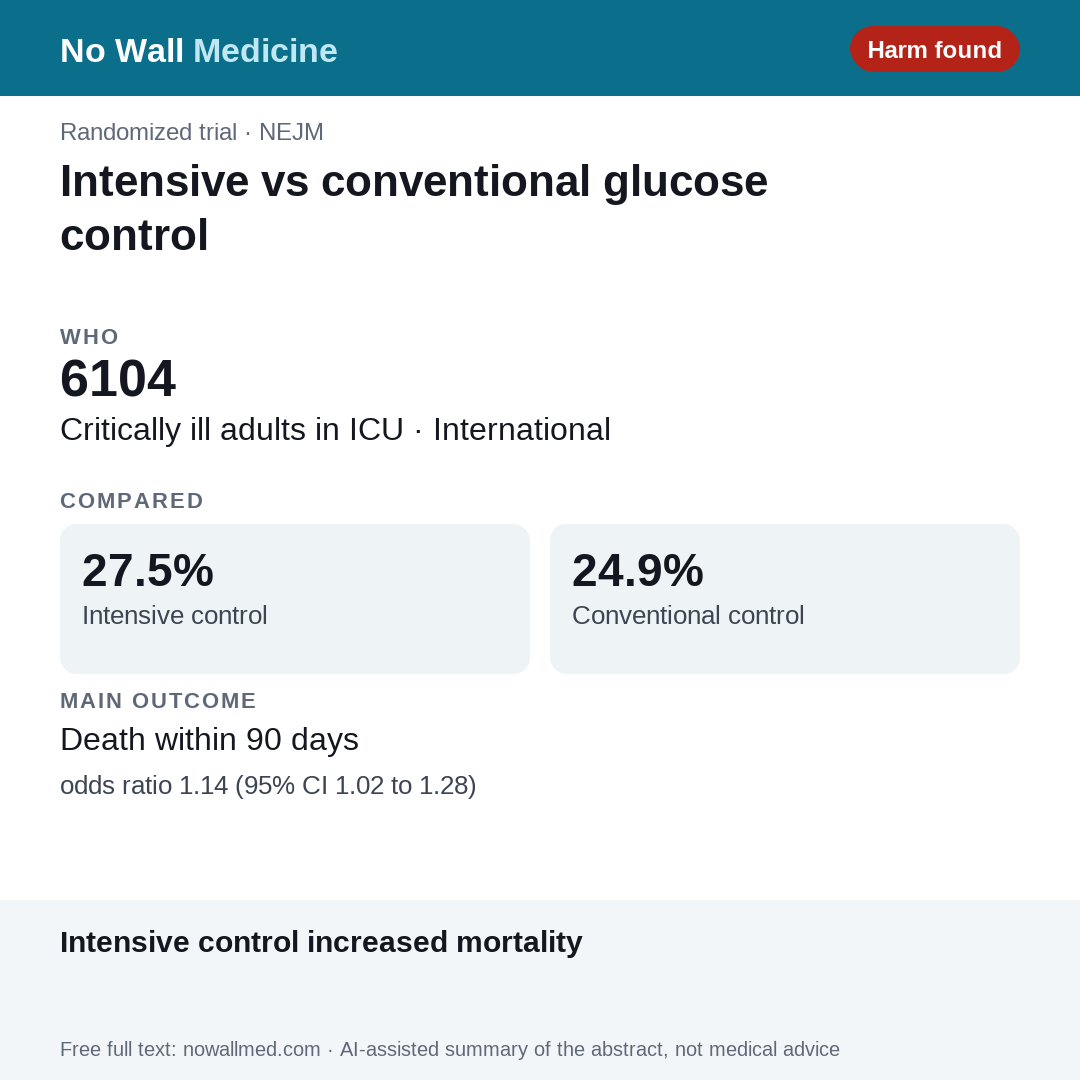
Intensive vs conventional glucose control
Who
6104
Critically ill adults in ICU · International
Compared
27.5%Intensive control (829/3010)
24.9%Conventional control (751/3012)
Main outcome
Death within 90 days
Result: odds ratio 1.14 (95% CI 1.02 to 1.28)
Bottom line: Intensive control increased mortality
NEJM · 2009-03-24Download image

Trial at a glance

Bottom line: Intensive glucose control increased mortality, conventional control had lower mortality

Clinical question

Glucose control in critically ill patients

Design

Randomized trial. International, multiple sites

Who was studied

6104 adults in intensive care unit

Key inclusion criteria

Interventions

Primary outcome

Death from any cause within 90 days. 829 (27.5%) vs 751 (24.9%) deaths, odds ratio 1.14

Harms

Severe hypoglycemia

Written with AI from the abstract; every number was checked against it. Details such as eligibility criteria may be missing because the abstract does not give them. Read the paper before relying on it.

Key points

Headline and key points written with AI from the paper’s abstract, with every number checked against it. Read the paper before relying on them.

Read the full paper free at the publisher ↗

Topics

Adrenal Cortex Hormones; Blood Glucose; Critical Care; Critical Illness; Female; Humans; Hyperglycemia; Hypoglycemia; Hypoglycemic Agents; Insulin; Intensive Care Units; Kaplan-Meier Estimate

DOI: 10.1056/NEJMoa0810625 · PubMed: 19318384 · Registered: NCT00220987

Spotted a mistake? Suggest a correction

More in Critical Care

Meta-analysisCrit Care · Nov 19, 2026 · Critical Care

Corticosteroids in sepsis have conflicting mortality conclusions in reviews

Discordant evidence on corticosteroids in sepsis: a meta-research study

ResearchPediatricResuscitation · Nov 17, 2026 · Critical Care

Eighty-nine percent of infants survived 28 days after chest compressions at birth in 2024

Survival after neonatal chest compressions at birth: Temporal trends and prognostic factors in a population-based cohort, Queensland, Australia

ResearchResuscitation · Nov 17, 2026 · Critical Care

Bystanders attaching AEDs had highest 30-day survival rate of 28 percent

Survival after out of hospital cardiac arrest in relation to AED usage in a multi response system including AED equipped drones

ResearchResuscitation · Nov 17, 2026 · Critical Care

Foreign body airway obstruction caused 1.1% of out-of-hospital cardiac arrests

Out-of-hospital cardiac arrests due to foreign body airway obstruction: A CanROC registry, retrospective cohort study

ResearchResuscitation · Nov 17, 2026 · Critical Care

Commercially available multimodal LLMs for EEG-based prognostication after cardiac arrest