Intensive blood pressure control was associated with less progression of brain small vessel disease
Intensive versus standard blood pressure control and overall brain small vessel disease burden: a post-hoc analysis of the SPRINT randomized clinical trial
Post-hoc analysis of a randomized clinical trialBenefit found
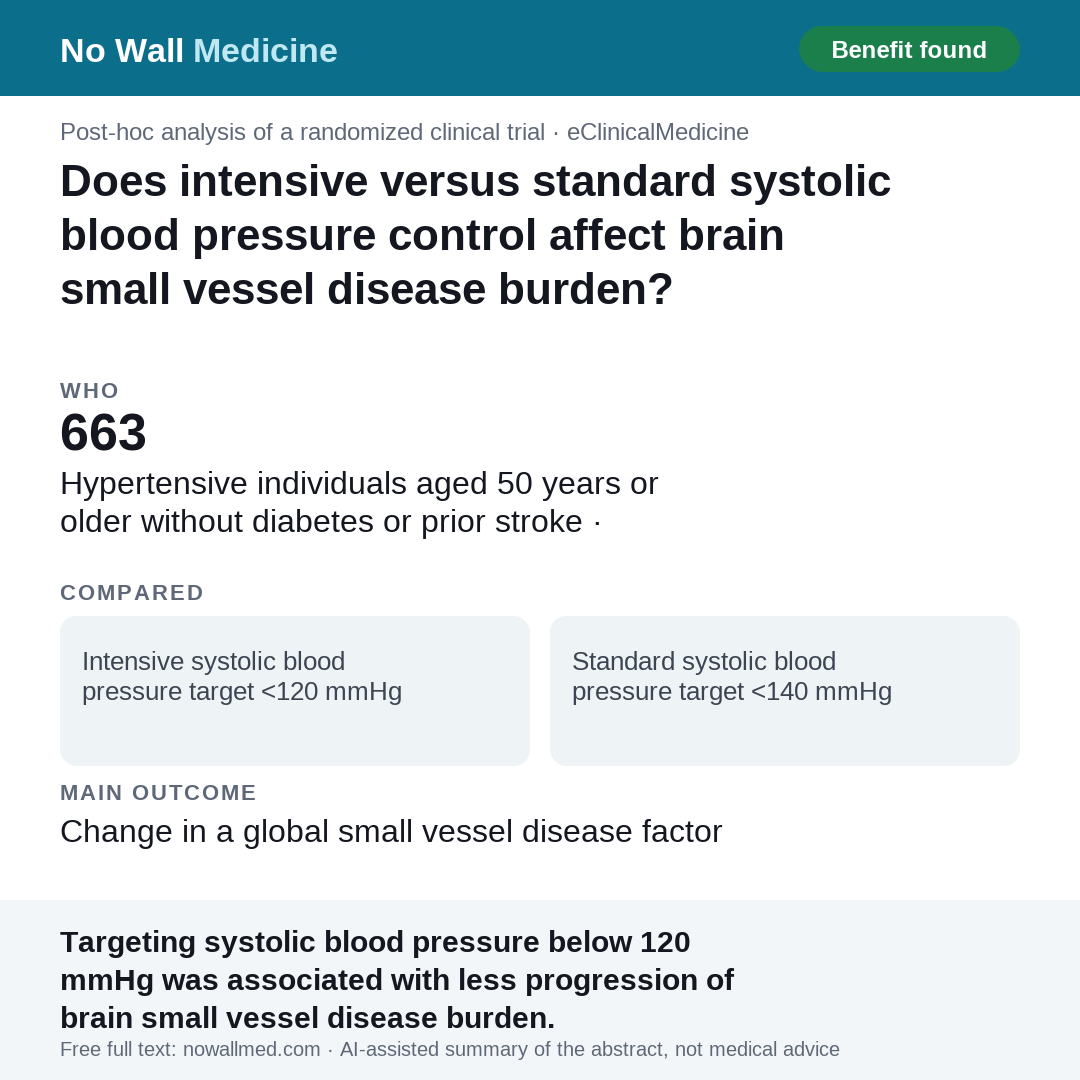
Does intensive versus standard systolic blood pressure control affect brain small vessel disease burden?
Who
663
Hypertensive individuals aged 50 years or older without diabetes or prior stroke · Multicenter
Compared
Intensive systolic blood pressure target <120 mmHg
Standard systolic blood pressure target <140 mmHg
Main outcome
Change in a global small vessel disease factor
Result: standardized mean difference -0.40 (95% CI -0.62 to -0.17)
Bottom line: Targeting systolic blood pressure below 120 mmHg was associated with less progression of brain small vessel disease burden.
Funded by: National Institutes of Health
eClinicalMedicine · 2026-08-11Download image
Clinical question: Does intensive versus standard systolic blood pressure control affect brain small vessel disease burden?
Why it matters: The effect of intensive systolic blood pressure control on the overall burden of cerebral small vessel disease remains uncharacterized.
Key points
- Researchers analyzed 663 and 442 participants from the SPRINT trial who underwent brain magnetic resonance imaging to measure small vessel disease, which refers to damage in the brain's tiny blood vessels.
- Intensive systolic blood pressure control of <120 mmHg was associated with significantly less disease progression compared to a standard target of <140 mmHg.
- Larger blood pressure reductions showed more protection, with 39.4% less progression for reductions of 20 mmHg or more compared to baseline.
Headline and key points written with AI from the paper’s abstract, with every number checked against it. Read the paper before relying on them.
Cite this article
Charisis S, Pajewski NM, Price LR, Ho NH, Rashid T, Wang D. Intensive versus standard blood pressure control and overall brain small vessel disease burden: a post-hoc analysis of the SPRINT randomized clinical trial. eClinicalMedicine. 2026. doi:10.1016/j.eclinm.2026.104143
Spotted a mistake? Suggest a correction