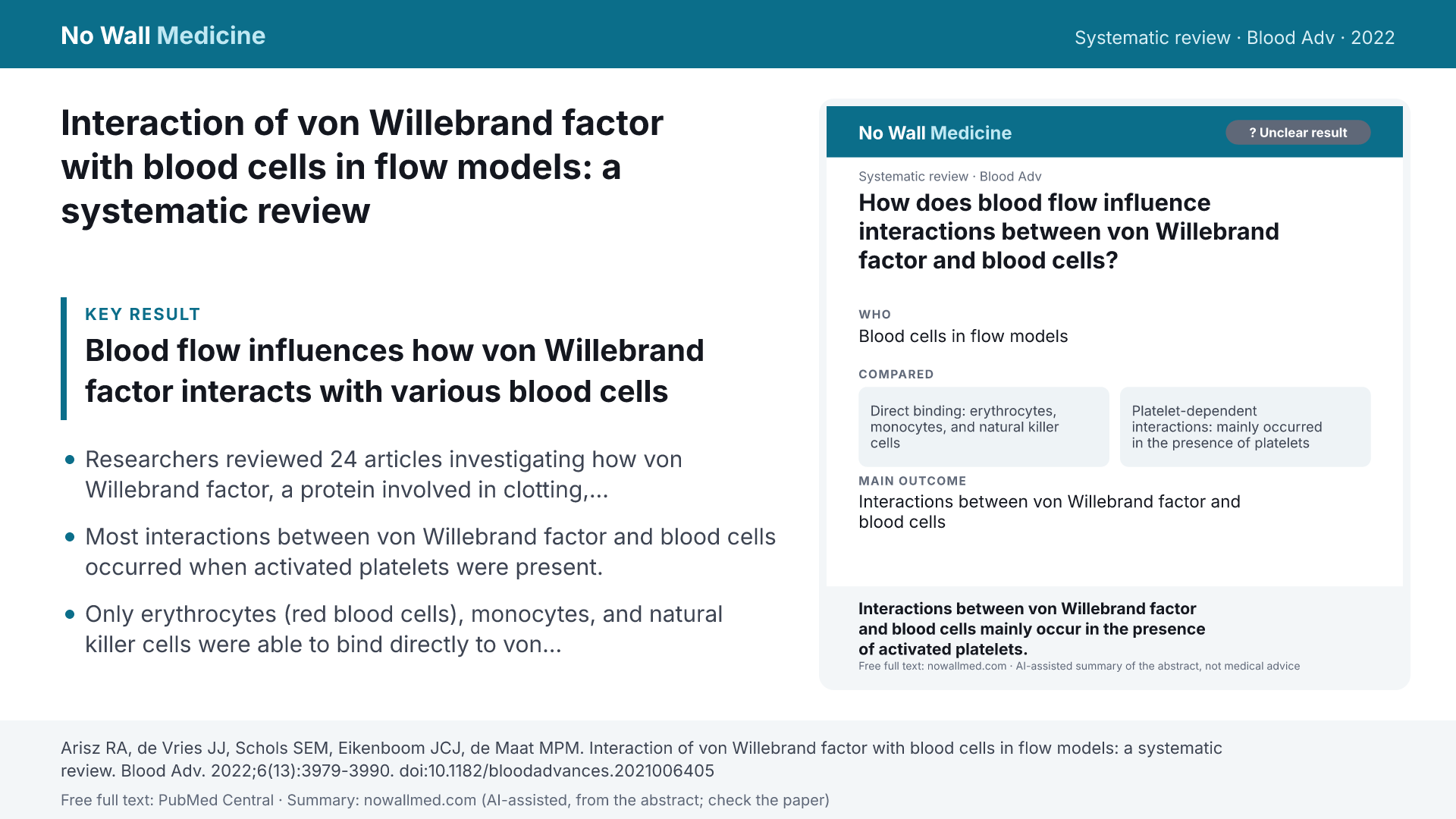
Blood flow influences how von Willebrand factor interacts with various blood cells
Interaction of von Willebrand factor with blood cells in flow models: a systematic review
Systematic reviewUnclear result
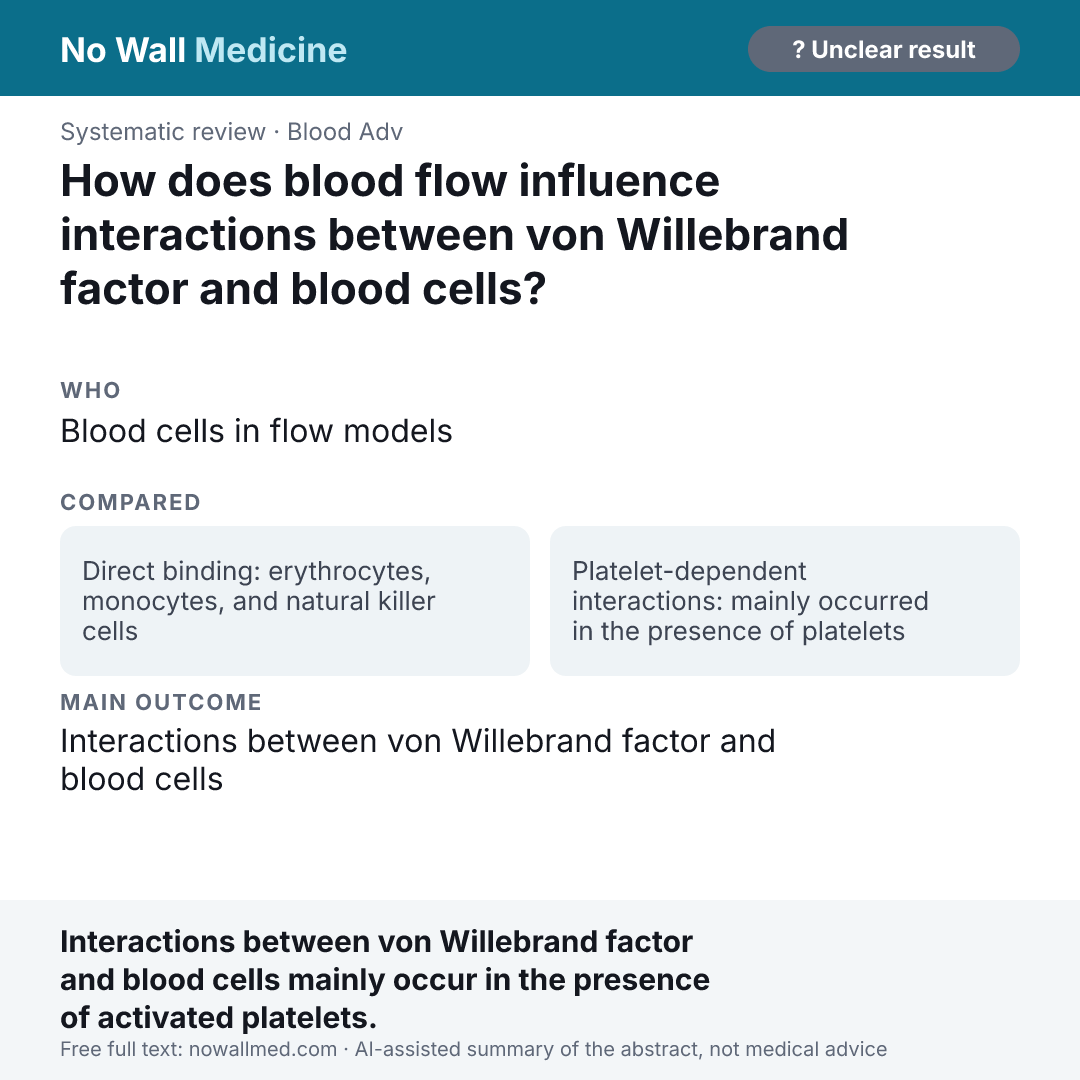
How does blood flow influence interactions between von Willebrand factor and blood cells?
Who
Blood cells in flow models
Compared
Direct binding: erythrocytes, monocytes, and natural killer cells
Platelet-dependent interactions: mainly occurred in the presence of platelets
Main outcome
Interactions between von Willebrand factor and blood cells
Bottom line: Interactions between von Willebrand factor and blood cells mainly occur in the presence of activated platelets.
Blood Adv · 2022-07-11
Headline and visual abstract written with AI from the paper’s abstract, with every number checked against it. Read the paper before relying on them.
Was this summary helpful?
Abstract
The presence of blood flow influences the interaction between von Willebrand factor (VWF) and blood cells, affecting characteristics of forming blood clots. The interactions between coagulation and inflammation have mainly been studied in thrombosis models, but it remains unclear whether these interactions might also play a role in reduced bleeding in patients with bleeding disorders. In this systematic review, we provide an overview of the literature investigating the interactions between VWF and blood cells in flow models. For article selection, a systematic search was performed in Embase, Medline-Ovid, Cochrane Library, Web of Science databases, and Google Scholar. After selection, 24 articles were included. These articles describe direct or platelet-dependent interactions between VWF and neutrophils, monocytes, erythrocytes, or lymphocytes under different flow conditions. Almost all the described interactions required the presence of activated platelets. Only erythrocytes, monocytes, and natural killer cells were capable of directly binding the VWF multimers. Overall, interactions between VWF and blood cells mainly occurred in the presence of platelets. Because of the large variation in study design and used flow rates, further research is necessary to compare the results between studies and draw firm conclusions on when and under what conditions these interactions can occur. After our findings, many questions remained unanswered. This review might provide a starting point for future research. Extended knowledge on the influence of blood flow on VWF and blood cell interactions can contribute to improved understanding of the variation in bleeding in patients with bleeding disorders.
Abstract reproduced under the article’s CC BY NC ND licence.
Subject terms
Cite this article
Arisz RA, de Vries JJ, Schols SEM, Eikenboom JCJ, de Maat MPM. Interaction of von Willebrand factor with blood cells in flow models: a systematic review. Blood Adv. 2022;6(13):3979-3990. doi:10.1182/bloodadvances.2021006405
Spotted a mistake? Suggest a correction