Intercontinental aeromedical transfers after decompressive craniectomy for severe traumatic brain injury: Systematic review and evidence-informed fitness-to-fly pathway
Systematic reviewUnclear result
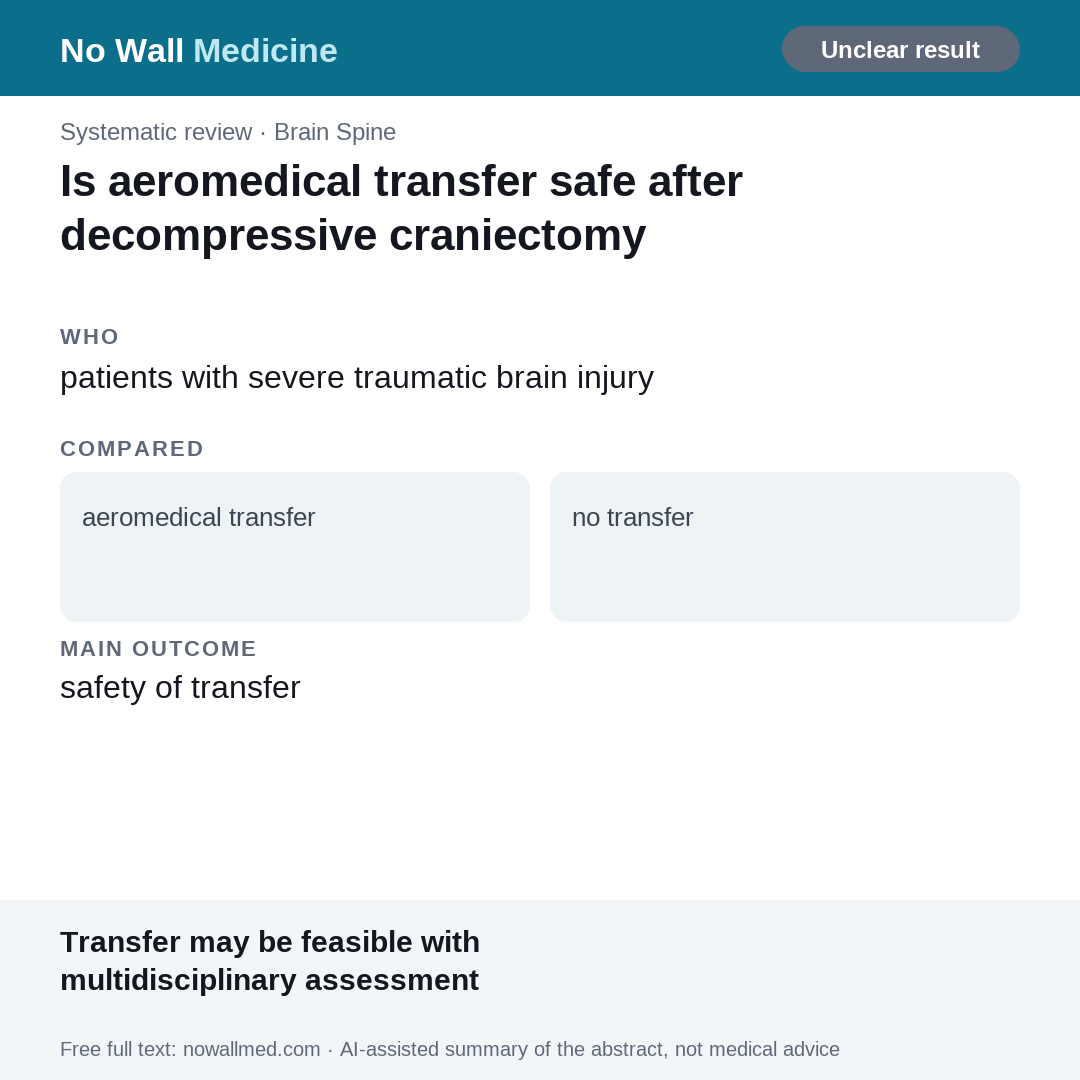
Is aeromedical transfer safe after decompressive craniectomy
Who
patients with severe traumatic brain injury
Compared
aeromedical transfer
no transfer
Main outcome
safety of transfer
Bottom line: Transfer may be feasible with multidisciplinary assessment
Brain Spine · 2026-08-09Download image
Abstract
Background
Traumatic brain injury (TBI) sustained abroad creates major clinical, logistical, and psychosocial challenges. Guidance on the timing and safety of aeromedical repatriation after cranial surgery remains inconsistent and largely unvalidated. Case description
A 26-year-old foreign national presented unconscious after a hotel-balcony fall. Computed tomography showed a right frontotemporoparietal acute subdural haematoma with bilateral basifrontal contusions. Intervention and outcome
Following resuscitation, he underwent decompressive craniectomy and haematoma evacuation. After tracheostomy and neurocritical-care stabilization, multidisciplinary coordination was undertaken with his family, insurer, authorities, and receiving centre. Pre-flight assessment confirmed neurological and cardiopulmonary stability, secure airway and ventilation, and absence of pneumocephalus and pneumothorax. Three weeks after surgery, transfer by ventilator-equipped fixed-wing air ambulance was completed without reported complications. Systematic review
A PRISMA 2020-aligned focused review was conducted on aeromedical transfers for patients after decompressive craniectomy for severe TBI. Of 737 records identified, 58 full-text reports were assessed, and twenty-six primary studies were included in the narrative synthesis; eight professional guidance, consensus, and regulatory documents were synthesized separately. Evidence was heterogeneous, comprising mainly retrospective military cohorts, surveys, mechanistic models, and case reports. Secondary physiological insults during transport-not elapsed postoperative time alone-were the recurring risk. Evidence relating intracranial-air volume to deterioration was inconsistent, and no universally safe volume or validated post-craniectomy interval was identified. Conclusion
Long-distance repatriation after decompressive craniectomy may be feasible following structured multidisciplinary assessment, physiological optimisation, exclusion of trapped intracranial or thoracic air, and appropriate cabin-pressure and monitoring strategies. The proposed defer/conditional/ready pathway requires prospective validation.
Cite this article
Gupta D, Garg V, Kishore R, Sharma R, Pandey K, Kumar A. Intercontinental aeromedical transfers after decompressive craniectomy for severe traumatic brain injury: Systematic review and evidence-informed fitness-to-fly pathway. Brain Spine. 2026. doi:10.1016/j.bas.2026.106278
Spotted a mistake? Suggest a correction