Interim PET scans after four chemotherapy cycles predict outcomes in primary mediastinal B-cell lymphoma
Interim PET after 4 cycles predicts outcome in histomolecularly confirmed primary mediastinal B-cell lymphoma
Post hoc analysis of a randomized phase 3 trialBenefit found
Does interim positron emission tomography after four cycles predict outcomes in primary mediastinal B-cell lymphoma?
Who
138
Patients with histomolecularly confirmed primary mediastinal B-cell lymphoma · Centrally reviewed
Compared
Tumor bulk >10 cm: shorter progression-free survival
ΔSUVmax PET4 ≤70%: shorter progression-free survival
Main outcome
progression-free survival and overall survival
Result: hazard ratio 4.95 (95% CI 1.71 to 14.3) for ΔSUVmax PET4 ≤70%
Bottom line: Interim positron emission tomography response after four cycles is a strong predictor of progression-free survival in primary mediastinal B-cell lymphoma.
Blood Adv · 2025-03-03Download image
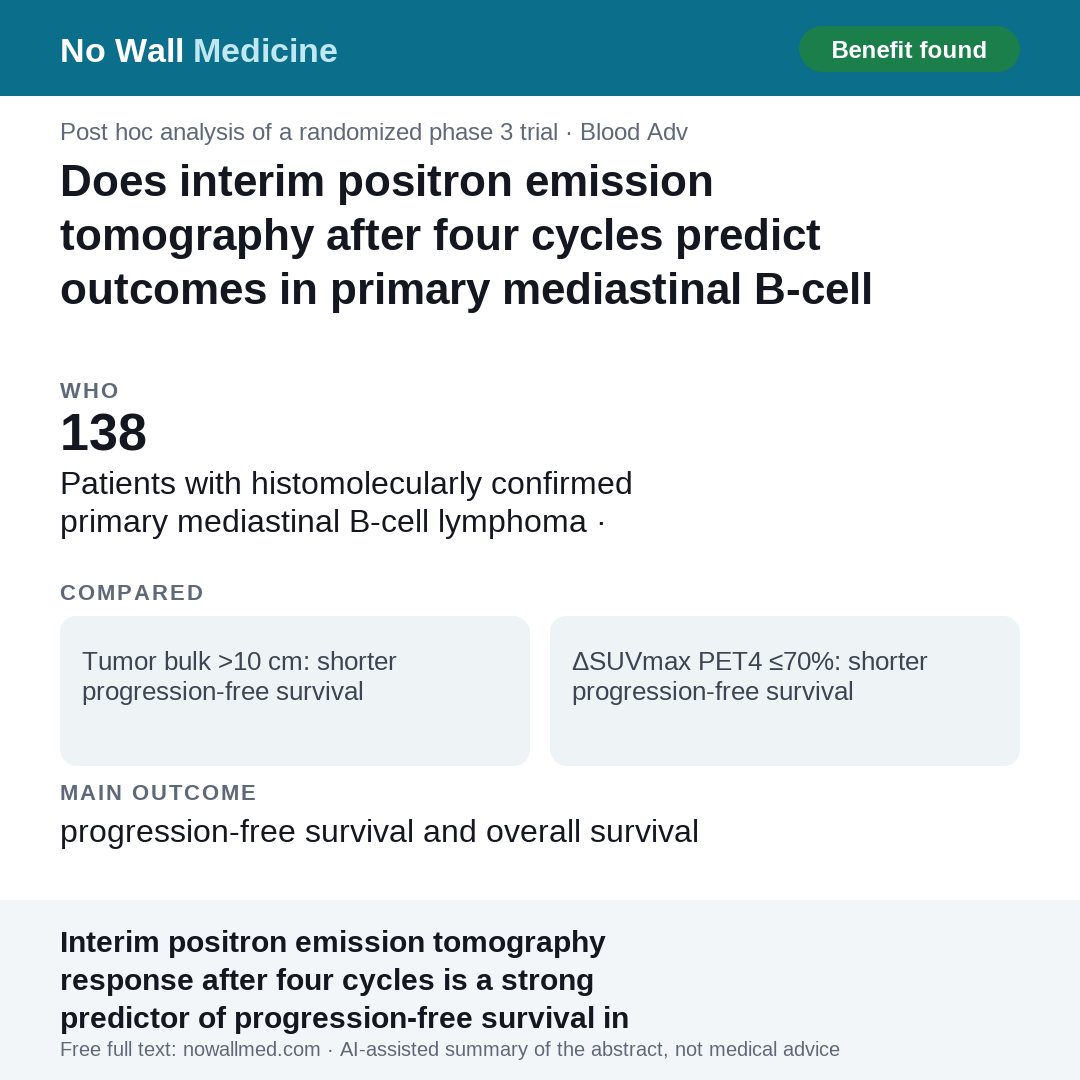
Clinical question: Does interim positron emission tomography after four cycles predict outcomes in primary mediastinal B-cell lymphoma?
Why it matters: It was unknown if interim positron emission tomography scans after four cycles of induction therapy could predict outcomes for patients with histomolecularly confirmed primary mediastinal B-cell lymphoma.
Key points
- Researchers analyzed 138 patients with histomolecularly confirmed primary mediastinal B-cell lymphoma from the GAINED randomized phase 3 trial.
- A change in maximum standardized uptake value on a positron emission tomography scan of 70% or less after four cycles was associated with shorter progression-free survival.
- Tumor bulk was also associated with shorter progression-free survival, but no factors were associated with overall survival after a median follow-up of 39.5 months.
Headline and key points written with AI from the paper’s abstract, with every number checked against it. Read the paper before relying on them.
Was this summary helpful?
Abstract
The GAINED study was a randomized phase 3 trial comparing obinutuzumab (G) with rituximab (R) plus ACVBP (doxorubicin, cyclophosphamide, and prednisone, combined with either vindesine or bleomycin) or CHOP14 (cyclophosphamide, doxorubicin, vincristine, and prednisone, administered on a 14-day schedule) induction, followed by positron emission tomography (PET)-guided consolidation. This post hoc analysis aimed to detail the outcomes of patients with primary mediastinal B-cell lymphoma (PMBL), verified through expert pathological review and the use of gene expression profiling (GEP) and next-generation sequencing. Of 620 centrally reviewed patients, 138 (22.3%) confirmed PMBL cases were analyzed. Baseline characteristics included a median age of 33.5 years, 63.8% female, 55.1% stage III to IV, 90.6% elevated lactate dehydrogenase, 87.6% Eastern Cooperative Oncology Group performance status score of 0 to 1, 62.3% extranodal involvement, 52.6% age-adjusted International Prognostic Index (aaIPI) of 2% to 3%, and 53.6% bulk (>10 cm). Induction regimens were R/G-CHOP14 (56.9%) and R/G-ACVBP (43.1%). Postinduction treatments, based on interim PET results, included: standard consolidation chemotherapy (59.8%) if change in maximum standardized uptake value (ΔSUVmax) of >66% after cycle 2 and >70% after cycle 4 (PET2-/4-), intensive treatment and autologous transplantation (26.8%) if PET2+/4-, and salvage therapy (13.4%) if PET4+ (ΔSUVmax of ≤70%). Among patients with GEP data (n = 107), 38 (35.5%) were PDL1high/PDL2high. Key somatic mutations data (n = 87) included SOCS1 (70.1%), B2M (56.3%), STAT6 (49.4%), TNFAIP3 (47.1%), GNA13 (39.1%), CIITA (37.9%), CD58 (36.8%), and TP53 (29.9%). After a median follow-up of 39.5 months, 2-year progression-free survival (PFS) and overall survival (OS) rates were 86.2% and 93.2%, respectively. In a multivariate model including bulk, aaIPI, and ΔSUVmax PET2/PET4, only bulk and ΔSUVmax PET4 of ≤70% were associated with shorter PFS (hazard ratio, 4.39 [95% confidence interval (CI), 1.28-15.11] and 4.95 [95% CI, 1.71-14.3], respectively), whereas none were associated with OS. The ΔSUVmax-based interim PET4 response emerged as the strongest predictor of patient outcomes in this selected clinical trial population. This trial was registered at www.ClinicalTrials.gov as #NCT01659099.
Abstract reproduced under the article’s CC BY NC ND licence.
Subject terms
Cite this article
Camus V, Molina T, Desmots F, Blanc-Durand P, Kanoun S, Moslemi A. Interim PET after 4 cycles predicts outcome in histomolecularly confirmed primary mediastinal B-cell lymphoma. Blood Adv. 2025. doi:10.1182/bloodadvances.2024015577
Spotted a mistake? Suggest a correction
Top studies every Monday
The week’s key trials and guidelines in your specialties, plus any topics you follow. By email, free.
Get the weekly digest