Interleukin-1 and transforming growth factor beta systems interact to regulate corneal wound healing
Interleukin-1 and Transforming Growth Factor Beta: Commonly Opposing, but Sometimes Supporting, Master Regulators of the Corneal Wound Healing Response to Injury
Systematic reviewUnclear result
How do interleukin-1 and transforming growth factor beta interact to regulate corneal wound healing?
Who
Corneal cells and bone marrow-derived cells
Compared
Interleukin-1 alpha and beta
Transforming growth factor beta 1 and 2
Main outcome
Corneal wound healing response to injury or infection
Bottom line: The interleukin-1 and transforming growth factor beta systems must be coordinated to control corneal wound healing and eliminate fibrosis.
Invest Ophthalmol Vis Sci · 2021-04-07Download image
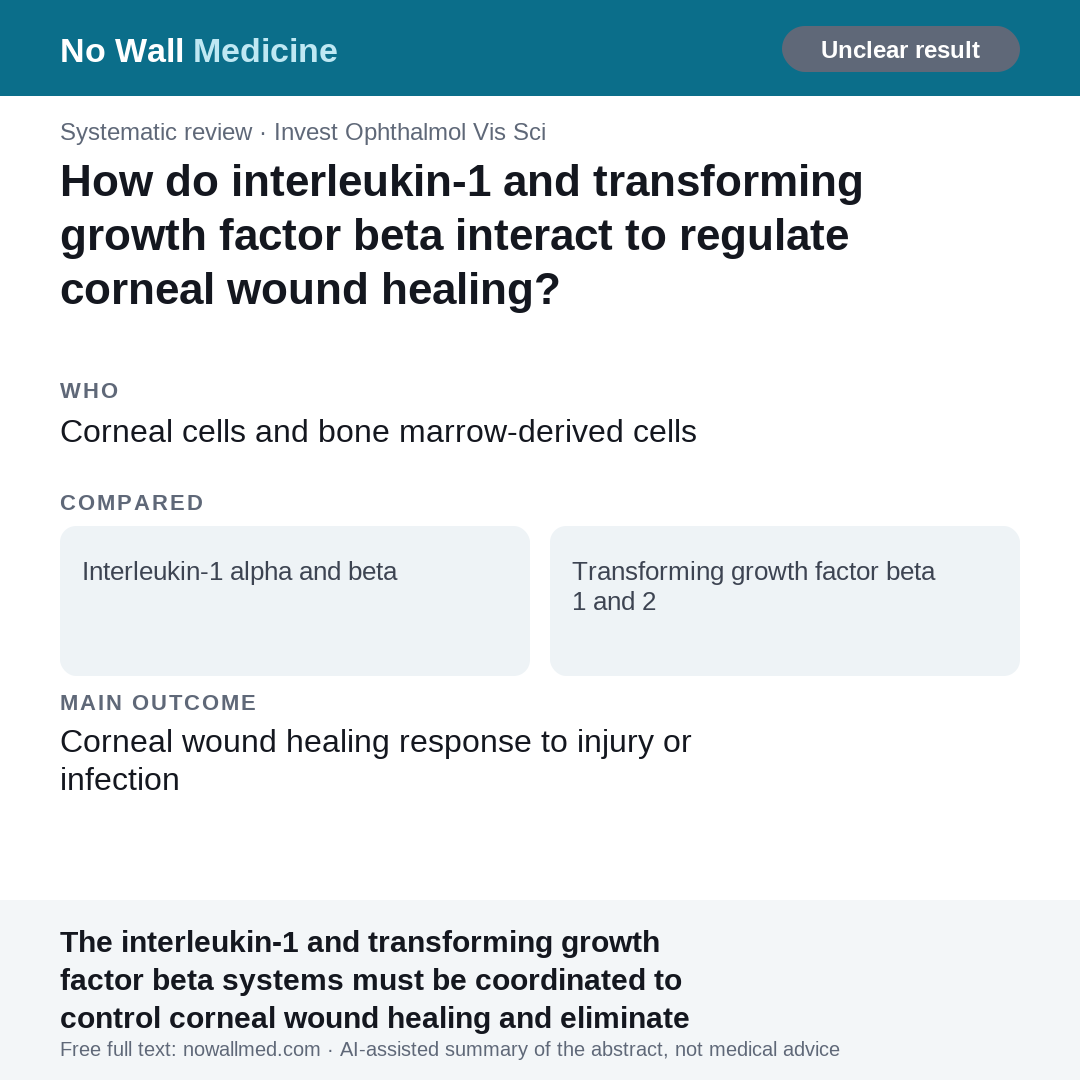
Clinical question: How do interleukin-1 and transforming growth factor beta interact to regulate corneal wound healing?
Why it matters: The specific interactions between interleukin-1 and transforming growth factor beta systems in controlling the corneal wound healing response are not fully understood.
Key points
- This systematic review examined how interleukin-1 and transforming growth factor beta regulate the response of corneal cells to injury or infection.
- Interleukin-1 modulates functions like cell death and growth factor production, while transforming growth factor beta stimulates the development of myofibroblasts.
- The coordinated downregulation of both systems is necessary to end the healing response and prevent scarring from fibrosis.
Headline and key points written with AI from the paper’s abstract, with every number checked against it. Read the paper before relying on them.
Was this summary helpful?
Subject terms
Cite this article
Wilson SE. Interleukin-1 and Transforming Growth Factor Beta: Commonly Opposing, but Sometimes Supporting, Master Regulators of the Corneal Wound Healing Response to Injury. Invest Ophthalmol Vis Sci. 2021. doi:10.1167/iovs.62.4.8
Spotted a mistake? Suggest a correction
Top studies every Monday
The week’s key trials and guidelines in your specialties, plus any topics you follow. By email, free.
Get the weekly digest