Nitroglycerin sublingual powder did not significantly increase walking distance in patients with peripheral artery disease
Intermittent Administration of Nitroglycerin Sublingual Powder Compared with Placebo in Outpatients with Peripheral Artery Disease: Results of a Randomised Proof of Concept Study
Randomised, double blind, placebo controlled, phase IIa studyNo clear difference
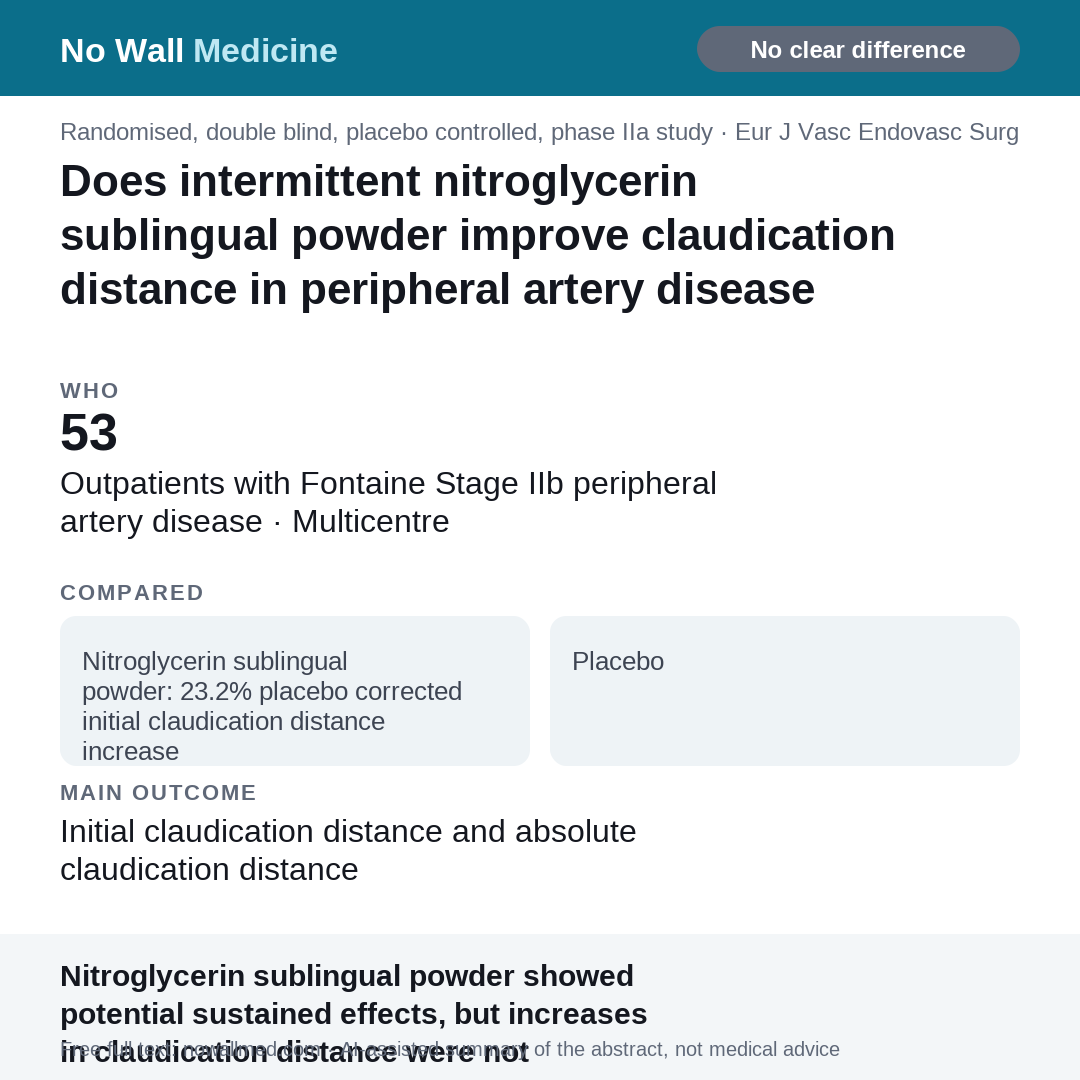
Does intermittent nitroglycerin sublingual powder improve claudication distance in peripheral artery disease patients?
Who
53
Outpatients with Fontaine Stage IIb peripheral artery disease · Multicentre
Compared
Nitroglycerin sublingual powder: 23.2% placebo corrected initial claudication distance increase
Placebo
Main outcome
Initial claudication distance and absolute claudication distance
Bottom line: Nitroglycerin sublingual powder showed potential sustained effects, but increases in claudication distance were not statistically significant.
Limitation: This was a phase IIa proof of concept study.
Eur J Vasc Endovasc Surg · 2020-12-23Download image
Clinical question: Does intermittent nitroglycerin sublingual powder improve claudication distance in peripheral artery disease patients?
Why it matters: Vasoactive substances used to treat peripheral artery disease have limited efficacy and effects that do not last beyond the active treatment period.
Key points
- The study randomized 73 patients with Fontaine Stage IIb peripheral artery disease to receive either nitroglycerin sublingual powder or a placebo.
- Nitroglycerin led to a placebo corrected initial claudication distance increase of 23.2% and an absolute claudication distance increase of 3.6%, but neither result was statistically significant.
- At week 26, after treatment ended, the initial claudication distance increase was 49.3% and the absolute claudication distance increase was 20.6%, but these were also not statistically significant.
Limitation the authors note: This was a phase IIa proof of concept study.
Headline and key points written with AI from the paper’s abstract, with every number checked against it. Read the paper before relying on them.
Was this summary helpful?
Subject terms
Cite this article
Lawall H, Bramlage P, Gorath M, Wittig T. Intermittent Administration of Nitroglycerin Sublingual Powder Compared with Placebo in Outpatients with Peripheral Artery Disease: Results of a Randomised Proof of Concept Study. Eur J Vasc Endovasc Surg. 2020. doi:10.1016/j.ejvs.2020.11.024
Spotted a mistake? Suggest a correction
Top studies every Monday
The week’s key trials and guidelines in your specialties, plus any topics you follow. By email, free.
Get the weekly digest