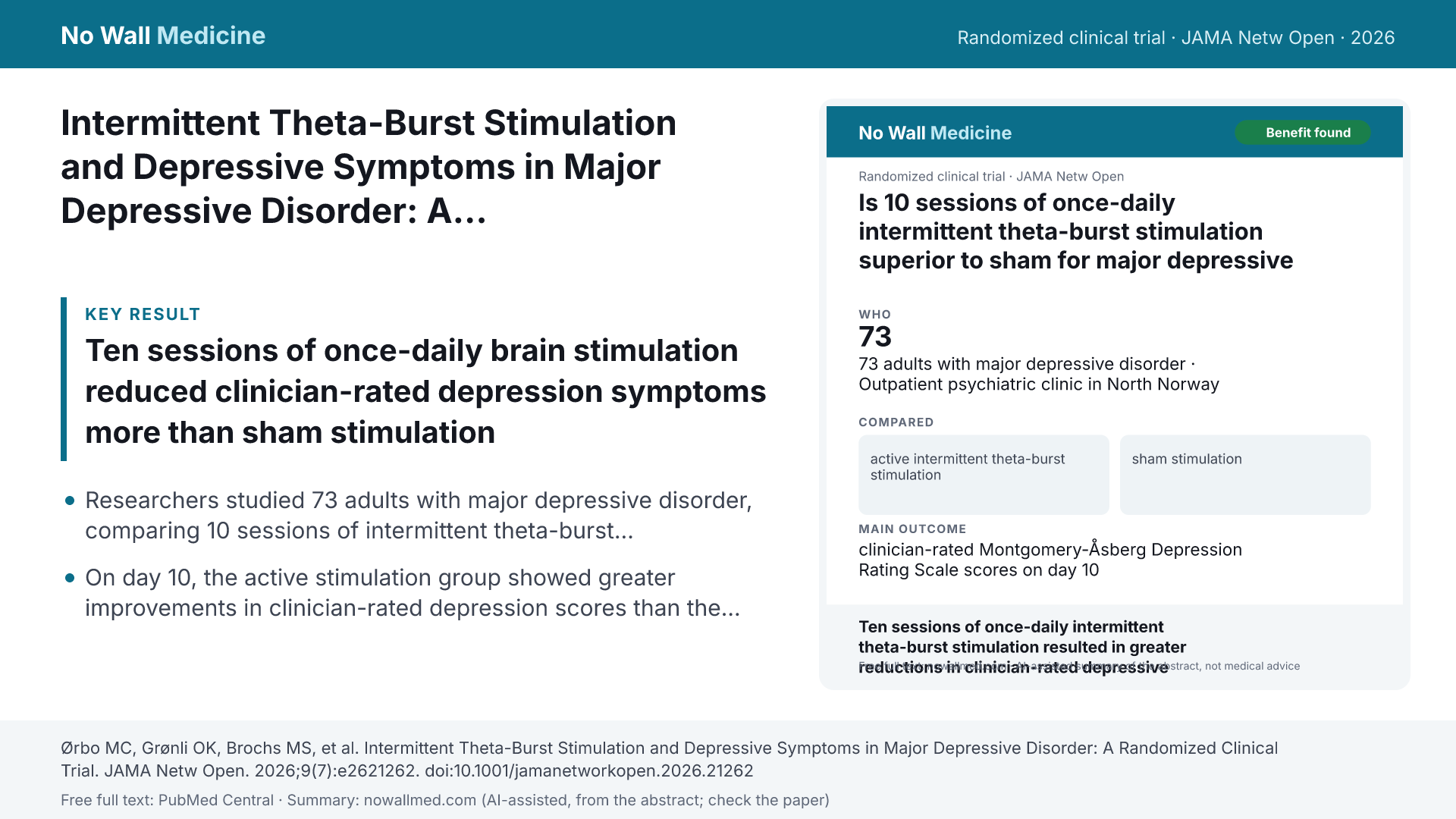
Intermittent Theta-Burst Stimulation and Depressive Symptoms in Major Depressive Disorder: A Randomized Clinical Trial
Key result: Ten sessions of once-daily brain stimulation reduced clinician-rated depression symptoms more than sham stimulation
Key points
- Researchers studied 73 adults with major depressive disorder, comparing 10 sessions of intermittent theta-burst stimulation to a sham treatment.
- On day 10, the active stimulation group showed greater improvements in clinician-rated depression scores than the sham group (mean difference, 3.57).
- The difference between groups was not significant for self-reported depression scores on the Beck Depression Inventory-II or at the 4-week follow-up.
Why it matters: Sham-controlled evidence for once-daily protocols of intermittent theta-burst stimulation remains limited for treating major depressive disorder.
Discussion prompts
- Would these patients look like yours? Who was left out?
- Is the main outcome one that matters to patients?
- Is the difference large enough to change what you do?
Cite: Ørbo MC, Grønli OK, Brochs MS, et al. Intermittent Theta-Burst Stimulation and Depressive Symptoms in Major Depressive Disorder: A Randomized Clinical Trial. JAMA Netw Open. 2026;9(7):e2621262. doi:10.1001/jamanetworkopen.2026.21262
Free full text: PubMed Central · Summary and visual abstract: nowallmed.com/a/intermittent-theta-burst-stimulation-and-depressive-symptoms-in-major-1aat5wn/ (AI-assisted from the abstract; check the paper before relying on it).