Ultra-brief brain stimulation works as well as standard therapy for depression in Parkinson disease
Intermittent Theta-Burst Stimulation for Depressive Symptoms in Parkinson Disease: A Randomized Clinical Trial
Triple-arm, randomized, sham-controlled clinical trialBenefit found
Is ultra-brief intermittent theta-burst stimulation effective for depressive symptoms in Parkinson disease?
Who
54
Patients with Parkinson disease aged 50 to 80 years with depression · Single-center, China
Compared
Intermittent theta-burst stimulation: HAMD-24 score mean difference: -4.97 [95% CI, -7.71 to -2.23]
High-frequency repetitive transcranial magnetic stimulation: HAMD-24 score mean difference: -5.73 [95% CI, -8.95 to -2.51]
Sham stimulation
Main outcome
24-item Hamilton Depression Rating Scale score at week 2
Result: iTBS vs sham HAMD-24 mean difference: -4.97 (95% CI -7.71 to -2.23)
Bottom line: Ultra-brief intermittent theta-burst stimulation is as effective as high-frequency repetitive transcranial magnetic stimulation for Parkinson disease depression.
JAMA Netw Open · 2026-05-01Download image
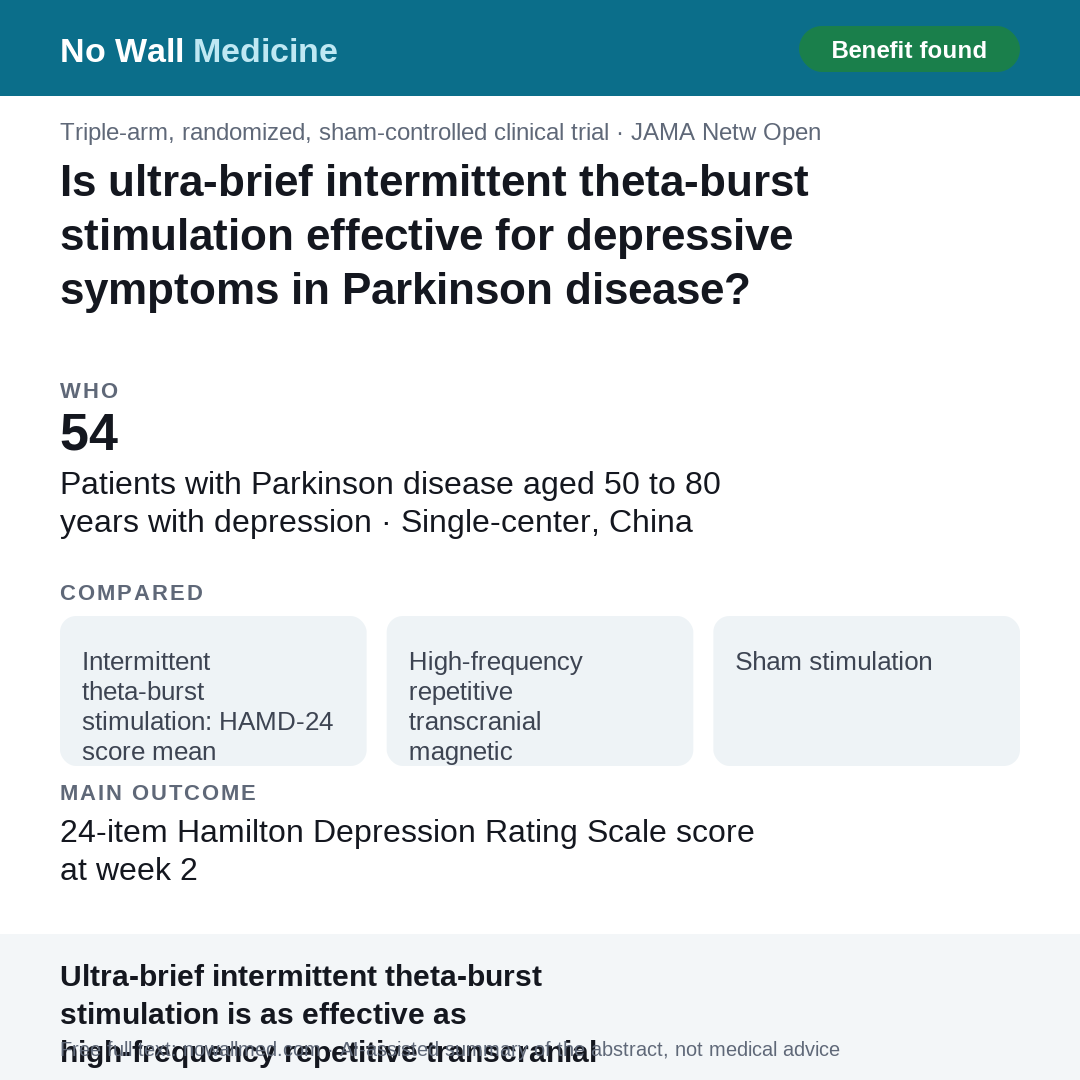
Clinical question: Is ultra-brief intermittent theta-burst stimulation effective for depressive symptoms in Parkinson disease?
Why it matters: Standard high-frequency repetitive transcranial magnetic stimulation for depression is effective but time intensive, which limits its practicality for patients.
Key points
- Researchers studied 54 patients with Parkinson disease and depression, comparing ultra-brief intermittent theta-burst stimulation, standard high-frequency repetitive transcranial magnetic stimulation, and a sham treatment.
- At week 2, both active brain stimulation methods significantly reduced depression scores compared to sham, with the ultra-brief method showing a mean difference of -4.97.
- The antidepressant effects of both active treatments remained significant at week 6 and both improved quality of life scores at week 2.
Headline and key points written with AI from the paper’s abstract, with every number checked against it. Read the paper before relying on them.
Topics
Cite this article
Hou M, Tian B, Qi C, Song L, Ma B, Chen X. Intermittent Theta-Burst Stimulation for Depressive Symptoms in Parkinson Disease: A Randomized Clinical Trial. JAMA Netw Open. 2026. doi:10.1001/jamanetworkopen.2026.13580
Spotted a mistake? Suggest a correction