Internet-based interventions show mixed results for reproductive health outcomes in women planning pregnancy
Internet-Based Interventions for Preventing Premature Birth in Preconceptional Women of Childbearing Age: Systematic Review
Systematic review of randomized controlled trials and quasi-experimental studiesMixed results
Are internet-based interventions effective for preventing premature birth in preconceptional women?
Who
Preconceptional women of childbearing age · Primarily high-income countries
Compared
Internet-based interventions
Control
Main outcome
Premature birth and reproductive health outcomes
Bottom line: Internet-based interventions showed mixed effectiveness, improving reproductive health knowledge but showing limited success in altering behaviors.
Limitation: Small number of studies and prevalent high risk of bias.
J Med Internet Res · 2025-06-03Download image
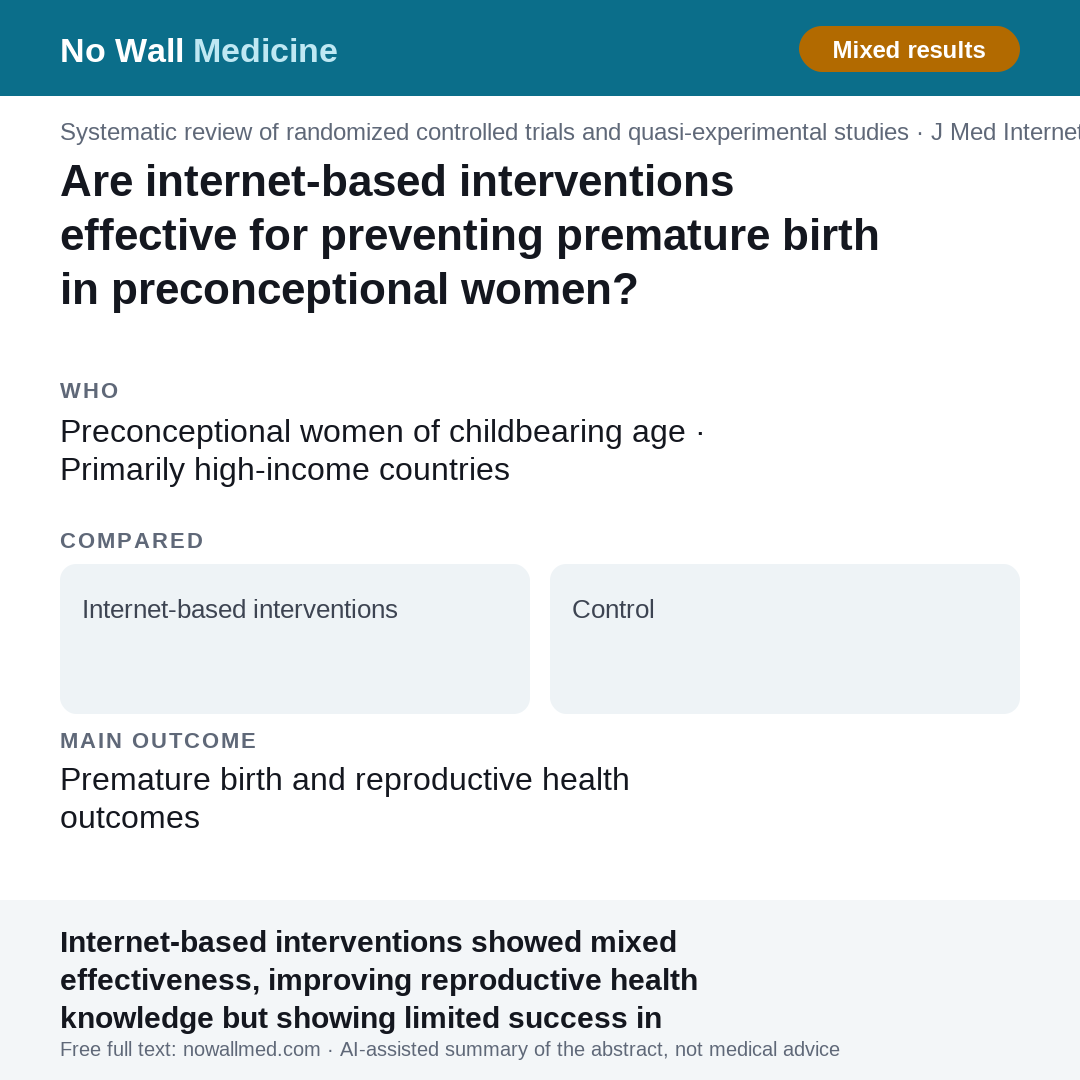
Clinical question: Are internet-based interventions effective for preventing premature birth in preconceptional women?
Why it matters: The effectiveness of scalable internet-based solutions for preventing premature birth through preconception care remains underexplored.
Key points
- Researchers reviewed 9 studies involving randomized controlled trials and quasi-experimental studies on internet-based interventions for women of childbearing age.
- Interventions improved reproductive health knowledge in 3/9 (33%) studies but showed no consistent impact on self-efficacy in 2/3 (67%) studies.
- Behavioral outcomes like folic acid use were inconsistent, with significant effects in 2/9 (22%) short-term studies but not in 2/4 (50%) long-term studies.
Limitation the authors note: The review was limited by a small number of studies and a high risk of bias in 6/9 (67%) of the included studies.
Headline and key points written with AI from the paper’s abstract, with every number checked against it. Read the paper before relying on them.
Topics
Cite this article
Kim SH, Jung SY, Park JH, De Gagne JC. Internet-Based Interventions for Preventing Premature Birth in Preconceptional Women of Childbearing Age: Systematic Review. J Med Internet Res. 2025. doi:10.2196/60690
Spotted a mistake? Suggest a correction