Internet-delivered cognitive-behavioural therapy is being tested for anxiety related to asthma
Internet-delivered cognitive-behaviour therapy for anxiety related to asthma: study protocol for a randomised controlled trial
Randomised controlled trial protocolUnclear result
Is internet-delivered cognitive-behavioural therapy more effective than usual care for asthma-related anxiety?
Who
90
Participants with asthma and anxiety
Compared
Internet-delivered cognitive-behavioural therapy
Treatment as usual plus medical education
Main outcome
Catastrophising Asthma Scale
Bottom line: This study protocol aims to investigate if internet-delivered cognitive-behavioural therapy improves anxiety and asthma control.
BMJ Open Respir Res · 2024-05-27Download image
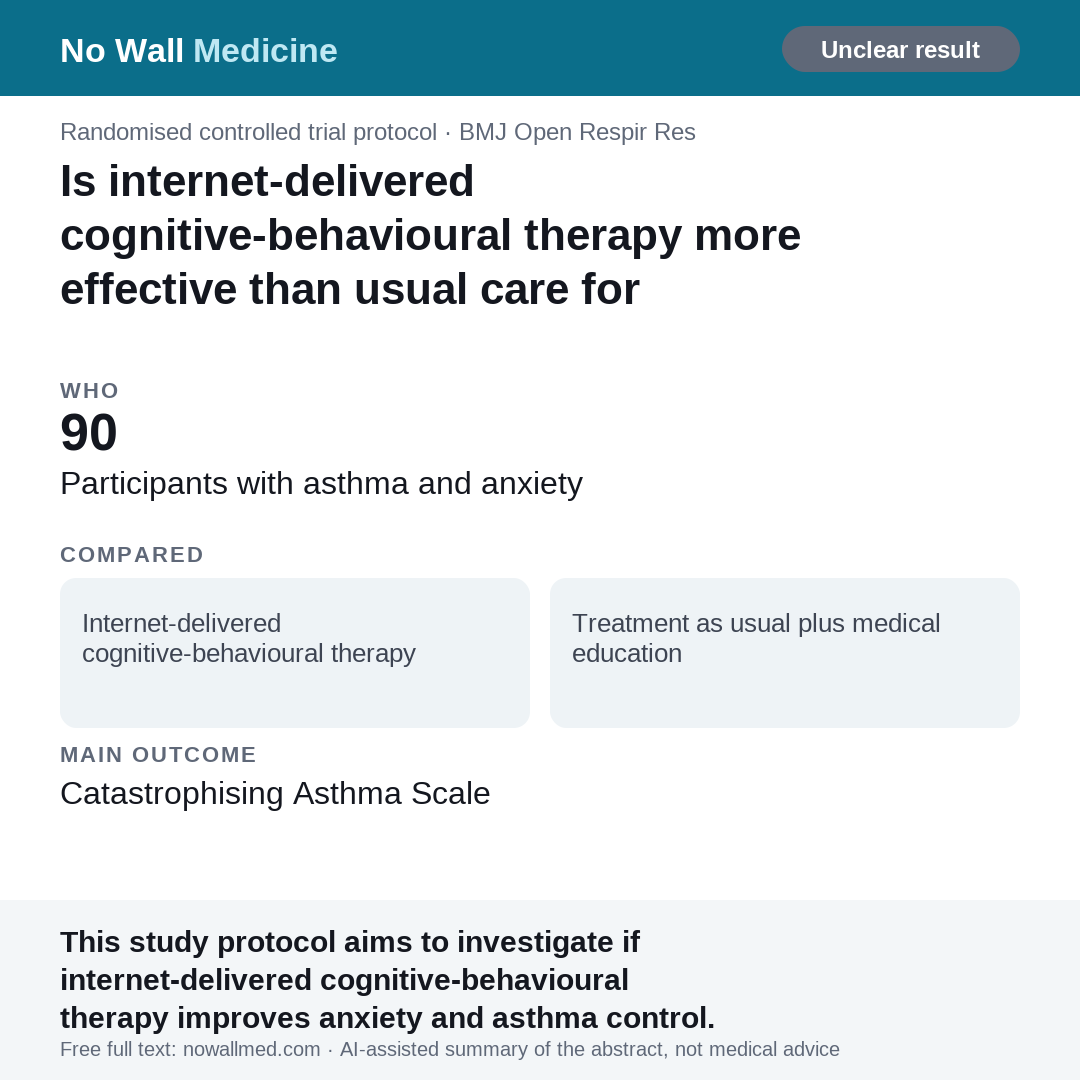
Clinical question: Is internet-delivered cognitive-behavioural therapy more effective than usual care for asthma-related anxiety?
Why it matters: Evidence is currently weak for treatments targeting anxiety related to asthma, and results for cognitive-behavioural therapy have been mixed.
Key points
- The study will involve 90 participants randomized 1:1 to receive either 8 weeks of internet-delivered cognitive-behavioural therapy or treatment as usual plus medical education.
- Researchers will measure the primary outcome using the patient-reported Catastrophising Asthma Scale from baseline to 16 weeks.
- Secondary outcomes to be measured include asthma control, quality of life, and forced expiratory volume in 1 second, which is the amount of air exhaled in one second.
Headline and key points written with AI from the paper’s abstract, with every number checked against it. Read the paper before relying on them.
Was this summary helpful?

Abstract
Introduction
There is an established association between asthma and anxiety. The overlap between asthma symptoms and symptoms of anxiety may cause individuals to overestimate their asthma severity and restrict their daily activities leading to a low quality of life. There is currently weak evidence for treatments targeting anxiety related to asthma, but cognitive-behavioural therapy (CBT) has shown some promising but mixed results. The current randomised controlled trial will investigate if exposure-based internet-delivered CBT (Internet-CBT) is more effective than treatment as usual+medical education (TAU+ME) to relieve symptoms of anxiety and asthma control. Methods and analysis
90 participants will be randomised 1:1 to 8 weeks of Internet-CBT or TAU+ME. The primary outcome, the patient-reported Catastrophising Asthma Scale, will be analysed from baseline to the primary endpoint at 16 weeks using hierarchical linear mixed model of the slope over time. Secondary outcomes, such as asthma control, quality of life and forced expiratory volume in 1 s, will be analysed correspondingly. Ethics and dissemination
All participants will be informed about the study and leave their consent before study entry. All results will be analysed at group level and reported through publication in a peer-reviewed scientific journal within the field. The study received ethical approval by the Swedish Ethical Review Authority in January 2020 (ID: 2019-05985; 2022-01117-02). Trial registration number
Registered at ClinicalTrials.gov (ID: NCT04230369).
Abstract reproduced under the article’s CC BY licence.
Subject terms
Cite this article
Bonnert M, Nash S, Andersson EM, Bergström SE, Janson C, Almqvist C. Internet-delivered cognitive-behaviour therapy for anxiety related to asthma: study protocol for a randomised controlled trial. BMJ Open Respir Res. 2024. doi:10.1136/bmjresp-2023-002035
Spotted a mistake? Suggest a correction