Finerenone effects on heart failure outcomes were similar across different potassium and kidney function levels
Interplay of serum potassium and kidney function with finerenone in heart failure with mildly reduced or preserved ejection fraction: Findings from FINEARTS-HF
Randomized trialBenefit found
Does finerenone efficacy and safety vary by serum potassium and kidney function in heart failure?
Who
6001
Patients with heart failure and mildly reduced or preserved ejection fraction
Compared
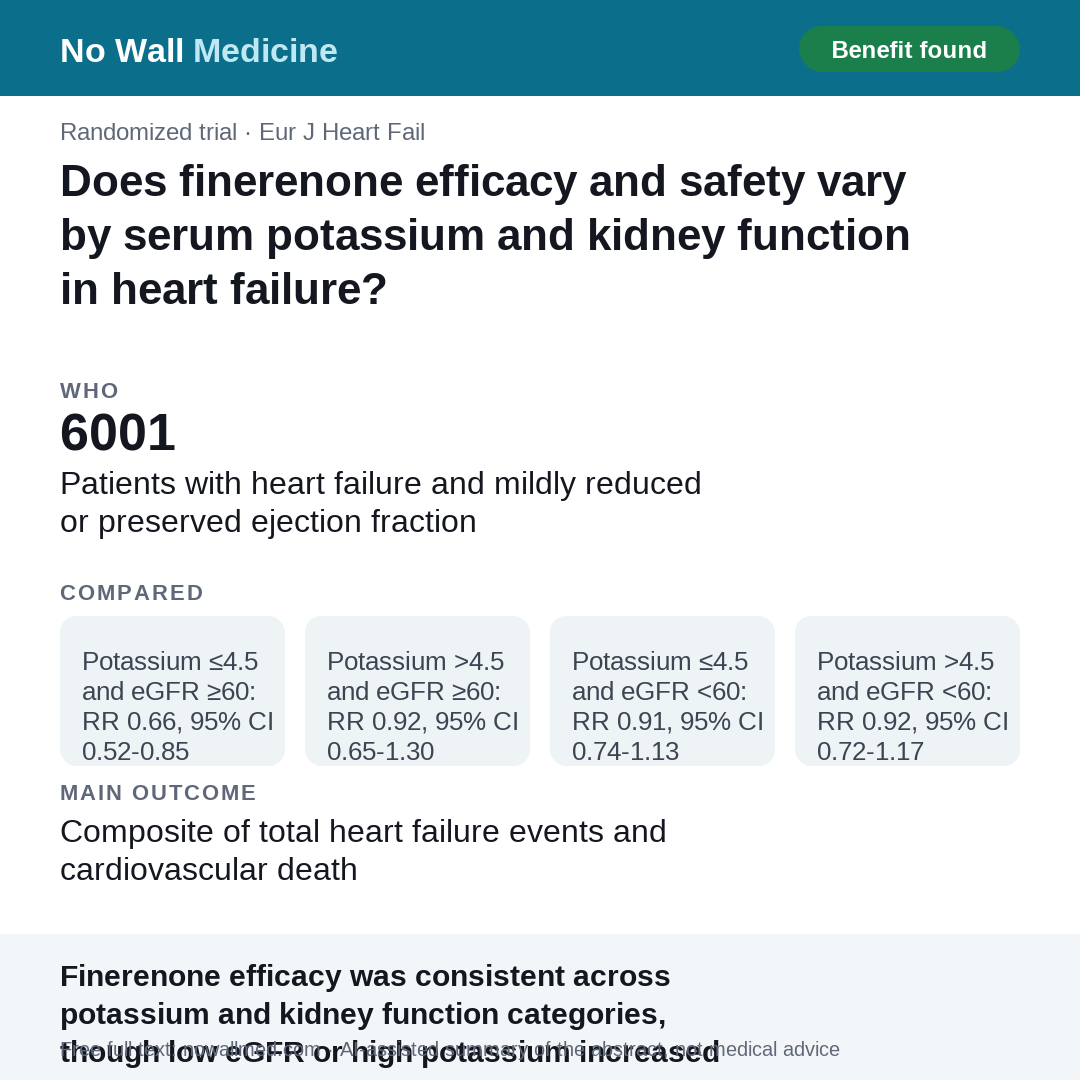
Potassium ≤4.5 and eGFR ≥60: RR 0.66, 95% CI 0.52-0.85
Potassium >4.5 and eGFR ≥60: RR 0.92, 95% CI 0.65-1.30
Potassium ≤4.5 and eGFR <60: RR 0.91, 95% CI 0.74-1.13
Potassium >4.5 and eGFR <60: RR 0.92, 95% CI 0.72-1.17
Main outcome
Composite of total heart failure events and cardiovascular death
Result: p for interaction = 0.20
Bottom line: Finerenone efficacy was consistent across potassium and kidney function categories, though low eGFR or high potassium increased adverse events.
Eur J Heart Fail · 2025-10-02Download image
Clinical question: Does finerenone efficacy and safety vary by serum potassium and kidney function in heart failure?
Why it matters: Clinical decisions for starting mineralocorticoid receptor antagonists often depend on kidney function and potassium levels, but how these factors influence finerenone efficacy and safety is not fully understood.
Key points
- Researchers studied 6001 patients with heart failure and mildly reduced or preserved ejection fraction over a median of 32 months.
- Finerenone showed no significant difference in the primary outcome of heart failure events and cardiovascular death across different serum potassium and estimated glomerular filtration rate categories.
- Patients with low kidney function or high potassium levels experienced more frequent adverse events and treatment discontinuation.
Headline and key points written with AI from the paper’s abstract, with every number checked against it. Read the paper before relying on them.
Was this summary helpful?
Subject terms
Cite this article
Ferreira JP, Vaduganathan M, Claggett BL, Kulac I, Ostrominski JW, Desai AS. Interplay of serum potassium and kidney function with finerenone in heart failure with mildly reduced or preserved ejection fraction: Findings from FINEARTS-HF. Eur J Heart Fail. 2025. doi:10.1002/ejhf.70052
Spotted a mistake? Suggest a correction
Top studies every Monday
The week’s key trials and guidelines in your specialties, plus any topics you follow. By email, free.
Get the weekly digest