Deep learning model predicts molecular subtypes of endometrial cancer from standard tissue slides
Interpretable deep learning model to predict the molecular classification of endometrial cancer from haematoxylin and eosin-stained whole-slide images: a combined analysis of the PORTEC randomised trials and clinical cohorts
Combined analysis of randomised trials and clinical cohortsBenefit found
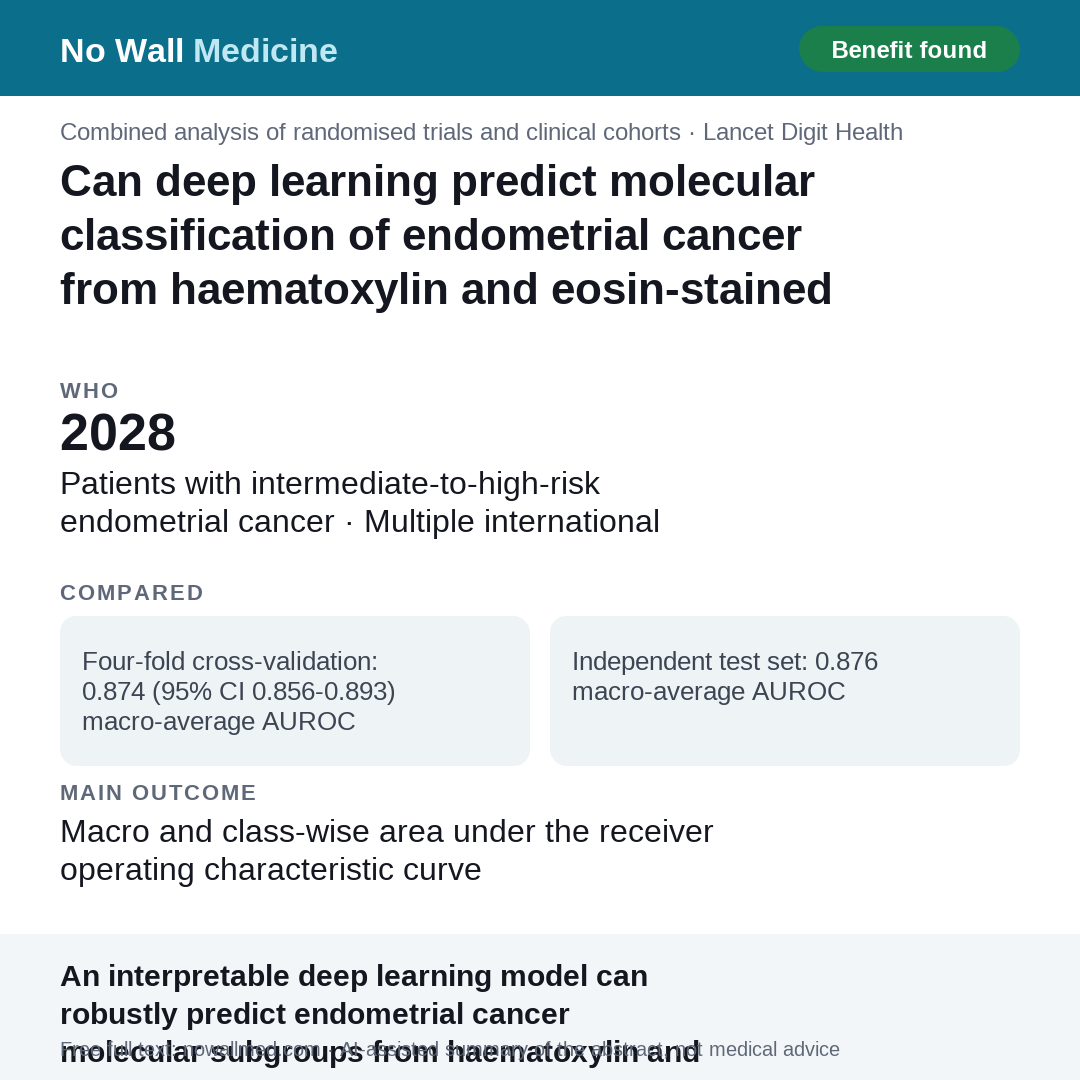
Can deep learning predict molecular classification of endometrial cancer from haematoxylin and eosin-stained images?
Who
2028
Patients with intermediate-to-high-risk endometrial cancer · Multiple international cohorts and randomised trials
Compared
Four-fold cross-validation: 0.874 (95% CI 0.856-0.893) macro-average AUROC
Independent test set: 0.876 macro-average AUROC
Main outcome
Macro and class-wise area under the receiver operating characteristic curve
Result: macro-average AUROC 0.874 (95% CI 0.856-0.893)
Bottom line: An interpretable deep learning model can robustly predict endometrial cancer molecular subgroups from haematoxylin and eosin-stained whole-slide images.
Funded by: Hanarth Foundation, Promedica Foundation, and Swiss Federal Institutes of Technology
Lancet Digit Health · 2022-12-07Download image
Clinical question: Can deep learning predict molecular classification of endometrial cancer from haematoxylin and eosin-stained images?
Why it matters: It is unknown if deep learning can accurately predict the four molecular subgroups of endometrial cancer using only standard stained tissue slides.
Key points
- Researchers analyzed 2028 patients with intermediate-to-high-risk endometrial cancer using a deep learning pipeline called im4MEC on standard haematoxylin and eosin-stained slides.
- The model achieved a macro-average area under the receiver operating characteristic curve of 0.874 during cross-validation and 0.876 on an independent test set.
- Class-wise performance included an area under the receiver operating characteristic curve of 0.849 for POLEmut, 0.844 for mismatch repair deficient, 0.883 for no specific molecular profile, and 0.928 for p53 abnormal.
Headline and key points written with AI from the paper’s abstract, with every number checked against it. Read the paper before relying on them.
Was this summary helpful?
Abstract
Background
Endometrial cancer can be molecularly classified into POLEmut, mismatch repair deficient (MMRd), p53 abnormal (p53abn), and no specific molecular profile (NSMP) subgroups. We aimed to develop an interpretable deep learning pipeline for whole-slide-image-based prediction of the four molecular classes in endometrial cancer (im4MEC), to identify morpho-molecular correlates, and to refine prognostication. Methods
This combined analysis included diagnostic haematoxylin and eosin-stained slides and molecular and clinicopathological data from 2028 patients with intermediate-to-high-risk endometrial cancer from the PORTEC-1 (n=466), PORTEC-2 (n=375), and PORTEC-3 (n=393) randomised trials and the TransPORTEC pilot study (n=110), the Medisch Spectrum Twente cohort (n=242), a case series of patients with POLEmut endometrial cancer in the Leiden Endometrial Cancer Repository (n=47), and The Cancer Genome Atlas-Uterine Corpus Endometrial Carcinoma cohort (n=395). PORTEC-3 was held out as an independent test set and a four-fold cross validation was performed. Performance was measured with the macro and class-wise area under the receiver operating characteristic curve (AUROC). Whole-slide images were segmented into tiles of 360 μm resized to 224 × 224 pixels. im4MEC was trained to learn tile-level morphological features with self-supervised learning and to molecularly classify whole-slide images with an attention mechanism. The top 20 tiles with the highest attention scores were reviewed to identify morpho-molecular correlates. Predictions of a nuclear classification deep learning model serve to derive interpretable morphological features. We analysed 5-year recurrence-free survival and explored prognostic refinement by molecular class using the Kaplan-Meier method. Findings
im4MEC attained macro-average AUROCs of 0·874 (95% CI 0·856-0·893) on four-fold cross-validation and 0·876 on the independent test set. The class-wise AUROCs were 0·849 for POLEmut (n=51), 0·844 for MMRd (n=134), 0·883 for NSMP (n=120), and 0·928 for p53abn (n=88). POLEmut and MMRd tiles had a high density of lymphocytes, p53abn tiles had strong nuclear atypia, and the morphology of POLEmut and MMRd endometrial cancer overlapped. im4MEC highlighted a low tumour-to-stroma ratio as a potentially novel characteristic feature of the NSMP class. 5-year recurrence-free survival was significantly different between im4MEC predicted molecular classes in PORTEC-3 (log-rank p<0·0001). The ten patients with aggressive p53abn endometrial cancer that was predicted as MMRd showed inflammatory morphology and appeared to have a better prognosis than patients with correctly predicted p53abn endometrial cancer (p=0·30). The four patients with NSMP endometrial cancer that was predicted as p53abn showed higher nuclear atypia and appeared to have a worse prognosis than patients with correctly predicted NSMP (p=0·13). Patients with MMRd endometrial cancer predicted as POLEmut had an excellent prognosis, as do those with true POLEmut endometrial cancer. Interpretation
We present the first interpretable deep learning model, im4MEC, for haematoxylin and eosin-based prediction of molecular endometrial cancer classification. im4MEC robustly identified morpho-molecular correlates and could enable further prognostic refinement of patients with endometrial cancer. Funding
The Hanarth Foundation, the Promedica Foundation, and the Swiss Federal Institutes of Technology.
Abstract reproduced under the article’s CC BY licence.
Subject terms
Cite this article
Fremond S, Andani S, Barkey Wolf J, Dijkstra J, Melsbach S, Jobsen JJ. Interpretable deep learning model to predict the molecular classification of endometrial cancer from haematoxylin and eosin-stained whole-slide images: a combined analysis of the PORTEC randomised trials and clinical cohorts. Lancet Digit Health. 2022. doi:10.1016/S2589-7500(22)00210-2
Spotted a mistake? Suggest a correction
Top studies every Monday
The week’s key trials and guidelines in your specialties, plus any topics you follow. By email, free.
Get the weekly digest