Intervention Stage Completion and Behavioral Health Outcomes: An Integrated Behavioral Health and Primary Care Randomized Pragmatic Trial
Pragmatic, cluster randomized controlled trialMixed results
Does completing intervention stages improve behavioral health outcomes and primary care integration?
Who
2945
Patients with multiple chronic medical and behavioral health conditions · Forty-two primary care practices across the United States
Compared
Intervention stages completed: No differences in patient health outcomes
Practice Integration Profile: total integration 2.7 (95% CI, 0.7 to 4.7)
Main outcome
Patient health and primary care integration outcomes
Bottom line: The intervention improved primary care integration but did not change patient health outcomes.
Limitation: Future research is needed to determine how to best target patient health outcomes.
Ann Fam Med · 2025-01-27Download image
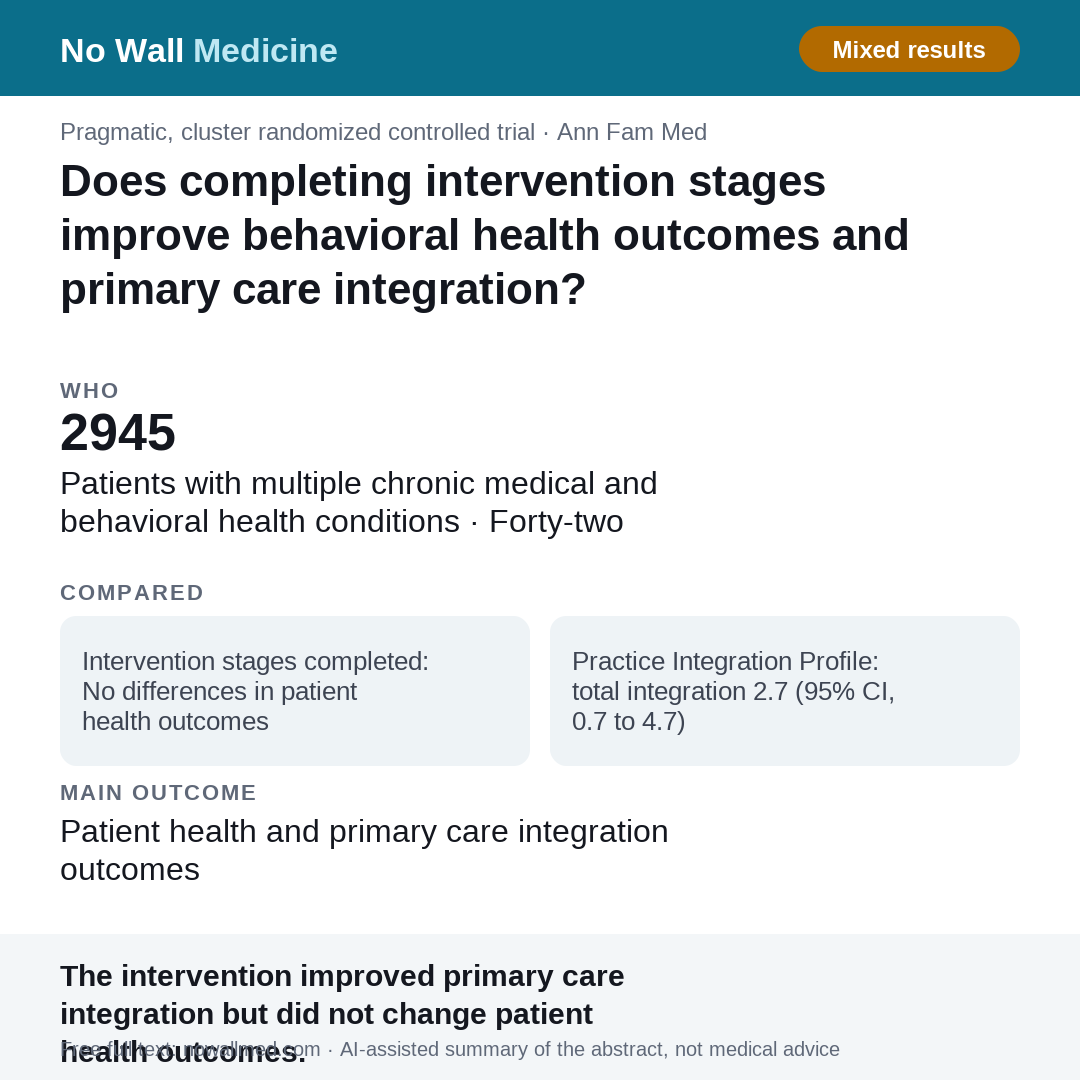
Clinical question: Does completing intervention stages improve behavioral health outcomes and primary care integration?
Abstract
Purpose
We performed a pragmatic, cluster randomized controlled trial of a comprehensive practice-level, multistage practice transformation intervention aiming to increase behavioral health integration in primary care practices and improve patient outcomes. We examined associations between completion of intervention stages and patient outcomes across a heterogeneous national sample of primary care practices. Methods
Forty-two primary care practices across the United States with colocated behavioral health and 2,945 patients with multiple chronic medical and behavioral health conditions completed surveys at baseline, midpoint, and 2-year follow-up. We examined effects of intervention on patient health and primary care integration outcomes using multilevel mixed-effects models, controlling for baseline outcome measurements. Results
No differences were found associated with the number of intervention stages completed and patient health outcomes including depression, anxiety, fatigue, sleep disturbance, pain, pain interference, social participation, and physical function. However, the completion of each intervention stage was associated with increases in Practice Integration Profile domain scores and confirmed with modeling using multiple imputation for the following: workflow 3.5 (95% CI, 0.9 to 6.1), integration methods 4.6 (95% CI, 1.5 to 7.6), patient identification 2.9 (95% CI, 0.9 to 5.0), and total integration 2.7 (95% CI, 0.7 to 4.7). Conclusion
A practice-centric flexible practice transformation intervention improved integration of behavioral health in primary care across heterogeneous primary care practices treating patients with multiple chronic conditions when accounting for completion of intervention stages. Interventions that allow practices to flexibly improve care have the potential to help complex patient populations. Future research is needed to determine how to best target patient health outcomes at the population level.
Subject terms
Cite this article
Stephens KA, van Eeghen C, Zheng Z, Anastas T, Ma KPK, Prado MG. Intervention Stage Completion and Behavioral Health Outcomes: An Integrated Behavioral Health and Primary Care Randomized Pragmatic Trial. Ann Fam Med. 2025. doi:10.1370/afm.230576
Spotted a mistake? Suggest a correction
Top studies every Monday
The week’s key trials and guidelines in your specialties, plus any topics you follow. By email, free.
Get the weekly digest