Cyanoacrylate closure showed lower anatomical failure rates compared to laser or radiofrequency ablation
Interventions for great saphenous vein reflux: network meta-analysis of randomized clinical trials
Network meta-analysis of randomized clinical trialsMixed results
What are the best interventions for great saphenous vein reflux?
Who
72
Patients with great saphenous vein reflux
Compared
Endothermal techniques
Open surgery
Mechanochemical ablation
Radiofrequency ablation
Main outcome
Anatomical failure rates and clinical recurrence
Result: risk ratio 1.87 (95 per cent c.i. 1.14 to 3.07)
Bottom line: Cyanoacrylate closure ranked best for anatomical failure, while mechanochemical ablation and foam sclerotherapy performed poorly.
Br J Surg · 2021-04-02Download image
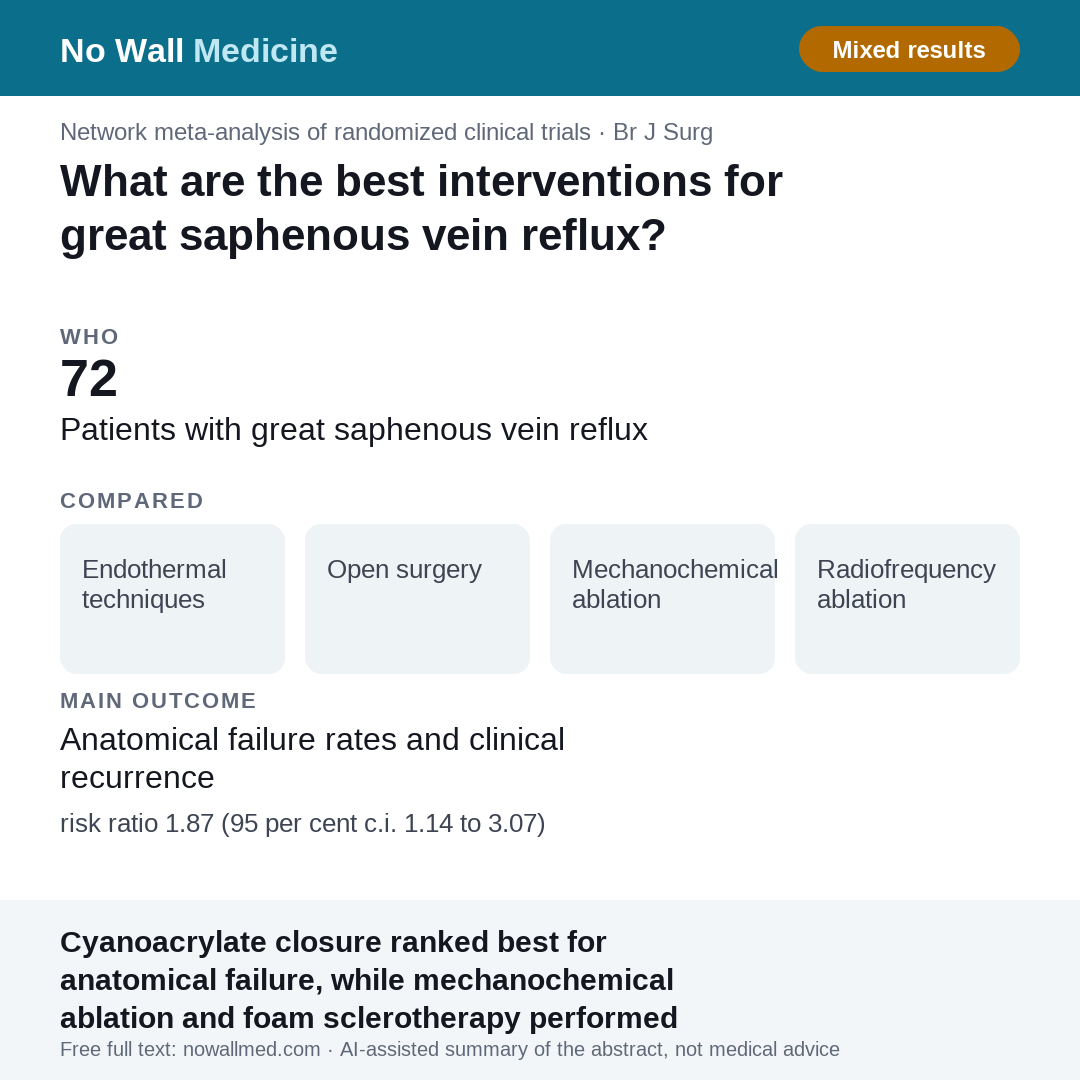
Clinical question: What are the best interventions for great saphenous vein reflux?
Why it matters: Comparisons of treatment outcomes for great saphenous vein reflux have been inconsistent across different medical interventions.
Key points
- Researchers analyzed 72 randomized clinical trials comparing different treatments for great saphenous vein reflux, which is a condition where blood flows backward in a large leg vein.
- Cyanoacrylate closure had a risk ratio of 0.56 (0.34 to 0.93) for anatomical failure compared to radiofrequency ablation or endovenous laser ablation at the early term.
- Endovenous laser ablation was associated with higher long-term anatomical failure rates with a pooled risk ratio of 1.87 (1.14 to 3.07) compared to open surgery.
Headline and key points written with AI from the paper’s abstract, with every number checked against it. Read the paper before relying on them.
Was this summary helpful?
Subject terms
Cite this article
Siribumrungwong B, Wilasrusmee C, Orrapin S, Srikuea K, Benyakorn T, McKay G. Interventions for great saphenous vein reflux: network meta-analysis of randomized clinical trials. Br J Surg. 2021. doi:10.1093/bjs/znaa101
Spotted a mistake? Suggest a correction
Top studies every Monday
The week’s key trials and guidelines in your specialties, plus any topics you follow. By email, free.
Get the weekly digest