Interventions for sustainable surgery: a systematic review
Systematic reviewBenefit found
What interventions improve the environmental and financial sustainability of surgical practice?
Who
Interventions across the operative pathway
Compared
Reusable devices: 40-66% lower emissions
Single-use alternatives
Main outcome
Environmental and financial impact of surgical interventions
Bottom line: Reusable equipment can reduce emissions by 40-66% and costs to 47-83% of single-use equivalents.
Limitation: Emissions and cost data are limited, with longitudinal impacts rarely investigated.
Int J Surg · 2023-05-01Download image
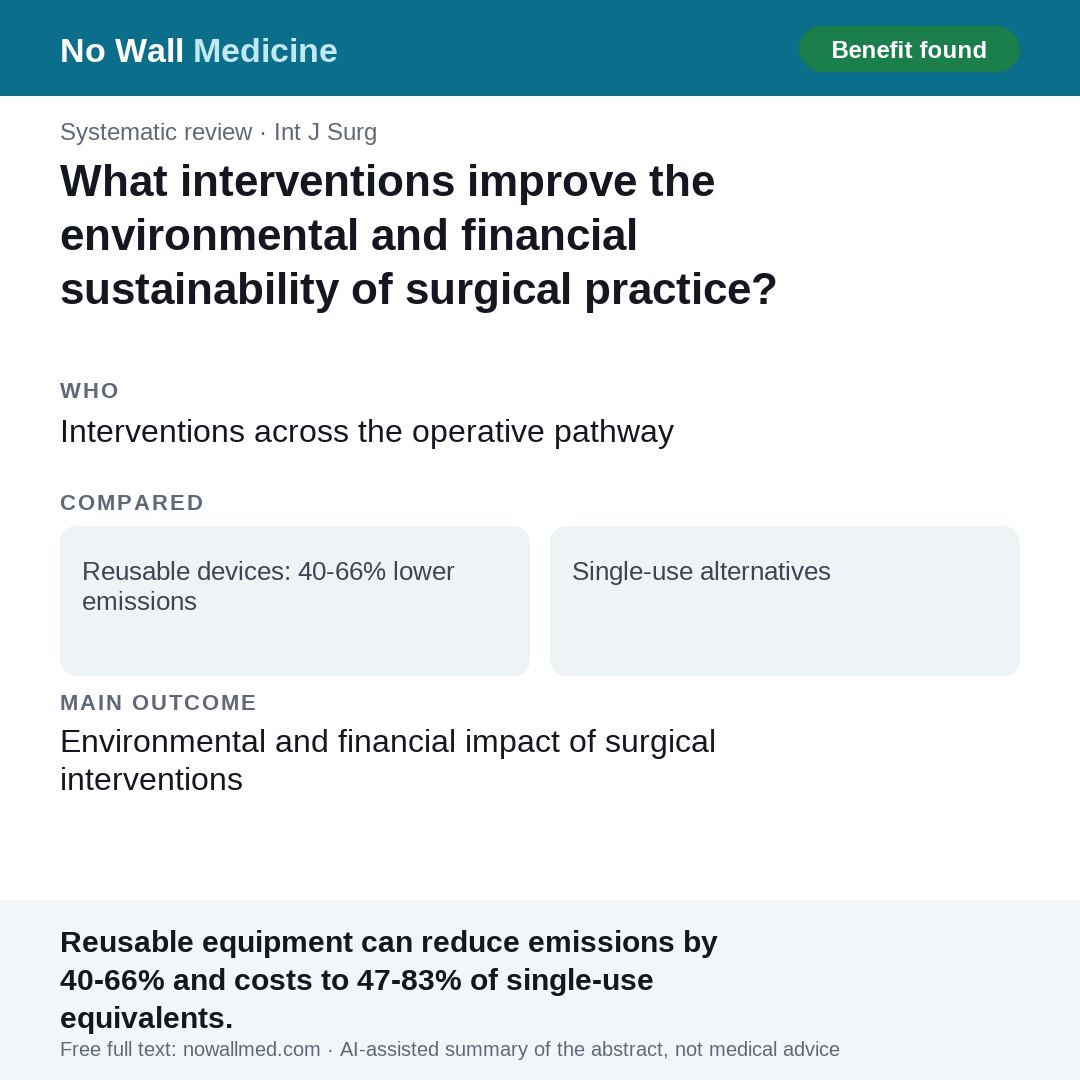
Clinical question: What interventions improve the environmental and financial sustainability of surgical practice?
Abstract
Objective
To systematically evaluate interventions designed to improve the sustainability of surgical practice with respect to their environmental and financial impact. Background
Surgery contributes significantly to emissions attributed to healthcare due to its high resource and energy use. Several interventions across the operative pathway have, therefore, been trialed to minimize this impact. Few comparisons of the environmental and financial effects of these interventions exist. Materials and methods
A search of studies published up to 2nd February 2022 describing interventions to increase surgical sustainability was undertaken. Articles regarding the environmental impact of only anesthetic agents were excluded. Data regarding environmental and financial outcomes were extracted with a quality assessment completed dependent upon the study design. Results
In all, 1162 articles were retrieved, of which 21 studies met inclusion criteria. Twenty-five interventions were described, which were categorized into five domains: 'reduce and rationalize', 'reusable equipment and textiles', 'recycling and waste segregation', 'anesthetic alternatives', and 'other'. Eleven of the 21 studies examined reusable devices; those demonstrating a benefit reported 40-66% lower emissions than with single-use alternatives. In studies not showing a lower carbon footprint, the reduction in manufacturing emissions was offset by the high environmental impact of local fossil fuel-based energy required for sterilization. The per use monetary cost of reusable equipment was 47-83% of the single-use equivalent. Conclusions
A narrow repertoire of interventions to improve the environmental sustainability of surgery has been trialed. The majority focuses on reusable equipment. Emissions and cost data are limited, with longitudinal impacts rarely investigated. Real-world appraisals will facilitate implementation, as will an understanding of how sustainability impacts surgical decision-making.
Subject terms
Cite this article
Lam K, Gadi N, Acharya A, Winter Beatty J, Darzi A, Purkayastha S. Interventions for sustainable surgery: a systematic review. Int J Surg. 2023. doi:10.1097/JS9.0000000000000359
Spotted a mistake? Suggest a correction
Top studies every Monday
The week’s key trials and guidelines in your specialties, plus any topics you follow. By email, free.
Get the weekly digest