Common components identified in interventions targeting intimate partner violence and violence against children
Interventions that prevent or respond to intimate partner violence against women and violence against children: a systematic review
Systematic reviewBenefit found
What interventions prevent or respond to intimate partner violence and violence against children?
Who
Parents, caregivers, women, and children · 16 countries
Compared
Primary prevention interventions
Therapeutic programmes
Main outcome
Reduction in intimate partner violence and violence against children
Bottom line: Coordinated prevention and response programmes can effectively address intimate partner violence and violence against children.
Limitation: Response interventions for both are rare and feasibility in low-income countries is uncertain.
Lancet Public Health · 2024-05-04Download image
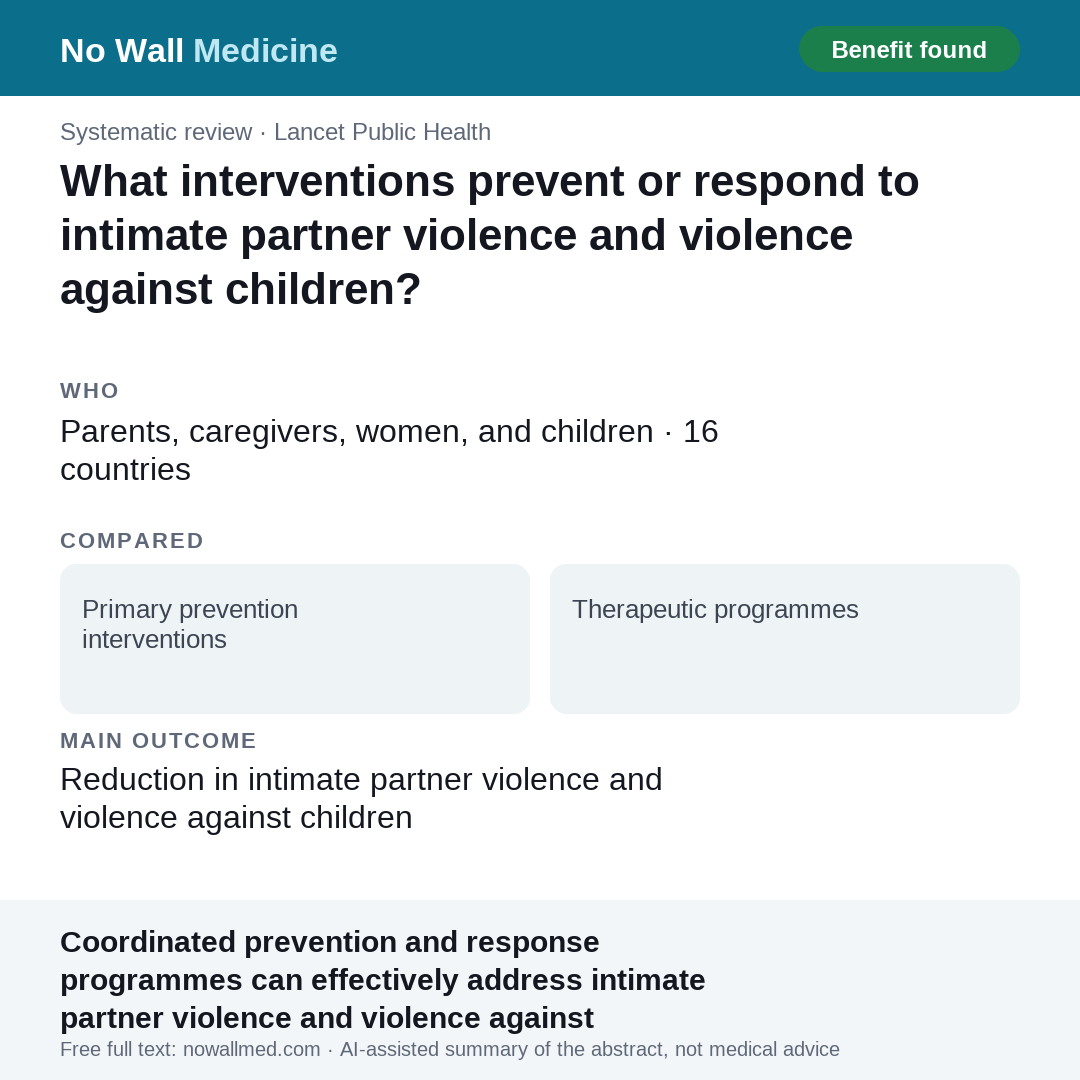
Clinical question: What interventions prevent or respond to intimate partner violence and violence against children?
Why it matters: It is unknown which specific intervention components and mechanisms are most effective for addressing the intersections between intimate partner violence and violence against children.
Key points
- Researchers reviewed 30 unique interventions from 16 countries that aimed to prevent or respond to intimate partner violence and violence against children.
- Primary prevention interventions used mechanisms like improved communication, conflict resolution, and reflection on harmful gender norms to address violence.
- Therapeutic programs for women and children exposed to violence facilitated engagement with trauma and increased awareness of the effects of violence.
Headline and key points written with AI from the paper’s abstract, with every number checked against it. Read the paper before relying on them.
Was this summary helpful?
Abstract
Efforts to prevent or respond to intimate partner violence (IPV) and violence against children (VAC) are still disparate worldwide, despite increasing evidence of intersections across these forms of violence. We conducted a systematic review to explore interventions that prevent or respond to IPV and VAC by parents or caregivers, aiming to identify common intervention components and mechanisms that lead to a reduction in IPV and VAC. 30 unique interventions from 16 countries were identified, with 20 targeting both IPV and VAC. Key mechanisms for reducing IPV and VAC in primary prevention interventions included improved communication, conflict resolution, reflection on harmful gender norms, and awareness of the adverse consequences of IPV and VAC on children. Therapeutic programmes for women and children who were exposed to IPV facilitated engagement with IPV-related trauma, increased awareness of the effects of IPV, and promoted avoidance of unhealthy relationships. Evidence gaps in low-income and middle-income countries involved adolescent interventions, post-abuse interventions for women and children, and interventions addressing both prevention and response to IPV and VAC. Our findings strengthen evidence in support of efforts to address IPV and VAC through coordinated prevention and response programmes. However, response interventions for both IPV and VAC are rare and predominantly implemented in high-income countries. Although therapeutic programmes for parents, caregivers, and children in high-income countries are promising, their feasibility in low-income and middle-income countries remains uncertain. Despite this uncertainty, there is potential to improve the use of health services to address IPV and VAC together.
Abstract reproduced under the article’s CC BY licence.
Subject terms
Cite this article
Bacchus LJ, Colombini M, Pearson I, Gevers A, Stöckl H, Guedes AC. Interventions that prevent or respond to intimate partner violence against women and violence against children: a systematic review. Lancet Public Health. 2024. doi:10.1016/S2468-2667(24)00048-3
Spotted a mistake? Suggest a correction
Top studies every Monday
The week’s key trials and guidelines in your specialties, plus any topics you follow. By email, free.
Get the weekly digest