Exercise and multidimensional interventions may improve quality of life and intrinsic capacity in humans
Interventions that prolong multidimensional healthspan in humans: a systematic review of randomized controlled trials
Systematic review of randomized controlled trialsBenefit found
Do interventions prolong multidimensional healthspan in humans?
Who
4656
Humans
Compared
Exercise or multidimensional interventions: improved intrinsic capacity and quality of life
Other interventions
Main outcome
Intrinsic capacity and quality of life
Bottom line: Exercise or multidimensional interventions including exercise may improve intrinsic capacity and quality of life.
Limitation: High heterogeneity between studies and small number of studies for other interventions.
J Gerontol A · 2026-05-22Download image
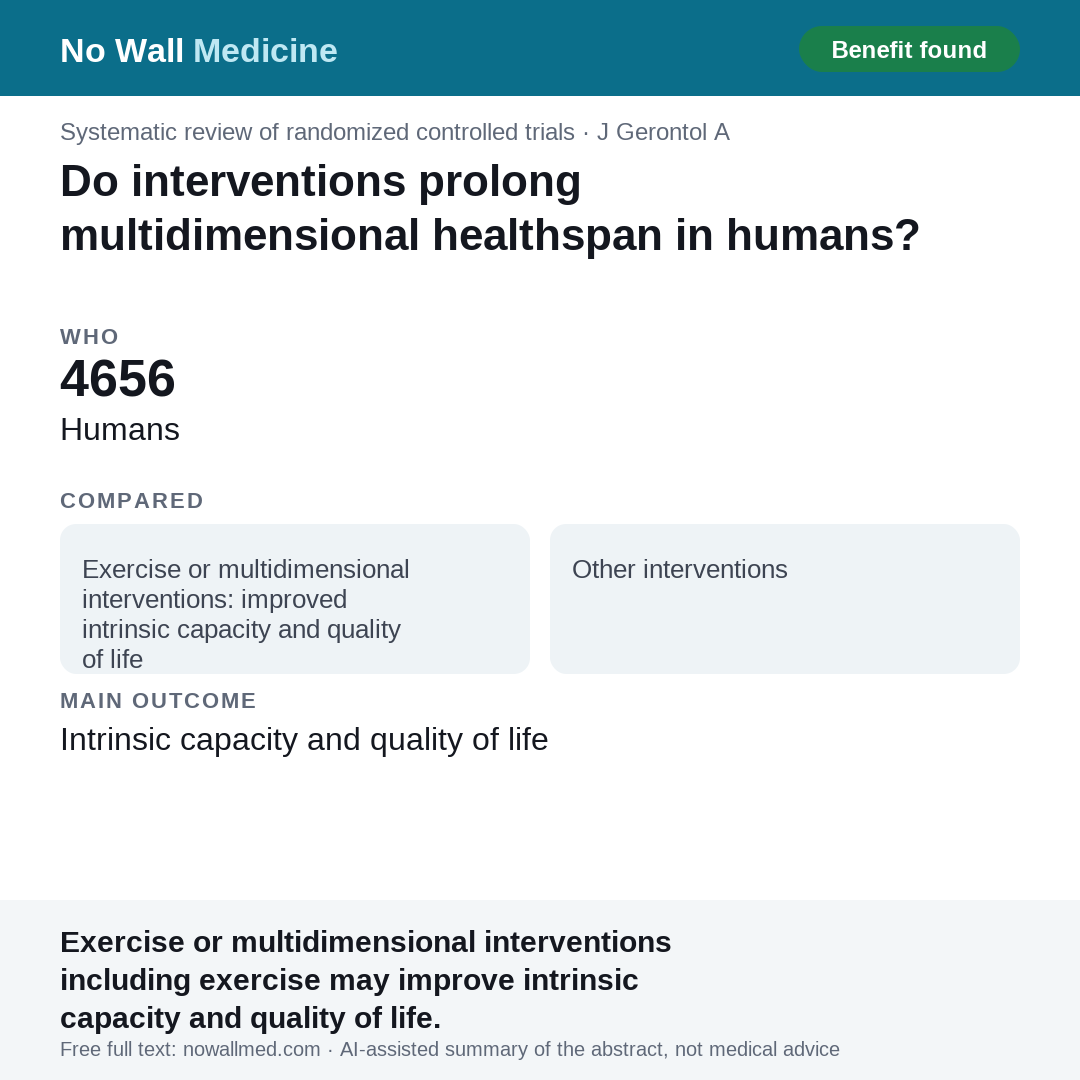
Clinical question: Do interventions prolong multidimensional healthspan in humans?
Why it matters: Researchers sought to summarize evidence on interventions that improve multidimensional person-centered outcomes like functioning and quality of life.
Key points
- Researchers reviewed 15 randomized controlled trials involving 4656 participants to evaluate interventions that prolong healthspan.
- Eleven studies reported that exercise or multidimensional interventions including exercise improved intrinsic capacity and quality of life.
- No conclusions could be drawn regarding the effects of daily oral supplementation or caloric restriction due to limited studies.
Limitation the authors note: The review noted high heterogeneity between studies and a small number of studies for certain interventions.
Headline and key points written with AI from the paper’s abstract, with every number checked against it. Read the paper before relying on them.
Topics
Spotted a mistake? Suggest a correction
More in Geriatrics
Lower force relative to body weight linked to frailty deterioration in older females
Association Between Sit-to-Stand Ground Reaction Force and 1-Year Frailty Deterioration in Community-Dwelling Older Adults
Seventy-nine trials studied healthy ageing in adults with developmental disabilities
Closing the evidence gap: a life course and neurodiversity-informed participatory scoping review of healthy ageing randomised controlled trials in adults with developmental disabilities
Professionals cite care systems as main obstacle to good care for older people
Health-care professionals' experiences of caring for older adults across Europe and beyond: a multinational, multilingual qualitative analysis of a cross-sectional survey
Low physical activity contributes most to life expectancy disparities among older adults
Contributions of lifestyle risk factors to socio-economic disparities in active and total life expectancy among older adults: A longitudinal cohort study