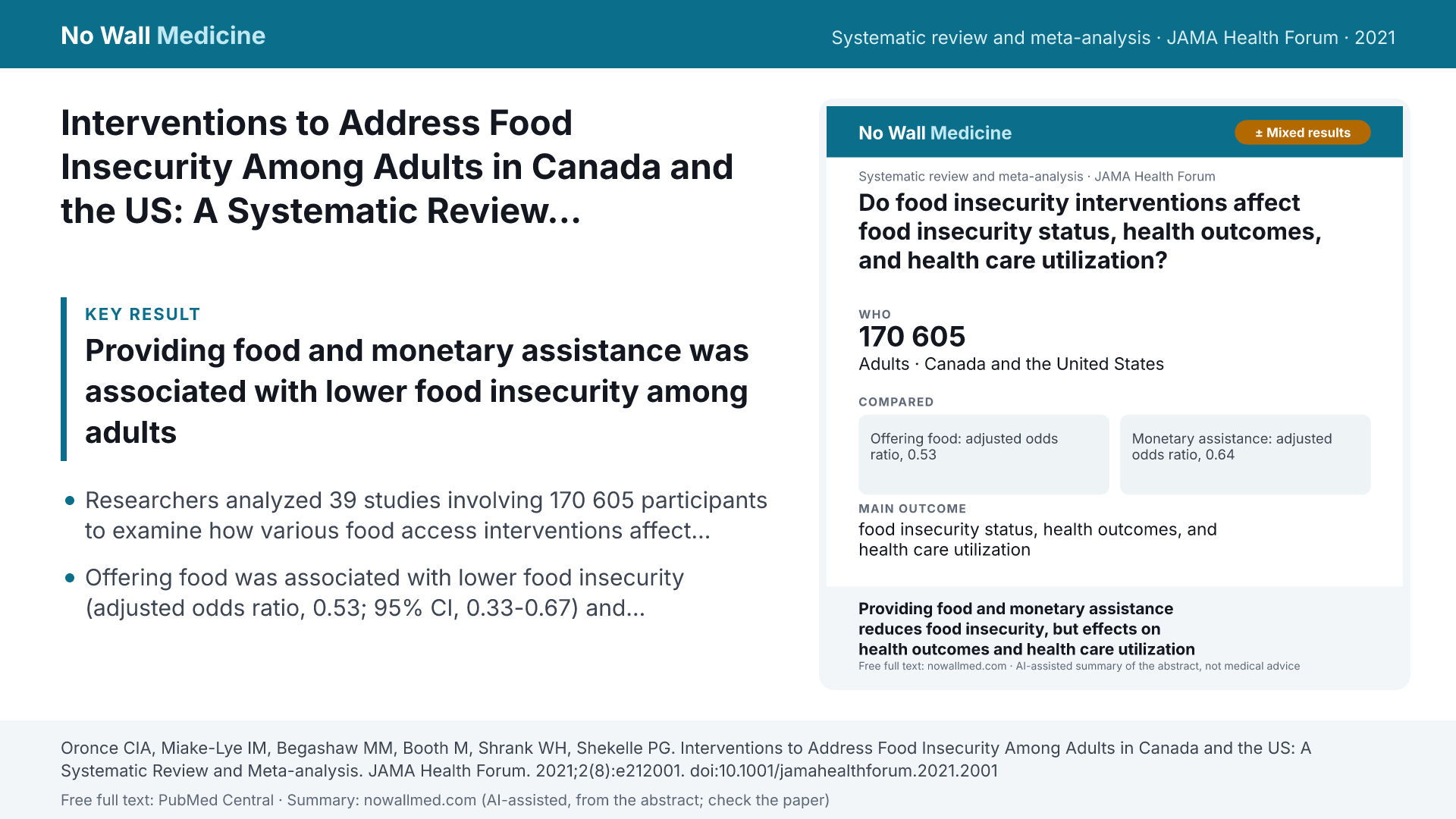
Providing food and monetary assistance was associated with lower food insecurity among adults
Interventions to Address Food Insecurity Among Adults in Canada and the US: A Systematic Review and Meta-analysis
Systematic review and meta-analysisMixed results
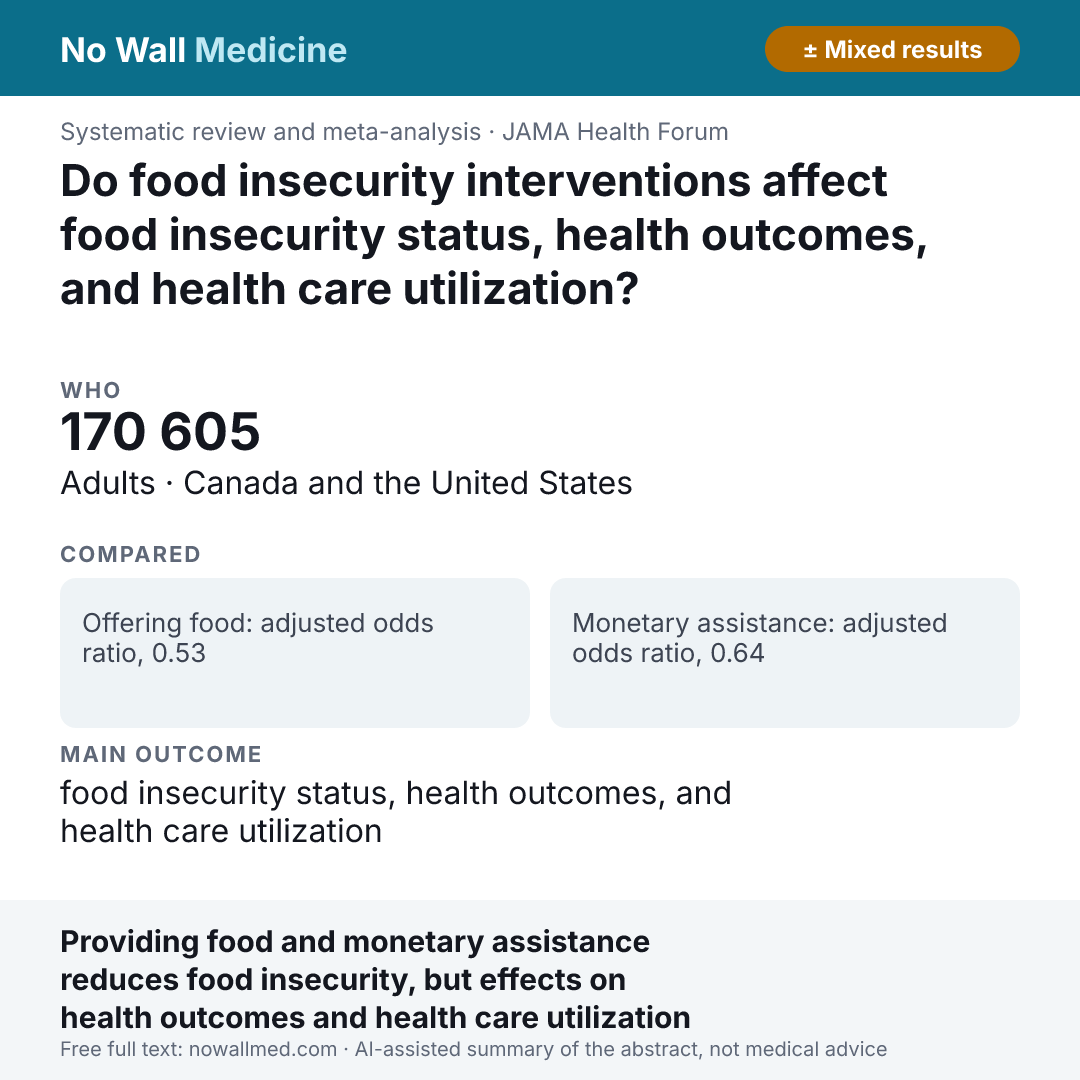
Do food insecurity interventions affect food insecurity status, health outcomes, and health care utilization?
Who
170 605
Adults · Canada and the United States
Compared
Offering food: adjusted odds ratio, 0.53
Monetary assistance: adjusted odds ratio, 0.64
Main outcome
food insecurity status, health outcomes, and health care utilization
Result: adjusted odds ratio, 0.53 (95% CI, 0.33-0.67) for food; 0.64 (95% CI, 0.49-0.84) for monetary assistance
Bottom line: Providing food and monetary assistance reduces food insecurity, but effects on health outcomes and health care utilization remain unclear.
Limitation: Evidence for associations between interventions and health outcomes or health care utilization was of low or very low certainty.
JAMA Health Forum · 2021-08-06 · Save PNG
Clinical question: Do food insecurity interventions affect food insecurity status, health outcomes, and health care utilization?
Key points
- Researchers analyzed 39 studies involving 170 605 participants to examine how various food access interventions affect food insecurity and health.
- Offering food was associated with lower food insecurity (adjusted odds ratio, 0.53; 95% CI, 0.33-0.67) and monetary assistance was also associated with lower food insecurity (adjusted odds ratio, 0.64; 95% CI, 0.49-0.84).
- Evidence was of low or very low certainty regarding whether these interventions were associated with changes in health outcomes or health care utilization.
Headline and key points written with AI from the paper’s abstract, with every number checked against it. Read the paper before relying on them.
Was this summary helpful?
Subject terms
Headline, design, result, key points, caveat and citation as plain text.
Cite this article
Oronce CIA, Miake-Lye IM, Begashaw MM, Booth M, Shrank WH, Shekelle PG. Interventions to Address Food Insecurity Among Adults in Canada and the US: A Systematic Review and Meta-analysis. JAMA Health Forum. 2021;2(8):e212001. doi:10.1001/jamahealthforum.2021.2001
Spotted a mistake? Suggest a correction