Interventions to address inappropriate prescribing reduced medication numbers but not hospitalizations or mortality
Interventions to Address Potentially Inappropriate Prescribing for Older Primary Care Patients: A Systematic Review and Meta-Analysis
Systematic review and meta-analysisMixed results
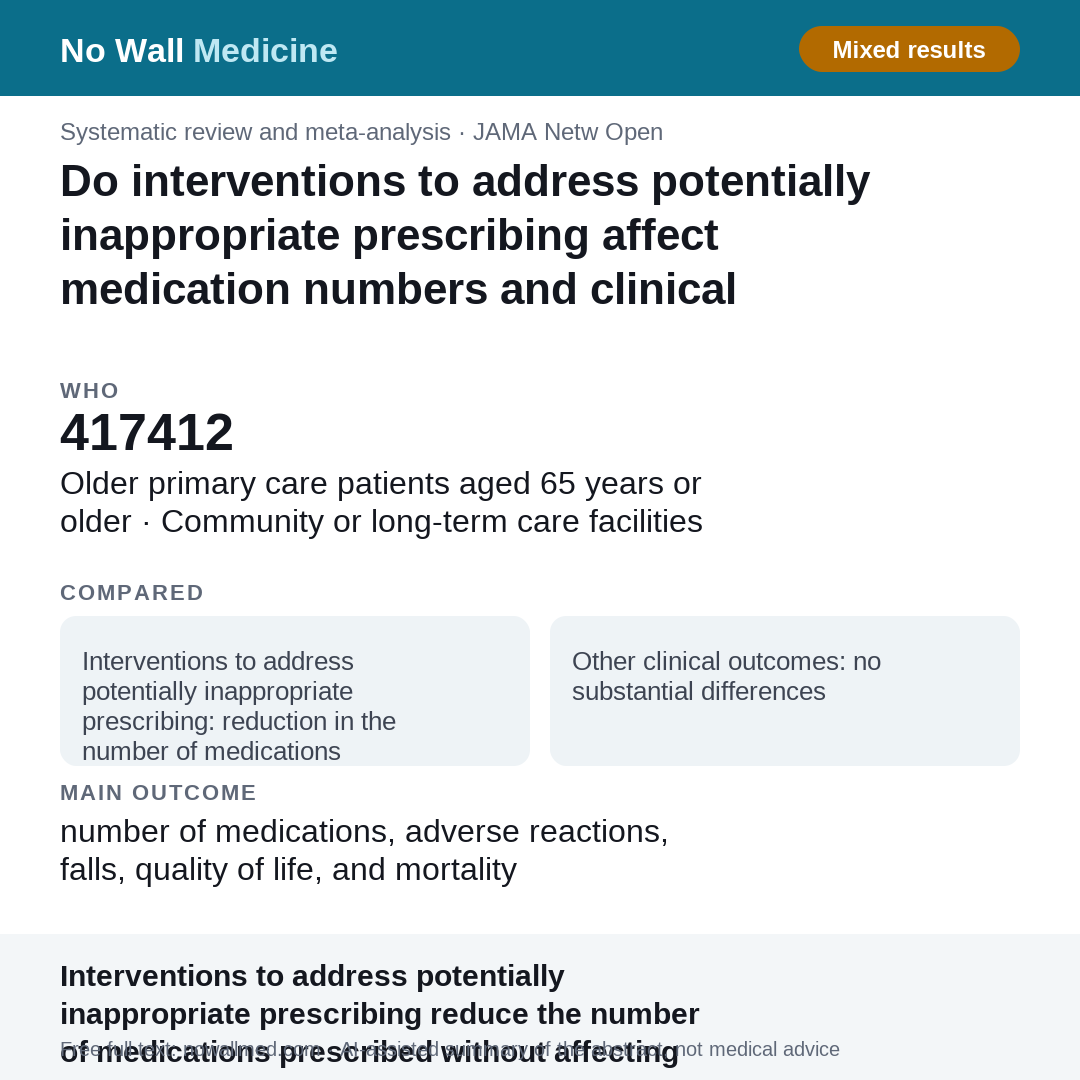
Do interventions to address potentially inappropriate prescribing affect medication numbers and clinical outcomes?
Who
417412
Older primary care patients aged 65 years or older · Community or long-term care facilities
Compared
Interventions to address potentially inappropriate prescribing: reduction in the number of medications prescribed (SMD, -0.25 [95% CI, -0.38 to -0.13])
Other clinical outcomes: no substantial differences
Main outcome
number of medications, adverse reactions, falls, quality of life, and mortality
Result: SMD, -0.25 (95% CI, -0.38 to -0.13) for number of medications
Bottom line: Interventions to address potentially inappropriate prescribing reduce the number of medications prescribed without affecting other clinical outcomes.
Limitation: Future studies should use standardized criteria and consistently report potential harms and key outcomes.
JAMA Netw Open · 2025-06-02Download image
Clinical question: Do interventions to address potentially inappropriate prescribing affect medication numbers and clinical outcomes?
Why it matters: It is unclear if interventions targeting potentially inappropriate medications for older adults affect clinical outcomes like hospitalizations, mortality, or quality of life.
Key points
- Researchers analyzed 118 randomized clinical trials involving 417,412 patients aged 65 years or older living in the community or long-term care facilities.
- Interventions were associated with a reduction in the number of medications prescribed (SMD, -0.25 [95% CI, -0.38 to -0.13]), roughly 0.5 fewer medications per patient.
- No substantial differences were found for nonserious adverse drug reactions, injurious falls, quality of life, medical visits, emergency department admissions, hospitalizations, or all-cause mortality.
Headline and key points written with AI from the paper’s abstract, with every number checked against it. Read the paper before relying on them.
Topics
Cite this article
Persaud N, Workentin A, Rizvi A, Pierson T, Bortolussi-Courval É, Liu K. Interventions to Address Potentially Inappropriate Prescribing for Older Primary Care Patients: A Systematic Review and Meta-Analysis. JAMA Netw Open. 2025. doi:10.1001/jamanetworkopen.2025.17965
Spotted a mistake? Suggest a correction