Interventions to enhance psychological resilience in displaced children showed mixed results for mental health
Interventions to enhance psychological resilience in forcibly displaced children: a systematic review
Systematic review and meta-analysisMixed results
Do interventions enhance psychological resilience in forcibly displaced children and adolescents?
Who
Forcibly displaced children and adolescents
Compared
Interventions
Comparator conditions
Main outcome
Psychological resilience, anxiety symptoms, and quality of life
Result: resilience gav=0.194 (95% CI 0.018 to 0.369)
Bottom line: Interventions improved resilience, but did not significantly improve anxiety symptoms or quality of life.
Limitation: Multiplicity of study designs, intervention types, outcomes and measures incumbered quantifying effectiveness.
BMJ Glob Health · 2023-02-02Download image
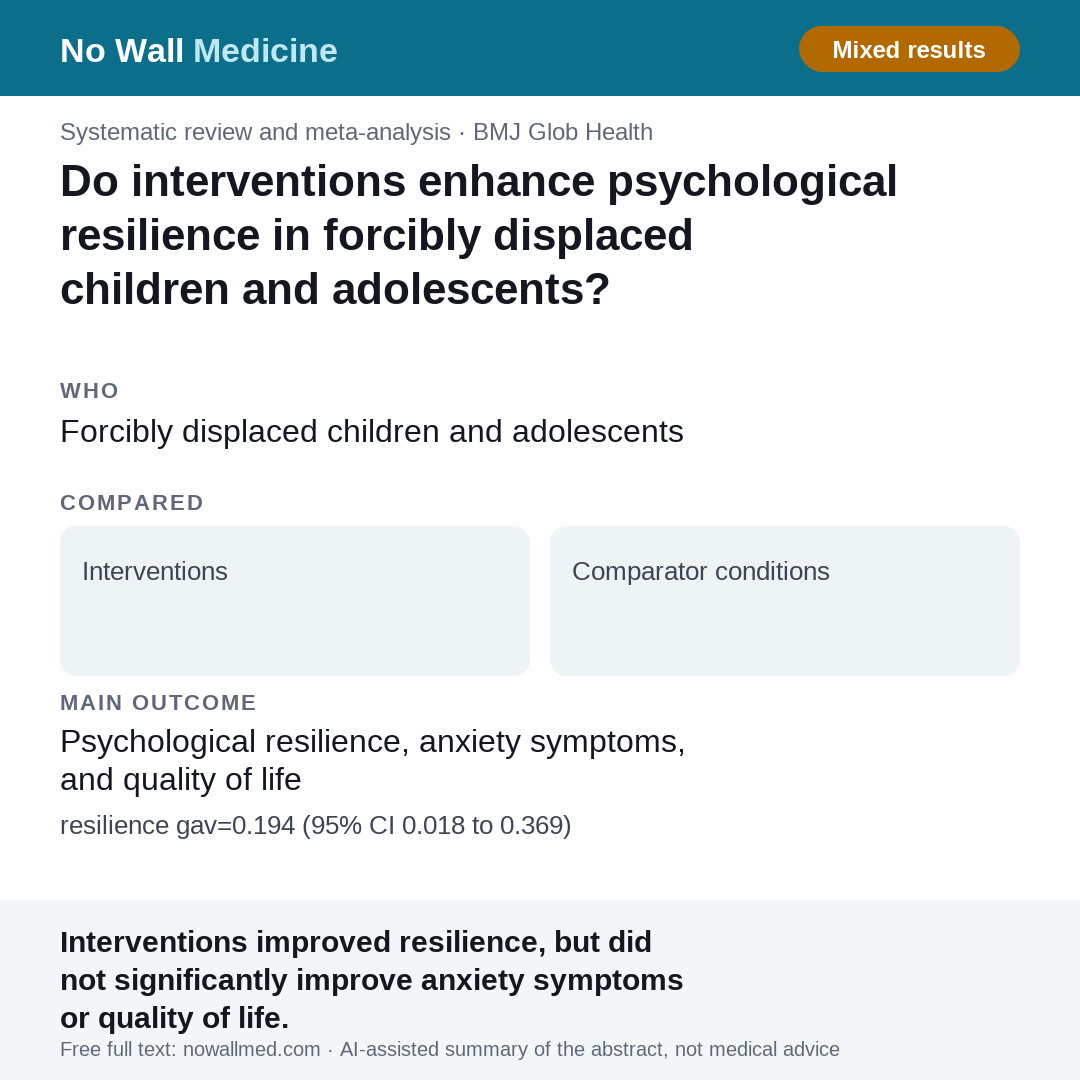
Clinical question: Do interventions enhance psychological resilience in forcibly displaced children and adolescents?
Why it matters: It was unknown how interventions implemented outside of clinical settings affect the psychological resilience of children in forcibly displaced populations.
Key points
- Researchers reviewed 23 studies involving forcibly displaced children and adolescents to evaluate interventions outside of clinical settings.
- Interventions were associated with improved resilience (gav=0.194, 95% CI 0.018 to 0.369) but were not associated with changes in anxiety symptoms or quality of life.
- Studies reported improvements in behavioral problems, coping mechanisms, and general well-being, but not in caregiver support or psychiatric symptoms.
Limitation the authors note: The quality of evidence for most outcomes was graded as very low and the variety of study designs and measures made quantifying effectiveness difficult.
Headline and key points written with AI from the paper’s abstract, with every number checked against it. Read the paper before relying on them.
Was this summary helpful?
Abstract
Background
Children represent nearly 40% of forcibly displaced populations and are subject to stressors that affect well-being. Little is known about the effects of interventions to enhance psychological resilience in these children, outside clinical settings. Methods
We conducted a systematic review, following Cochrane methods. Eligible studies tested resilience-enhancing interventions outside clinical settings in forcibly displaced children/adolescents. We included longitudinal quantitative studies with comparator conditions irrespective of geographical scope or language. We searched articles published between January 2010 and April 2020 in PubMed, Embase, Cochrane Library, Web of Science, PsycINFO and the WHO's Global Index Medicus. To standardise effect sizes across the different reported outcomes, we transformed reported mean differences to standardised mean differences using Hedge's g statistic with associated 95% CI. We pooled data for meta-analysis where appropriate. We used Cochrane tools to assess study risk of bias and used Grading of Recommendations Assessment, Development and Evaluation to determine evidence quality for meta-analysed outcomes. Results
Searches yielded 4829 results. Twenty-three studies met inclusion criteria. Studies reported 18 outcomes measured by 48 different scales; only 1 study explicitly measured resilience. Eight studies were randomised controlled trials; the rest were non-randomised pre-post studies. Interventions were diverse and typically implemented in group settings. Studies reported significant improvement in outcomes pertinent to behavioural problems, coping mechanisms and general well-being but not to caregiver support or psychiatric symptoms. In meta-analysis, resilience was improved (gav=0.194, 95% CI 0.018 to 0.369), but anxiety symptoms and quality of life were not (gav=-0.326, 95% CI -0.782 to 0.131 and gav=0.325, 95% CI -0.027 to 0.678, respectively). Risk of bias varied. Quality of evidence for most graded outcomes was very low. Conclusions
The multiplicity of study designs, intervention types, outcomes and measures incumbered quantifying intervention effectiveness. Future resilience research in this population should use rigorous methods and follow reporting guidelines. Prospero registration number
CRD42020177069.
Abstract reproduced under the article’s CC BY NC licence.
Subject terms
Cite this article
Thabet A, Ghandi S, Barker EK, Rutherford G, Malekinejad M. Interventions to enhance psychological resilience in forcibly displaced children: a systematic review. BMJ Glob Health. 2023. doi:10.1136/bmjgh-2021-007320
Spotted a mistake? Suggest a correction
Top studies every Monday
The week’s key trials and guidelines in your specialties, plus any topics you follow. By email, free.
Get the weekly digest