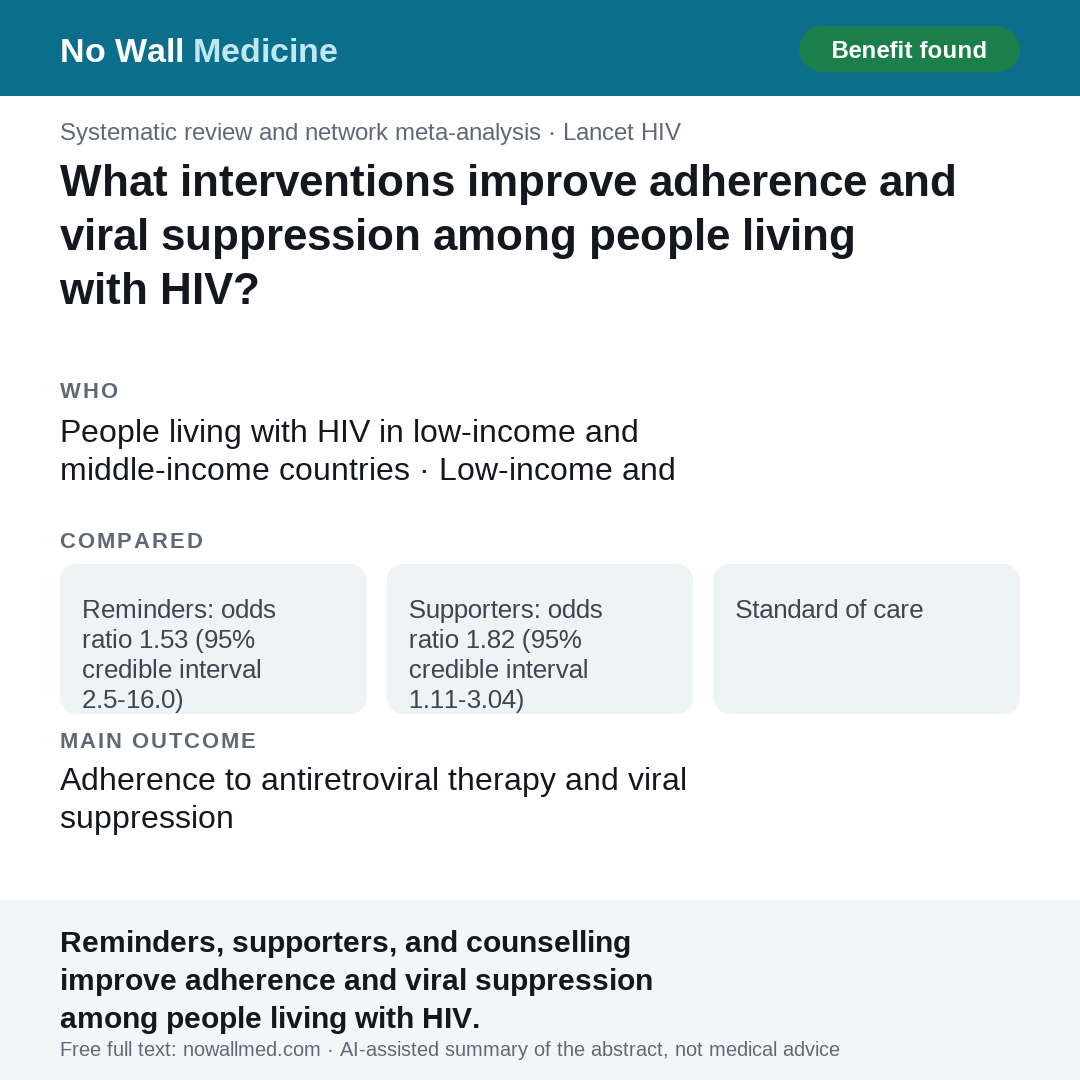
Reminders and supporters improved medication adherence and viral suppression in HIV treatment studies
Interventions to improve viral suppression and adherence to antiretroviral therapy among people living with HIV: a systematic review and network meta-analysis
Kanters S, Lawrence DS, McLennan VS, Orrell C, Pinto C, Chou R, et al
Clinical question: What interventions improve adherence and viral suppression among people living with HIV?
Why it matters: Suboptimal adherence to antiretroviral therapy threatens viral suppression and can lead to drug resistance, illness, death, and transmission.
Key points
Researchers analyzed 164 unique randomized trials to compare interventions like reminders, supporters, education, and counseling for people living with HIV.
At 24 weeks, reminders and supporters were the only interventions that improved adherence compared to standard care, with risk differences of 9.4% and 12.8% respectively.
Supporters improved viral suppression at 48 weeks with a risk difference of 6.5%.
Headline and key points written with AI from the paper’s abstract, with every number checked against it. Read the paper before relying on them.
Background
In 2025, 78% of people living with HIV worldwide were on antiretroviral therapy 95% of people on treatment were virally suppressed. Suboptimal adherence, defined as not taking interventions as prescribed, threatens viral suppression and can lead to antiviral resistance, morbidity, mortality, and transmission. We updated a systematic review and network meta-analysis to estimate the effects of different adherence interventions on adherence and viral suppression. Methods
In this systematic review and network meta-analysis, we searched MEDLINE, Embase, CENTRAL, and key conference proceedings for individually randomised trials of adherence interventions scalable in low-income and middle-income countries (LMICs) published from database inception to June 5, 2024. Trials were excluded if they were done among individuals receiving antiretroviral regimens associated with higher pill burden and toxicities or were assessing interventions reliant on costly technologies or highly specialised staff not scalable in LMICs. Two reviewers independently assessed all abstracts and subsequently full texts for inclusion. Discrepancies were resolved by consensus with a third reviewer. From the summary data, the initial reviewers then extracted the data, which included study characteristics, intervention types, and adherence. The primary outcome was adherence to antiretroviral therapy with different interventions, which was analysed in a network meta-analysis with fixed or random effects and in alignment with PRISMA guidelines. We assessed risk of bias using the Cochrane Risk of Bias 2 tool and evidence certainty using GRADE. Findings
10 336 potentially eligible records were identified from the database search, of which 167 were eligible. Five additional records were added from manual searches, resulting in 172 records mapped to 164 unique trials. The studies focused on the effect of reminders (n=49 [30%]), supporters (n=47 [29%]), education (n=40 [24%]), counselling (n=47 [29%]), and complex interventions (n=4 [2%]) on adherence. For the network meta-analysis, across the eligible trials, reminders, supporters, counselling, and education had some effect on adherence. Overall, at 24 weeks, the only interventions that improved adherence compared with standard of care at 24 weeks were reminders (estimated odds ratio [OR] 1·53 [95% credible interval (CrI)]; risk difference [RD] 9·4% [95% CrI 2·5-16·0)] and supporters (1·82 [1·11-3·04]; 12·8% [2·5-21·4]). In LMICs, only counselling at 12 weeks (2·53 [1·03-6·75]; 18·8% [0·8-30·5]) and supporter at 24 weeks (2·11 [1·12-4·51]; 14·3% [2·4-23·7]) had improved effects. Subgroup patterns varied: adolescents benefited from reminders and supporters and education, and people with previous non-adherence benefited from counselling and supporters. Effects on viral suppression paralleled adherence; for example, supporters improved viral suppression at 48 weeks (1·34 [1·11-1·66]; 6·5% [2·3-10·8]). Reminders improved viral suppression at 24 weeks, whereas counselling showed modest benefit at 48 weeks. Most studies were rated at low risk of bias: low risk for randomisation, missing outcome data, and selective reporting (I2 range 0-92% across direct treatment comparisons). Interpretation
Scalable adherence interventions-particularly reminders, counselling, and supporter-based approaches-improved adherence. Tailoring interventions to population needs could therefore strengthen HIV treatment outcomes and support global progress towards epidemic control. Funding
The Gates Foundation.
Abstract reproduced under the article’s CC BY licence.
Topics
Humans; HIV Infections; Adherence Interventions; Medication Adherence; Anti-HIV Agents; Viral Load; Randomized Controlled Trials as Topic