Giving clot-dissolving drugs during cardiac arrest did not improve survival or neurological outcomes
Intra-arrest systemic thrombolytic therapy during cardiopulmonary resuscitation: a systematic review and meta-analysis of randomized controlled trials
Systematic review and meta-analysis of randomized controlled trialsHarm found
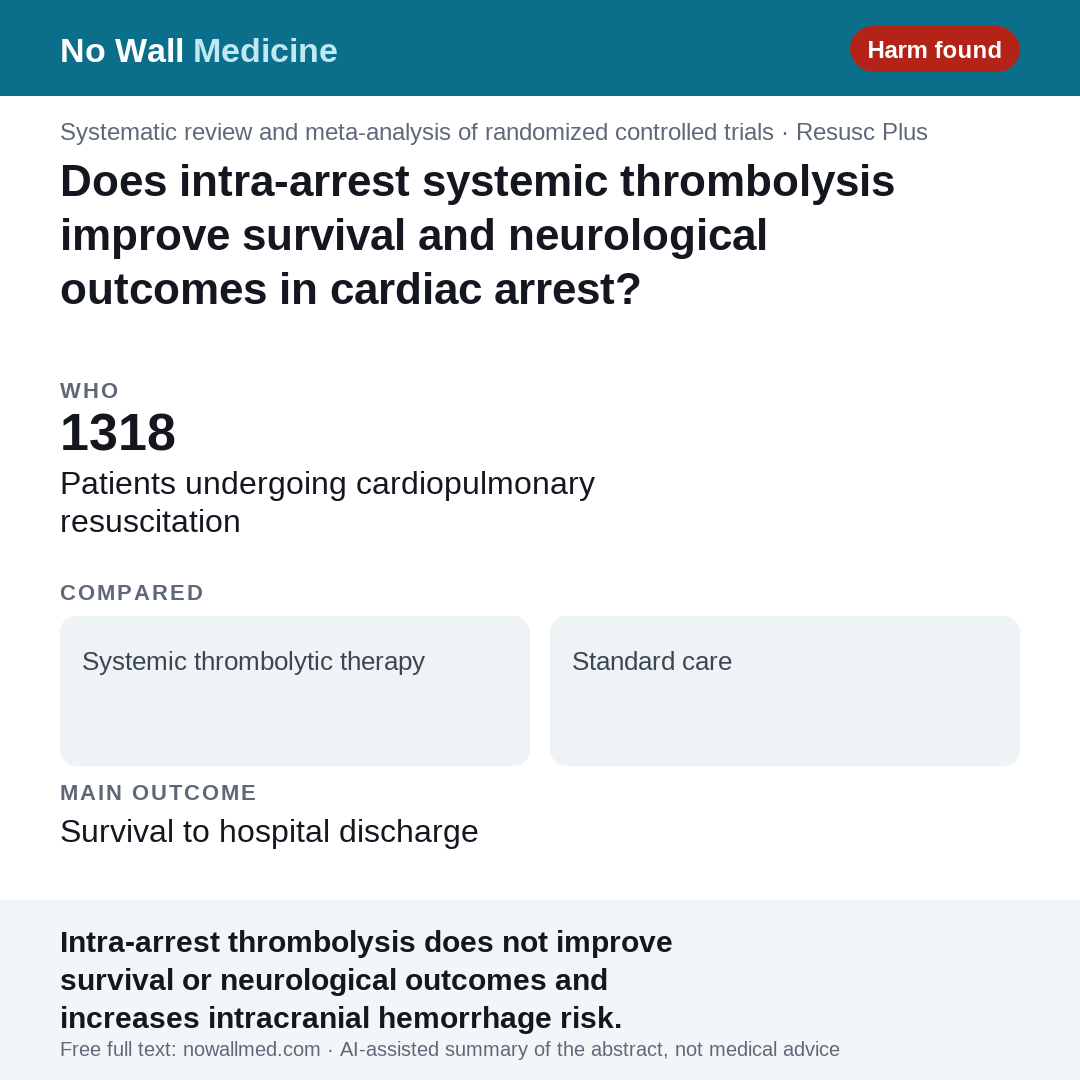
Does intra-arrest systemic thrombolysis improve survival and neurological outcomes in cardiac arrest?
Who
1318
Patients undergoing cardiopulmonary resuscitation
Compared
Systemic thrombolytic therapy
Standard care
Main outcome
Survival to hospital discharge
Result: relative risk 0.86 (95% CI 0.65-1.14)
Bottom line: Intra-arrest thrombolysis does not improve survival or neurological outcomes and increases intracranial hemorrhage risk.
Limitation: Only three randomized controlled trials were included in the meta-analysis.
Resusc Plus · 2026-03-18Download image
Clinical question: Does intra-arrest systemic thrombolysis improve survival and neurological outcomes in cardiac arrest?
Why it matters: It is unclear if routine administration of clot-dissolving drugs during cardiac arrest improves survival or neurological outcomes for patients.
Key points
- Researchers analyzed three randomized controlled trials involving 1318 participants to compare systemic thrombolysis, or clot-dissolving medication, against standard care during cardiopulmonary resuscitation.
- Thrombolysis was not linked to improved survival to hospital discharge (RR 0.86; 95% CI 0.65-1.14) or favorable neurological outcomes (RR 0.99; 95% CI 0.69-1.40).
- The use of thrombolysis was associated with an increased risk of any intracranial hemorrhage (RR 6.96, 95% CI 1.59-30.47).
Headline and key points written with AI from the paper’s abstract, with every number checked against it. Read the paper before relying on them.
Was this summary helpful?
Cite this article
Dehghani S, Ohshimo S, Giustini D, Böttiger BW, Nikolaou N, Couper K. Intra-arrest systemic thrombolytic therapy during cardiopulmonary resuscitation: a systematic review and meta-analysis of randomized controlled trials. Resusc Plus. 2026. doi:10.1016/j.resplu.2026.101291
Spotted a mistake? Suggest a correction
Top studies every Monday
The week’s key trials and guidelines in your specialties, plus any topics you follow. By email, free.
Get the weekly digest