Intra-arterial local hypothermia did not significantly improve functional outcomes in acute ischemic stroke patients
Intra-arterial selective hypothermia for acute ischemic stroke neuroprotection: A multicenter pilot trial in China
Multicenter, randomized trial with blinded outcome assessmentNo clear difference
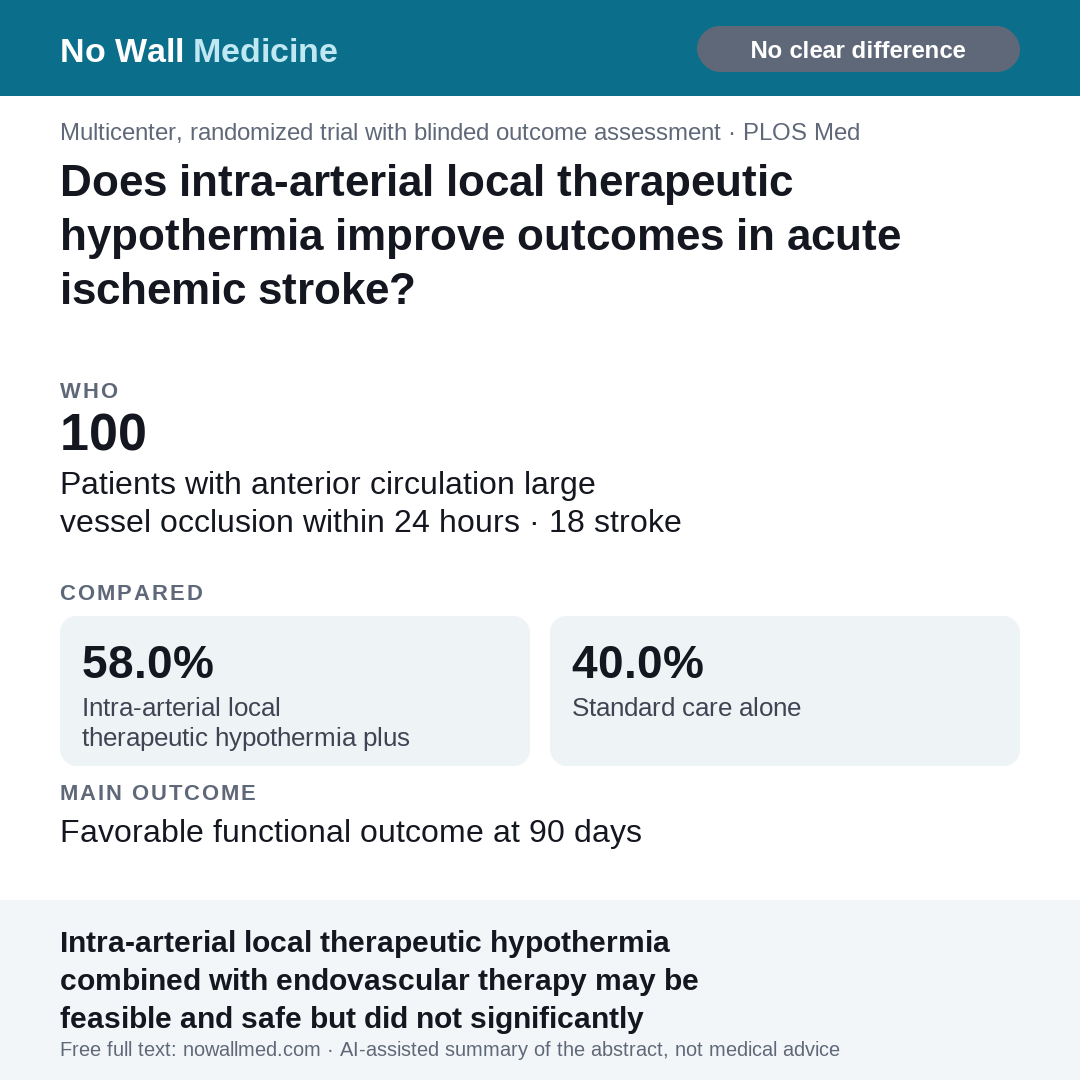
Does intra-arterial local therapeutic hypothermia improve outcomes in acute ischemic stroke?
Who
100
Patients with anterior circulation large vessel occlusion within 24 hours · 18 stroke centers in China
Compared
58.0%Intra-arterial local therapeutic hypothermia plus standard care (29/50)
40.0%Standard care alone (20/50)
Main outcome
Favorable functional outcome at 90 days
Result: adjusted relative risk 1.47 (95% CI 0.99 to 2.16)
Bottom line: Intra-arterial local therapeutic hypothermia combined with endovascular therapy may be feasible and safe but did not significantly improve outcomes.
Limitation: Insufficient sample size limited statistical power and the ability to adjust for important confounders.
PLOS Med · 2025-07-24Download image
Clinical question: Does intra-arterial local therapeutic hypothermia improve outcomes in acute ischemic stroke?
Why it matters: Additional neuroprotective strategies are needed for acute ischemic stroke patients because many still experience poor outcomes despite receiving reperfusion therapies.
Key points
- Researchers conducted a multicenter randomized trial of 100 patients with large vessel occlusion to compare standard care with standard care plus intra-arterial local therapeutic hypothermia.
- Favorable functional outcomes at 90 days were achieved in 58.0% (29/50) of the hypothermia group versus 40.0% (20/50) of the control group, but the result was not statistically significant.
- Safety outcomes including symptomatic intracranial hemorrhage and mortality showed no significant differences between the two groups.
Limitation the authors note: The study was a pilot trial with an insufficient sample size that limited statistical power and the ability to adjust for important confounders.
Headline and key points written with AI from the paper’s abstract, with every number checked against it. Read the paper before relying on them.
Was this summary helpful?
Subject terms
Cite this article
Huang ZX, Hu M, Zhang P, He X, Ma X, Hong Q. Intra-arterial selective hypothermia for acute ischemic stroke neuroprotection: A multicenter pilot trial in China. PLOS Med. 2025. doi:10.1371/journal.pmed.1004668
Spotted a mistake? Suggest a correction
Top studies every Monday
The week’s key trials and guidelines in your specialties, plus any topics you follow. By email, free.
Get the weekly digest