Tenecteplase administered into the artery showed no significant difference in disability outcomes after stroke reperfusion
Intra-Arterial Tenecteplase After Successful Reperfusion in Large Vessel Occlusion Stroke: A Randomized Clinical Trial
Open-label, blinded-outcome assessment trialNo clear difference
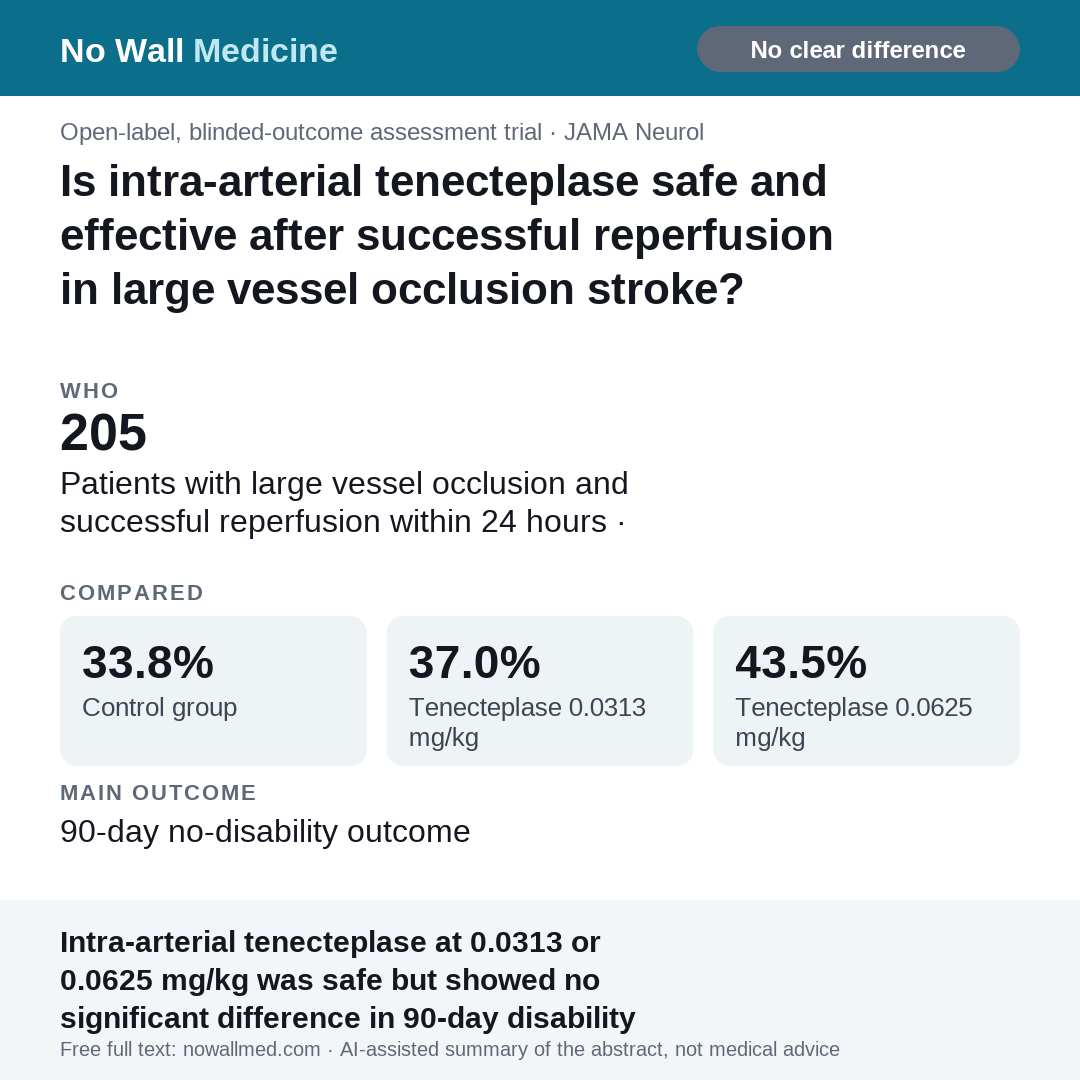
Is intra-arterial tenecteplase safe and effective after successful reperfusion in large vessel occlusion stroke?
Who
205
Patients with large vessel occlusion and successful reperfusion within 24 hours · Multicenter clinical trial in China
Compared
33.8%Control group
37.0%Tenecteplase 0.0313 mg/kg
43.5%Tenecteplase 0.0625 mg/kg
Main outcome
90-day no-disability outcome
Result: adjusted risk ratio 0.85 (95% CI, 0.54-1.35) and 1.15 (95% CI, 0.73-1.80)
Bottom line: Intra-arterial tenecteplase at 0.0313 or 0.0625 mg/kg was safe but showed no significant difference in 90-day disability outcomes.
JAMA Neurol · 2025-07-05Download image
Clinical question: Is intra-arterial tenecteplase safe and effective after successful reperfusion in large vessel occlusion stroke?
Why it matters: The optimal dose, safety, and efficacy of injecting tenecteplase directly into the artery after successful mechanical clot removal for large vessel occlusion stroke are unknown.
Key points
- Researchers studied 205 patients with large vessel occlusion stroke who had successful reperfusion via endovascular thrombectomy, comparing different doses of intra-arterial tenecteplase to a control group.
- In the randomized phase, 33.8% of the control group, 37.0% of the 0.0313 mg/kg group, and 43.5% of the 0.0625 mg/kg group had no disability at 90 days.
- At a dose of 0.1250 mg/kg in the nonrandomized phase, 3 of 12 patients experienced symptomatic intracranial hemorrhage, which exceeded the pre-set safety threshold.
Headline and key points written with AI from the paper’s abstract, with every number checked against it. Read the paper before relying on them.
Was this summary helpful?
Subject terms
Cite this article
Hou X, Huang J, Wang L, He Y, Song J, Guo C. Intra-Arterial Tenecteplase After Successful Reperfusion in Large Vessel Occlusion Stroke: A Randomized Clinical Trial. JAMA Neurol. 2025. doi:10.1001/jamaneurol.2025.2036
Spotted a mistake? Suggest a correction
Top studies every Monday
The week’s key trials and guidelines in your specialties, plus any topics you follow. By email, free.
Get the weekly digest