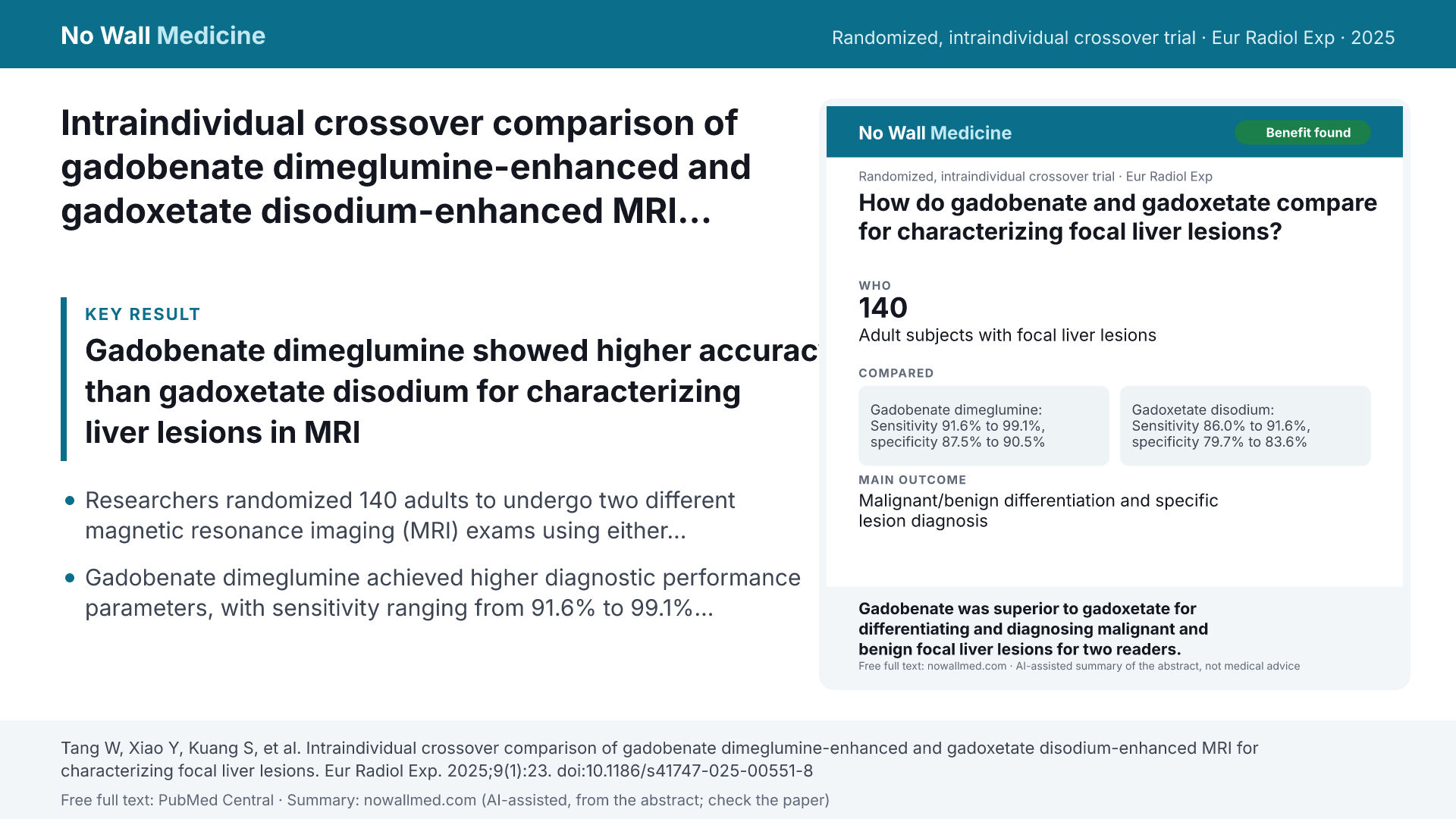
Gadobenate dimeglumine showed higher accuracy than gadoxetate disodium for characterizing liver lesions in MRI
Intraindividual crossover comparison of gadobenate dimeglumine-enhanced and gadoxetate disodium-enhanced MRI for characterizing focal liver lesions
Randomized, intraindividual crossover trialBenefit found
How do gadobenate and gadoxetate compare for characterizing focal liver lesions?
Who
140
Adult subjects with focal liver lesions
Compared
Gadobenate dimeglumine: Sensitivity 91.6% to 99.1%, specificity 87.5% to 90.5%
Gadoxetate disodium: Sensitivity 86.0% to 91.6%, specificity 79.7% to 83.6%
Main outcome
Malignant/benign differentiation and specific lesion diagnosis
Bottom line: Gadobenate was superior to gadoxetate for differentiating and diagnosing malignant and benign focal liver lesions for two readers.
Eur Radiol Exp · 2025-02-18Download image
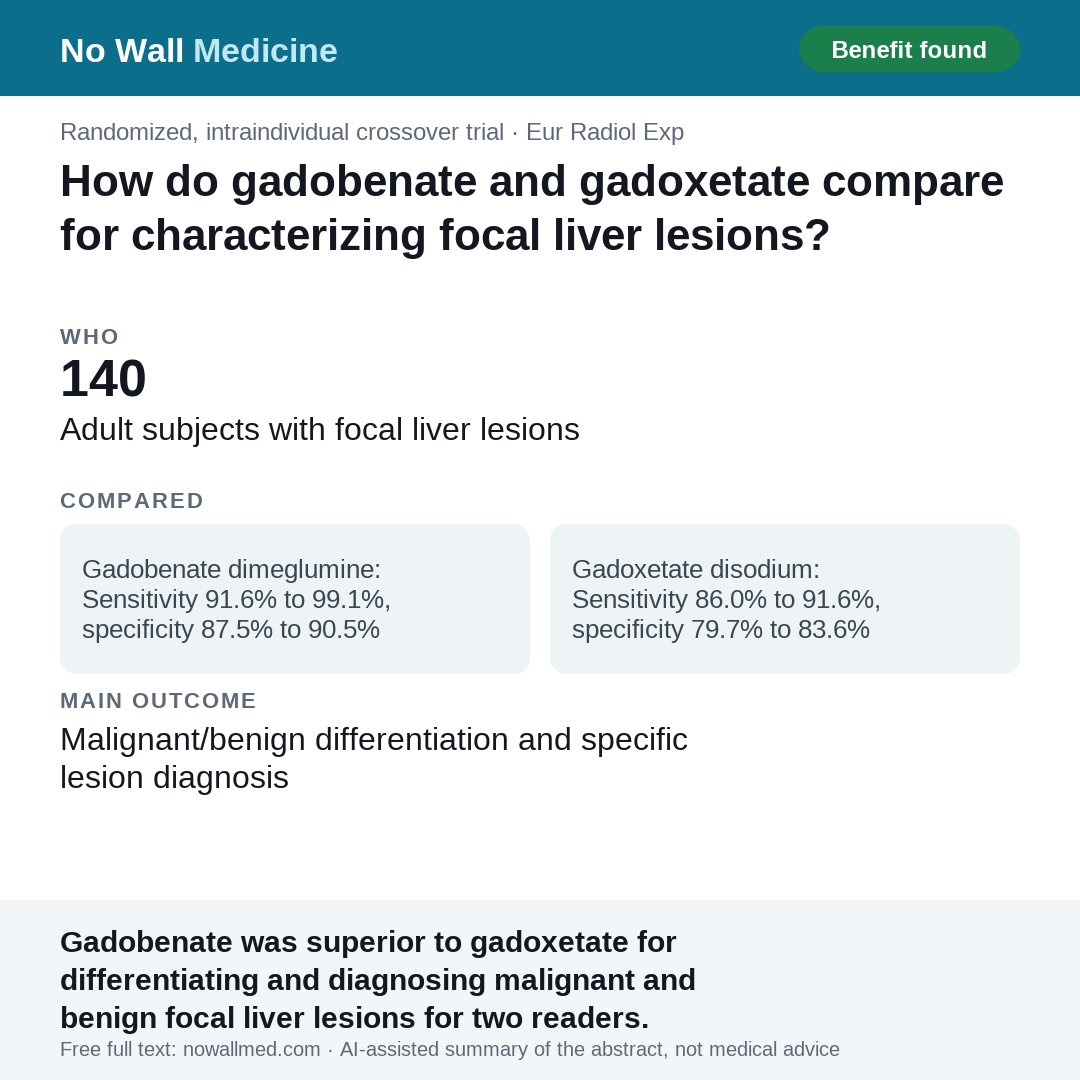
Clinical question: How do gadobenate and gadoxetate compare for characterizing focal liver lesions?
Why it matters: It was unknown how these two different liver-specific magnetic resonance imaging contrast agents compare when used within the same individual to characterize liver lesions.
Key points
- Researchers randomized 140 adults to undergo two different magnetic resonance imaging (MRI) exams using either gadobenate dimeglumine or gadoxetate disodium to evaluate 208 liver lesions.
- Gadobenate dimeglumine achieved higher diagnostic performance parameters, with sensitivity ranging from 91.6% to 99.1% and specificity from 87.5% to 90.5%.
- Two of three readers showed significantly greater accuracy and confidence for specific lesion diagnosis when using gadobenate dimeglumine compared to gadoxetate disodium.
Headline and key points written with AI from the paper’s abstract, with every number checked against it. Read the paper before relying on them.
Was this summary helpful?
Subject terms
Cite this article
Tang W, Xiao Y, Kuang S, et al. Intraindividual crossover comparison of gadobenate dimeglumine-enhanced and gadoxetate disodium-enhanced MRI for characterizing focal liver lesions. Eur Radiol Exp. 2025. doi:10.1186/s41747-025-00551-8
Spotted a mistake? Suggest a correction