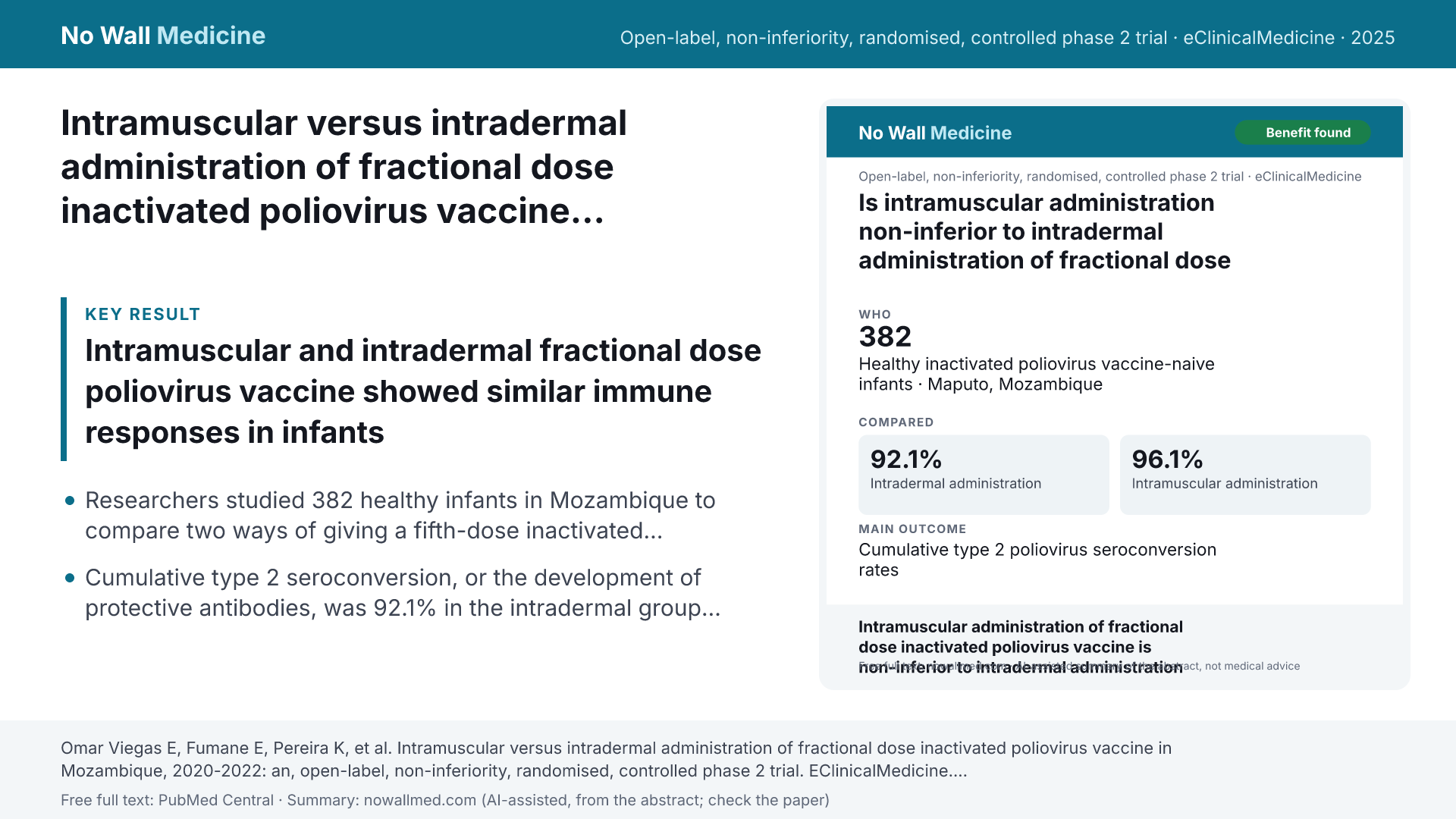
Intramuscular and intradermal fractional dose poliovirus vaccine showed similar immune responses in infants
Intramuscular versus intradermal administration of fractional dose inactivated poliovirus vaccine in Mozambique, 2020-2022: an, open-label, non-inferiority, randomised, controlled phase 2 trial
Open-label, non-inferiority, randomised, controlled phase 2 trialBenefit found
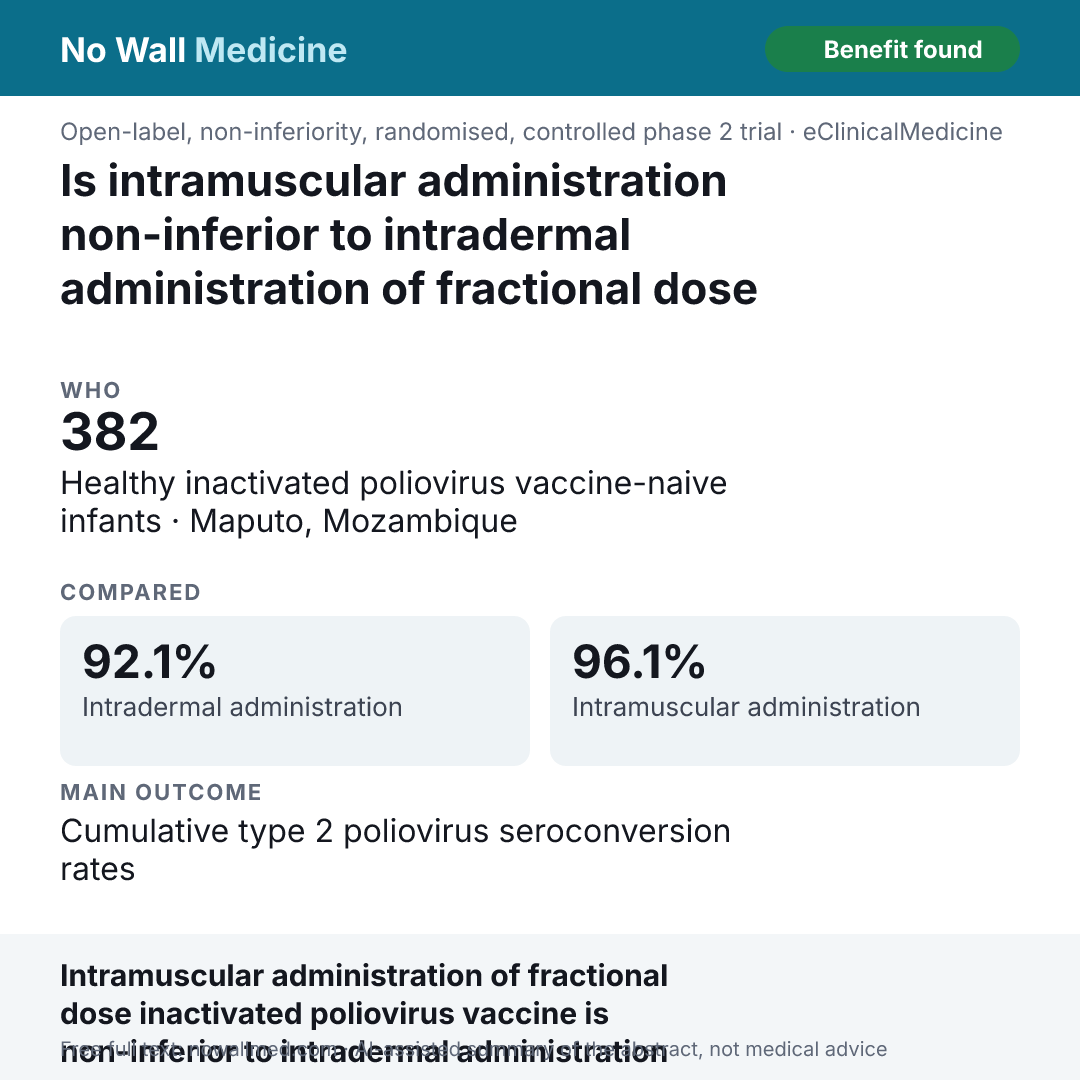
Is intramuscular administration non-inferior to intradermal administration of fractional dose inactivated poliovirus vaccine?
Who
382
Healthy inactivated poliovirus vaccine-naive infants · Maputo, Mozambique
Compared
92.1%Intradermal administration (139/151, 95% CI 86.5-95.8)
96.1%Intramuscular administration (148/154, 95% CI 91.7-98.6)
Main outcome
Cumulative type 2 poliovirus seroconversion rates
Bottom line: Intramuscular administration of fractional dose inactivated poliovirus vaccine is non-inferior to intradermal administration in young infants.
Funded by: World Health Organization
eClinicalMedicine · 2025-12-03 · Save PNG
Clinical question: Is intramuscular administration non-inferior to intradermal administration of fractional dose inactivated poliovirus vaccine?
Why it matters: Intradermal injection is considered difficult and requires skilled administration compared to the more common intramuscular injection method.
Key points
- Researchers studied 382 healthy infants in Mozambique to compare two ways of giving a fifth-dose inactivated poliovirus vaccine.
- Cumulative type 2 seroconversion, or the development of protective antibodies, was 92.1% in the intradermal group and 96.1% in the intramuscular group.
- The most common adverse events were upper respiratory tract infections, and none of the 12 serious adverse events were related to the vaccines.
Headline and key points written with AI from the paper’s abstract, with every number checked against it. Read the paper before relying on them.
Was this summary helpful?
Headline, design, result, key points, caveat and citation as plain text.
Cite this article
Omar Viegas E, Fumane E, Pereira K, et al. Intramuscular versus intradermal administration of fractional dose inactivated poliovirus vaccine in Mozambique, 2020-2022: an, open-label, non-inferiority, randomised, controlled phase 2 trial. EClinicalMedicine. 2025;90:103659. doi:10.1016/j.eclinm.2025.103659
Spotted a mistake? Suggest a correction