Fluid management using pleth variability index showed no difference in overall postoperative complications
Intraoperative pleth variability index-based fluid management therapy and gastrointestinal surgical outcomes in elderly patients: a randomised controlled trial
Randomised controlled trialMixed results
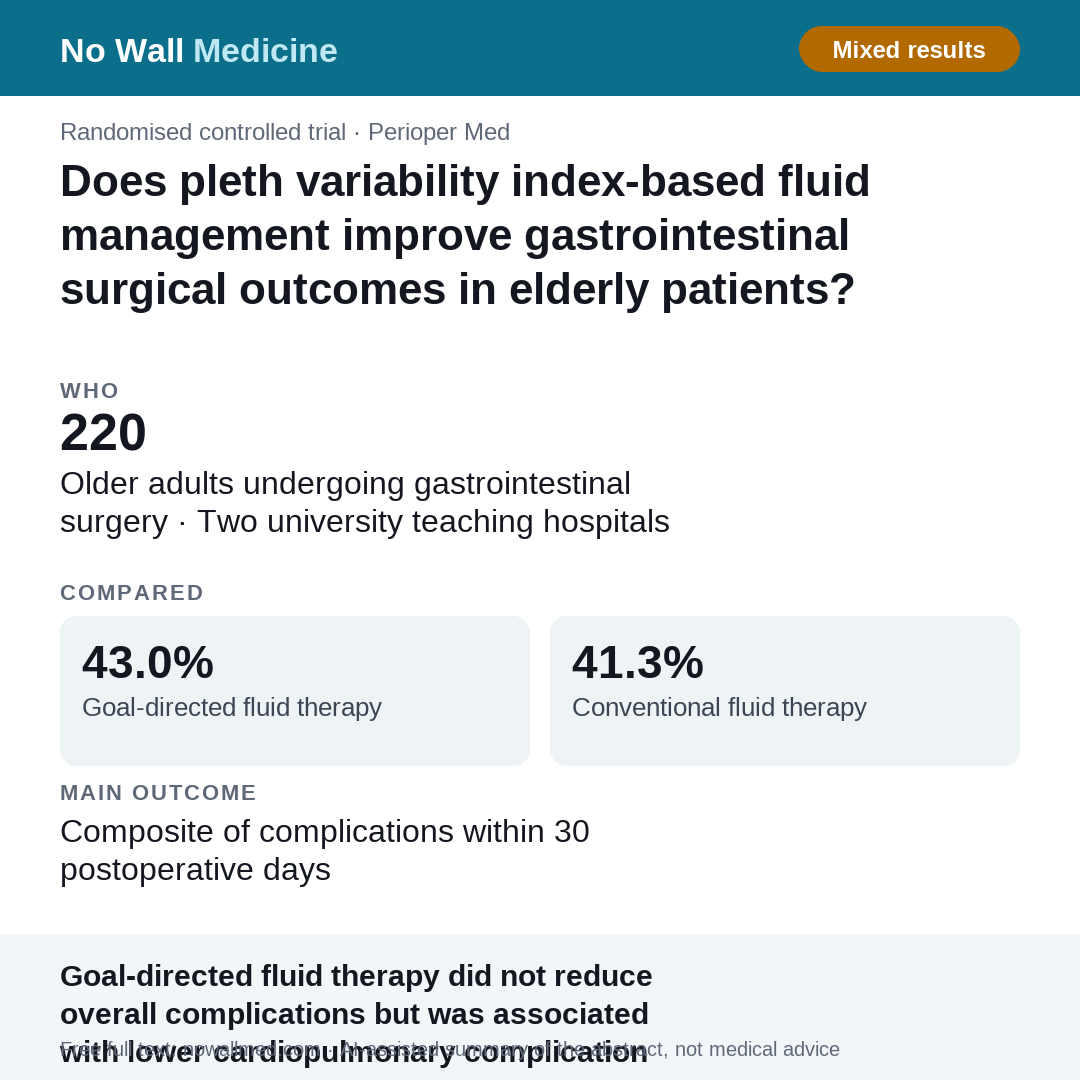
Does pleth variability index-based fluid management improve gastrointestinal surgical outcomes in elderly patients?
Who
220
Older adults undergoing gastrointestinal surgery · Two university teaching hospitals
Compared
43.0%Goal-directed fluid therapy
41.3%Conventional fluid therapy
Main outcome
Composite of complications within 30 postoperative days
Result: odds ratio 0.935 (95% CI 0.541-1.615)
Bottom line: Goal-directed fluid therapy did not reduce overall complications but was associated with lower cardiopulmonary complication rates.
Perioper Med · 2023-05-12Download image
Clinical question: Does pleth variability index-based fluid management improve gastrointestinal surgical outcomes in elderly patients?
Why it matters: The clinical benefits of using pleth variability index, a non-invasive measure of pulse wave variability, to guide fluid management in elderly gastrointestinal surgery patients remain unclear.
Key points
- Researchers studied 220 older adults undergoing gastrointestinal surgery who were randomized to receive either goal-directed fluid therapy using pleth variability index or conventional fluid therapy.
- There was no difference in overall complications within 30 days between the conventional group (41.3%) and the goal-directed group (43.0%).
- The goal-directed group received less total fluid (2.075 L) than the conventional group (2.5 L) and had a lower rate of cardiopulmonary complications (8.4% vs. 19.2%).
Headline and key points written with AI from the paper’s abstract, with every number checked against it. Read the paper before relying on them.
Cite this article
Wang Y, Zhang Y, Zheng J, Dong X, Wu C, Guo Z. Intraoperative pleth variability index-based fluid management therapy and gastrointestinal surgical outcomes in elderly patients: a randomised controlled trial. Perioper Med. 2023. doi:10.1186/s13741-023-00308-0
Spotted a mistake? Suggest a correction
Top studies every Monday
The week’s key trials and guidelines in your specialties, plus any topics you follow. By email, free.
Get the weekly digest