Universal antibiotic strategies were associated with lower early-onset Group B Streptococcus infection risk than risk-based approaches
Intrapartum antibiotic prophylaxis to prevent Group B streptococcal infections in newborn infants: a systematic review and meta-analysis comparing various strategies
Systematic review and meta-analysis of 72 observational studiesBenefit found
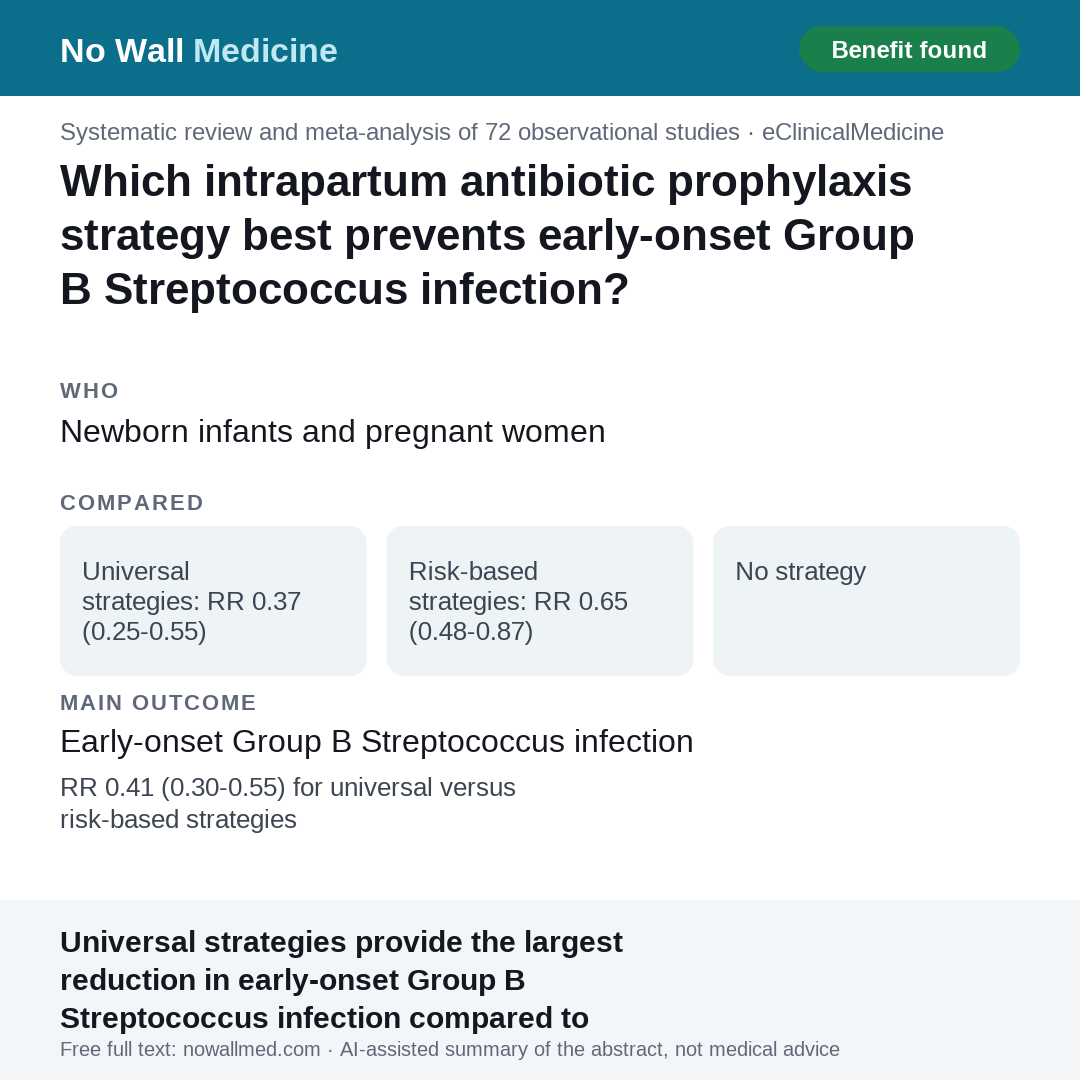
Which intrapartum antibiotic prophylaxis strategy best prevents early-onset Group B Streptococcus infection?
Who
Newborn infants and pregnant women
Compared
Universal strategies: RR 0.37 (0.25-0.55)
Risk-based strategies: RR 0.65 (0.48-0.87)
No strategy
Main outcome
Early-onset Group B Streptococcus infection
Result: RR 0.41 (0.30-0.55) for universal versus risk-based strategies
Bottom line: Universal strategies provide the largest reduction in early-onset Group B Streptococcus infection compared to risk-based strategies.
Funded by: UNDP-UNFPA-UNICEF-WHO-World Bank Special Programme
eClinicalMedicine · 2024-07-28Download image
Clinical question: Which intrapartum antibiotic prophylaxis strategy best prevents early-onset Group B Streptococcus infection?
Why it matters: There is no consensus on whether risk-based, universal, or combined antibiotic strategies are most effective for preventing early-onset Group B Streptococcus infection.
Key points
- Researchers analyzed 72 observational studies involving more than 10 million live births to compare different antibiotic prevention strategies.
- Universal antibiotic strategies were associated with a risk ratio of 0.41 (0.30-0.55) for early-onset Group B Streptococcus infection compared to risk-based strategies.
- The proportion of women receiving antibiotics was not significantly different between risk-based (16%) and universal (21%) strategies, with a risk ratio of 1.29 (0.95-1.75).
Limitation the authors note: The study was based on 72 observational studies.
Headline and key points written with AI from the paper’s abstract, with every number checked against it. Read the paper before relying on them.
Was this summary helpful?
Cite this article
Panneflek TJR, Hasperhoven GF, Chimwaza Y, Allen C, Lavin T, Te Pas AB. Intrapartum antibiotic prophylaxis to prevent Group B streptococcal infections in newborn infants: a systematic review and meta-analysis comparing various strategies. eClinicalMedicine. 2024. doi:10.1016/j.eclinm.2024.102748
Spotted a mistake? Suggest a correction
Top studies every Monday
The week’s key trials and guidelines in your specialties, plus any topics you follow. By email, free.
Get the weekly digest