Granulocyte colony-stimulating factor increases endometrial thickness but does not prevent adhesion recurrence in Asherman syndrome
Intrauterine administration of G-CSF for promoting endometrial growth after hysteroscopic adhesiolysis: a randomized controlled trial
Two-center prospective double-blind randomized controlled trialMixed results
Does intrauterine G-CSF prevent adhesion reformation and promote endometrial growth after hysteroscopic adhesiolysis?
Who
245
Patients with moderate to severe Asherman syndrome · Two centers
Compared
G-CSF: 7.91 ± 2.12 mm
Control: 7.22 ± 2.04 mm
Main outcome
Rate of formation of new adhesions
Result: 95% CI for difference: -1.26 to -0.12
Bottom line: G-CSF increases endometrial thickness and pregnancy rates but does not prevent the recurrence of intrauterine adhesions.
Limitation: Results cannot be extended to older patients or those without Asherman syndrome; low fertility analysis sample size.
Funded by: National Key Research and Development Program of China and others
Hum Reprod · 2022-02-12 · Save PNG
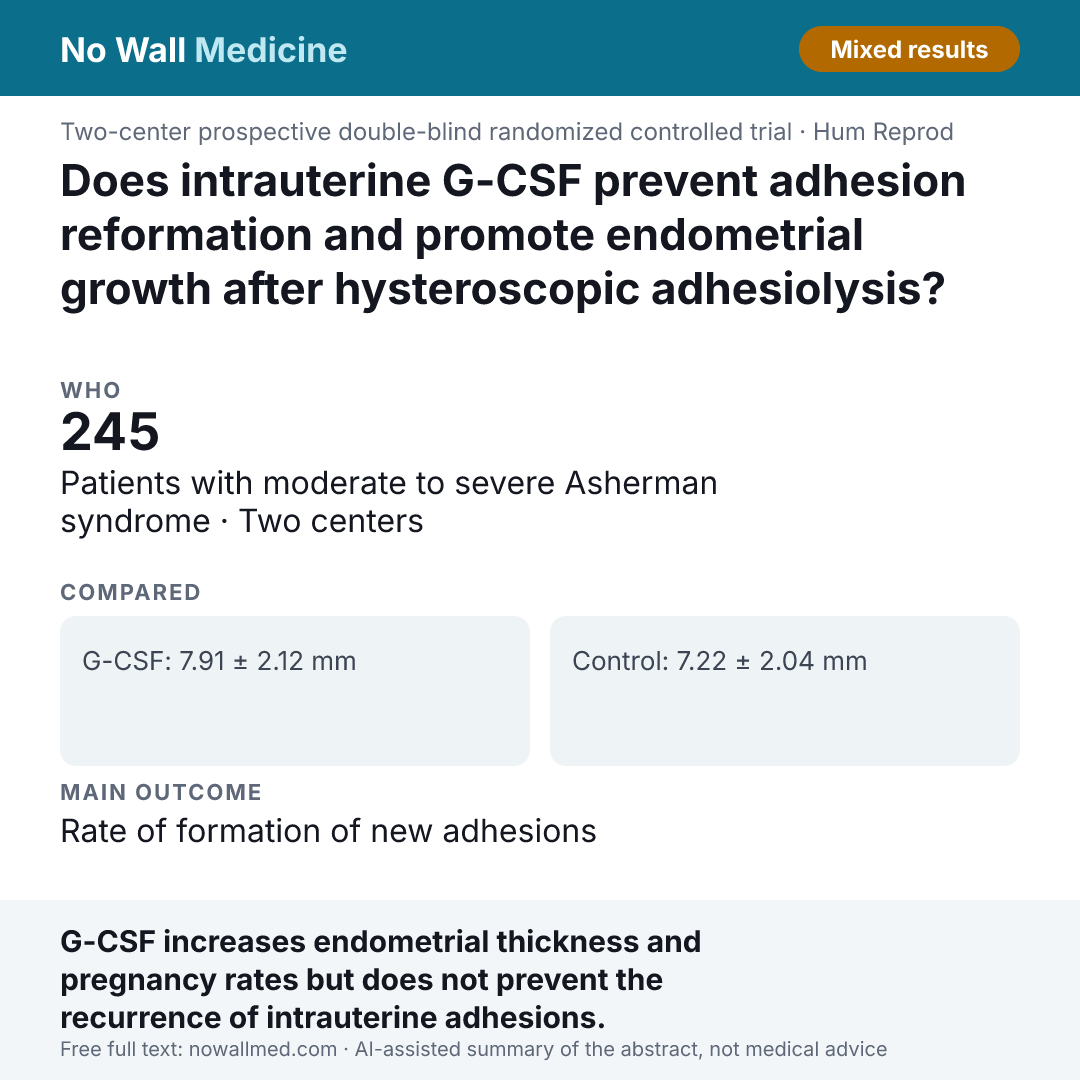
Clinical question: Does intrauterine G-CSF prevent adhesion reformation and promote endometrial growth after hysteroscopic adhesiolysis?
Key points
- In this randomized trial, 245 patients with moderate to severe Asherman syndrome were assigned to receive either granulocyte colony-stimulating factor or normal saline after surgery.
- Granulocyte colony-stimulating factor was associated with increased endometrial thickness of 7.91 ± 2.12 mm compared to 7.22 ± 2.04 mm, but showed no significant difference in adhesion reformation rates.
- The treatment was also associated with higher cumulative pregnancy and live birth rates among the 164 patients analyzed for fertility outcomes.
Limitation the authors note: The authors stated that the low number of patients in the fertility analysis could lead to biased results and that results may not extend to patients older than 40 years.
Headline and key points written with AI from the paper’s abstract, with every number checked against it. Read the paper before relying on them.
Was this summary helpful?
Subject terms
Headline, design, result, key points, caveat and citation as plain text.
Cite this article
Zhang Y, Chen X, Chen S, et al. Intrauterine administration of G-CSF for promoting endometrial growth after hysteroscopic adhesiolysis: a randomized controlled trial. Hum Reprod. 2022;37(4):725-733. doi:10.1093/humrep/deac023
Spotted a mistake? Suggest a correction