Intravascular imaging guided procedures were associated with lower risks of cardiac death and heart attacks
Intravascular imaging guided versus coronary angiography guided percutaneous coronary intervention: systematic review and meta-analysis
Systematic review and meta-analysisBenefit found
Does intravascular imaging guided versus angiography guided percutaneous coronary intervention improve outcomes in coronary artery disease?
Who
11698
Adults with coronary artery disease
Compared
Intravascular imaging guided
Coronary angiography guided
Main outcome
Cardiac death, myocardial infarction, stent thrombosis, and revascularization
Result: rate ratio 0.53 (95% confidence interval 0.39 to 0.72) for cardiac death
Bottom line: Intravascular imaging guided percutaneous coronary intervention reduces cardiac death and cardiovascular outcomes compared to angiography guided intervention.
BMJ · 2023-11-16Download image
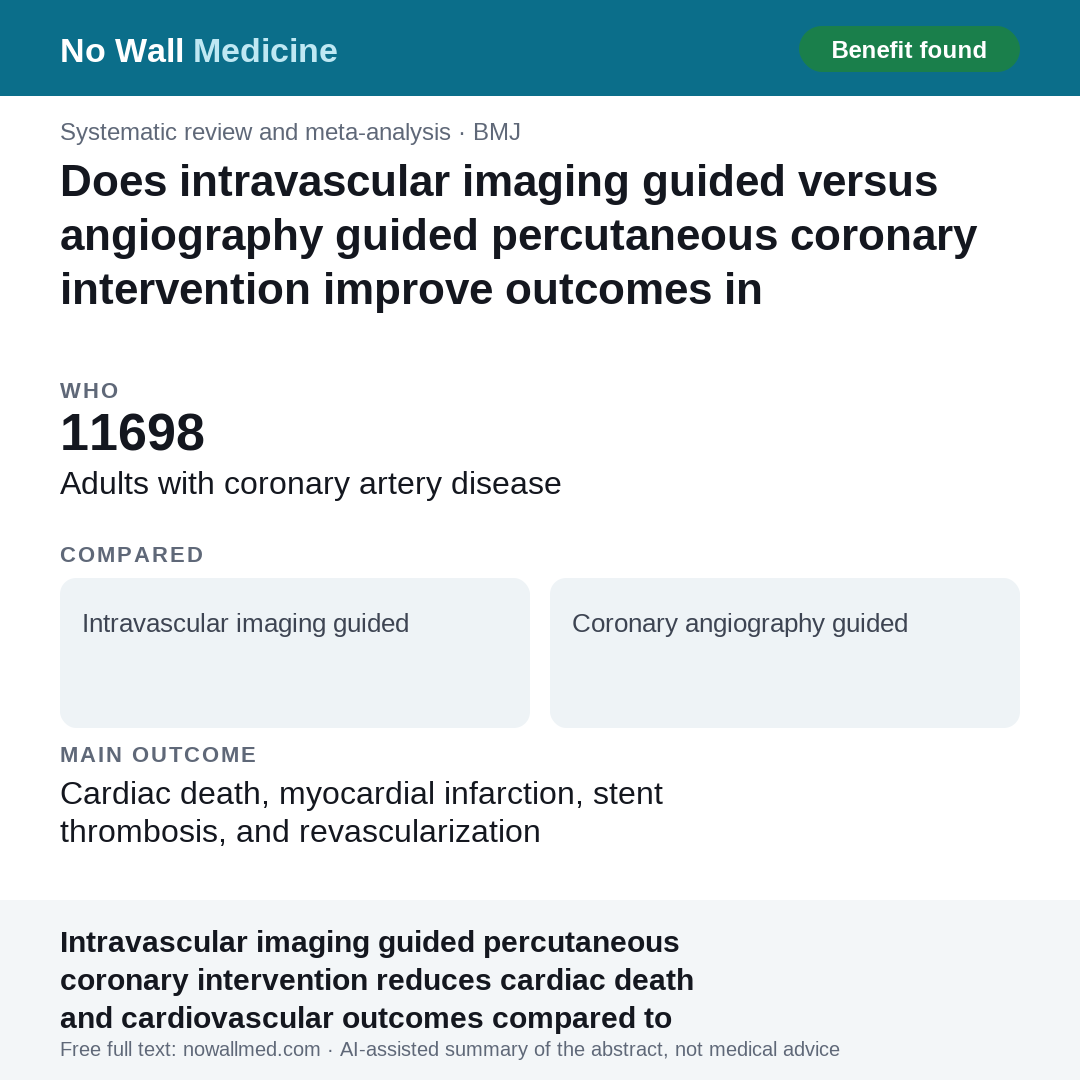
Clinical question: Does intravascular imaging guided versus angiography guided percutaneous coronary intervention improve outcomes in coronary artery disease?
Why it matters: Clinicians need to understand the absolute treatment effects of using intravascular imaging versus angiography based on a patient's baseline cardiovascular risk.
Key points
- Researchers analyzed 20 randomized controlled trials involving 11,698 adults with coronary artery disease to compare intravascular imaging with coronary angiography during stent procedures.
- Intravascular imaging was associated with a lower risk of cardiac death (rate ratio 0.53), myocardial infarction (0.81), and stent thrombosis (0.44).
- The imaging approach was also associated with fewer target vessel revascularization events (0.74) and target lesion revascularization events (0.71) per 1000 people.
Headline and key points written with AI from the paper’s abstract, with every number checked against it. Read the paper before relying on them.
Abstract
Objective
To assess the absolute treatment effects of intravascular imaging guided versus angiography guided percutaneous coronary intervention in patients with coronary artery disease, considering their baseline risk. Design
Systematic review and meta-analysis. Data sources
PubMed/Medline, Embase, and Cochrane Library databases up to 31 August 2023. Study selection
Randomized controlled trials comparing intravascular imaging (intravascular ultrasonography or optical coherence tomography) guided versus coronary angiography guided percutaneous coronary intervention in adults with coronary artery disease. Main outcome measures
Random effect meta-analysis and GRADE (grading of recommendations, assessment, development, and evaluation) were used to assess certainty of evidence. Data included rate ratios and absolute risks per 1000 people for cardiac death, myocardial infarction, stent thrombosis, target vessel revascularization, and target lesion revascularization. Absolute risk differences were estimated using SYNTAX risk categories for baseline risks at five years, assuming constant rate ratios across different cardiovascular risk thresholds. Results
In 20 randomized controlled trials (n=11 698), intravascular imaging guided percutaneous coronary intervention was associated with a reduced risk of cardiac death (rate ratio 0.53, 95% confidence interval 0.39 to 0.72), myocardial infarction (0.81, 0.68 to 0.97), stent thrombosis (0.44, 0.27 to 0.72), target vessel revascularization (0.74, 0.61 to 0.89), and target lesion revascularization (0.71, 0.59 to 0.86) but not all cause death (0.81, 0.64 to 1.02). Using SYNTAX risk categories, high certainty evidence showed that from low risk to high risk, intravascular imaging was likely associated with 23 to 64 fewer cardiac deaths, 15 to 19 fewer myocardial infarctions, 9 to 13 fewer stent thrombosis events, 28 to 38 fewer target vessel revascularization events, and 35 to 48 fewer target lesion revascularization events per 1000 people. Conclusions
Compared with coronary angiography guided percutaneous coronary intervention, intravascular imaging guided percutaneous coronary intervention was associated with significantly reduced cardiac death and cardiovascular outcomes in patients with coronary artery disease. The estimated absolute effects of intravascular imaging guided percutaneous coronary intervention showed a proportional relation with baseline risk, driven by the severity and complexity of coronary artery disease. Systematic review registration
PROSPERO CRD42023433568.
Abstract reproduced under the article’s CC BY NC licence.
Topics
Cite this article
Khan SU, Agarwal S, Arshad HB, Akbar UA, Mamas MA, Arora S. Intravascular imaging guided versus coronary angiography guided percutaneous coronary intervention: systematic review and meta-analysis. BMJ. 2023. doi:10.1136/bmj-2023-077848
Spotted a mistake? Suggest a correction
Top studies every Monday
The week’s key trials and guidelines in your specialties, plus any topics you follow. By email, free.
Get the weekly digest