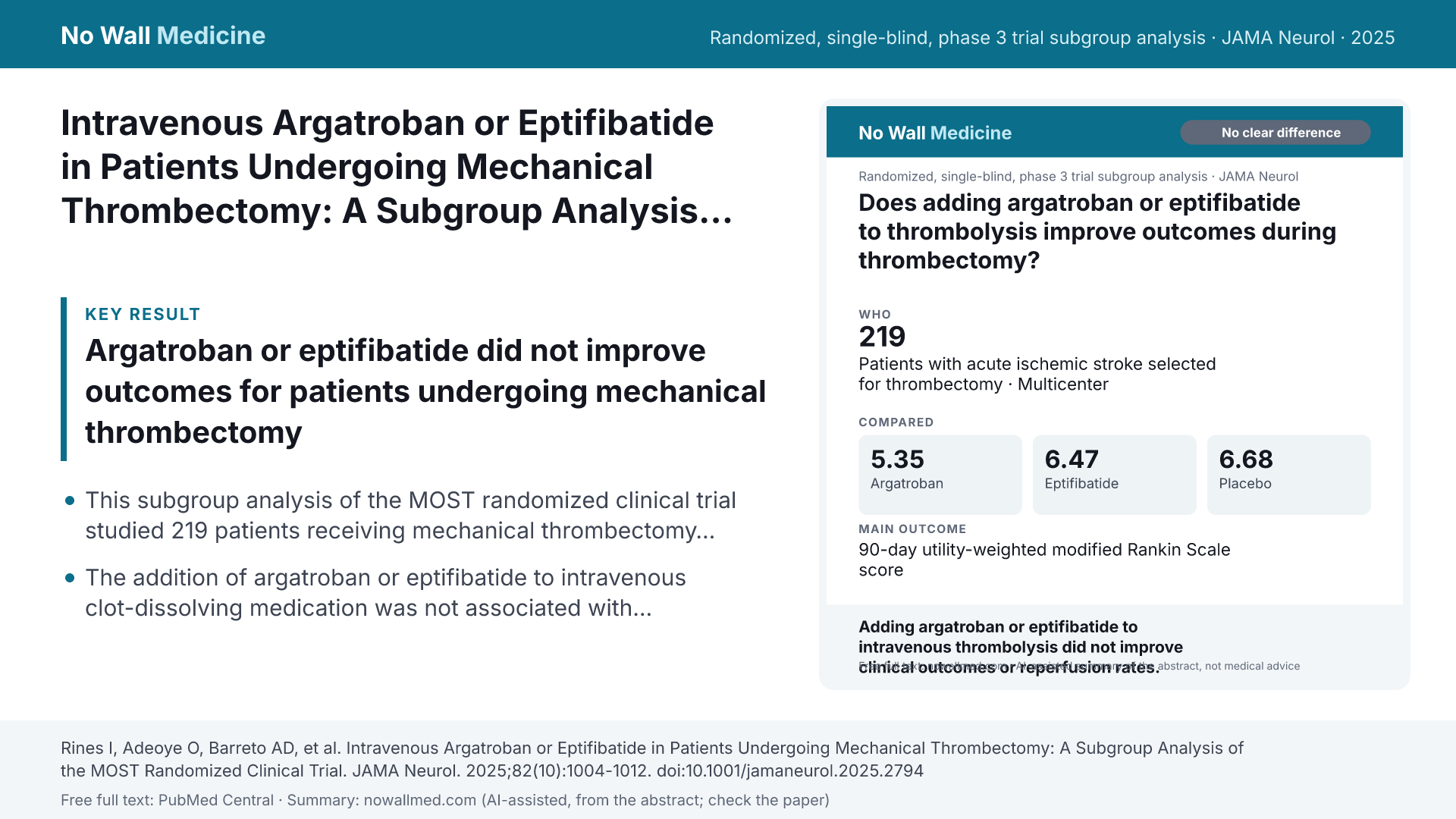
Argatroban or eptifibatide did not improve outcomes for patients undergoing mechanical thrombectomy
Intravenous Argatroban or Eptifibatide in Patients Undergoing Mechanical Thrombectomy: A Subgroup Analysis of the MOST Randomized Clinical Trial
Randomized, single-blind, phase 3 trial subgroup analysisNo clear difference
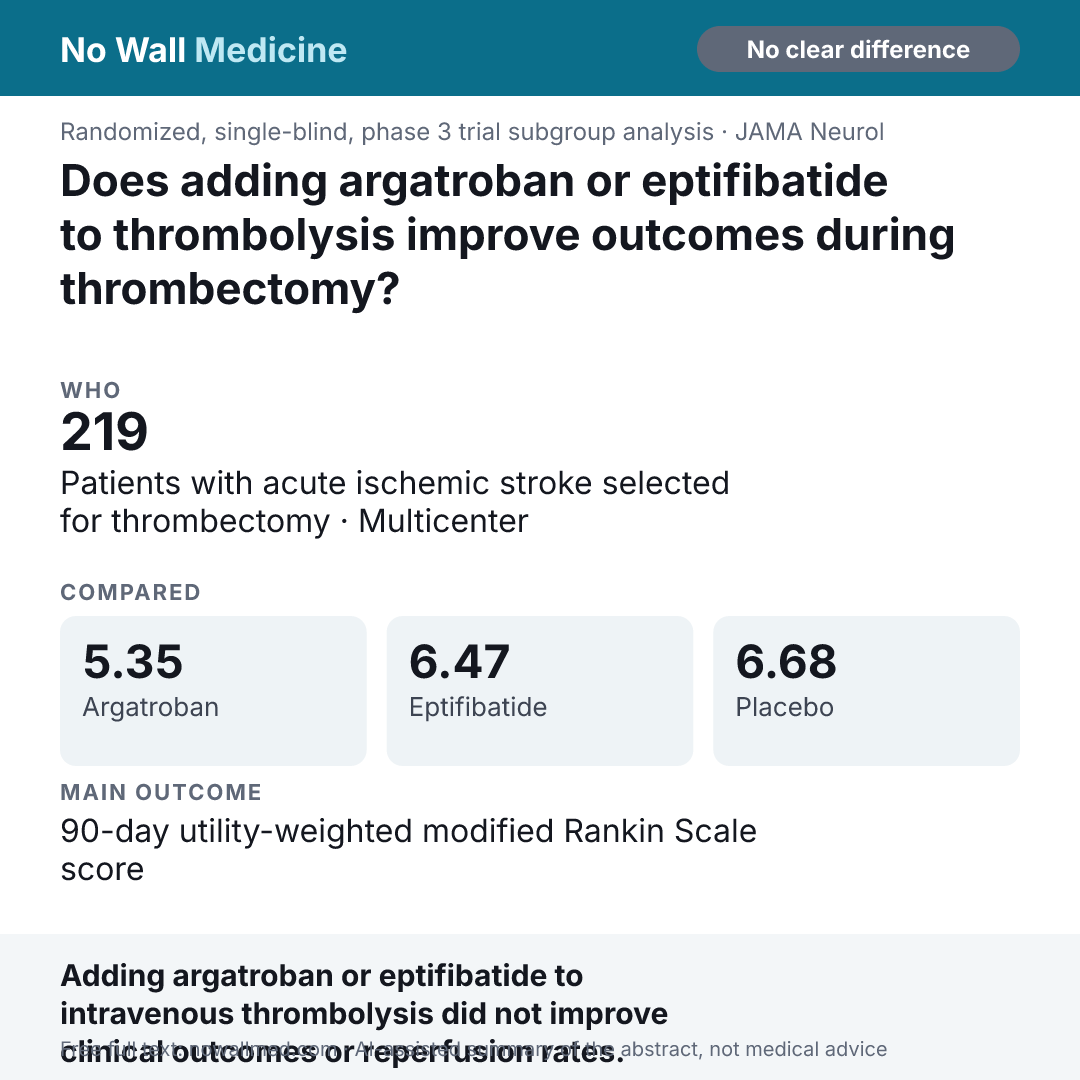
Does adding argatroban or eptifibatide to thrombolysis improve outcomes during thrombectomy?
Who
219
Patients with acute ischemic stroke selected for thrombectomy · Multicenter
Compared
5.35Argatroban (95% CI, 4.13-6.58)
6.47Eptifibatide (95% CI, 5.79-7.15)
6.68Placebo (95% CI, 5.98-7.39)
Main outcome
90-day utility-weighted modified Rankin Scale score
Bottom line: Adding argatroban or eptifibatide to intravenous thrombolysis did not improve clinical outcomes or reperfusion rates.
JAMA Neurol · 2025-08-18 · Save PNG
Same trial (NCT03735979)
Papers we list that report this registered trial, oldest first. Read a secondary analysis alongside the main results.
- Main results Harm found
Argatroban or eptifibatide added to stroke treatment did not reduce disability or increase survival NEJM 2024-09 - Related analysis Benefit found
Local and central assessments of stroke recovery scores showed excellent agreement in a randomized trial Stroke 2025-03 - Secondary analysis No clear difference
This paper JAMA Neurol 2025-08
Clinical question: Does adding argatroban or eptifibatide to thrombolysis improve outcomes during thrombectomy?
Key points
- This subgroup analysis of the MOST randomized clinical trial studied 219 patients receiving mechanical thrombectomy for acute ischemic stroke.
- The addition of argatroban or eptifibatide to intravenous clot-dissolving medication was not associated with better 90-day clinical outcomes or reperfusion rates.
- Good reperfusion rates were 83% in the placebo group, 63% in the argatroban group, and 84% in the eptifibatide group.
Headline and key points written with AI from the paper’s abstract, with every number checked against it. Read the paper before relying on them.
Was this summary helpful?
Headline, design, result, key points, caveat and citation as plain text.
Cite this article
Rines I, Adeoye O, Barreto AD, et al. Intravenous Argatroban or Eptifibatide in Patients Undergoing Mechanical Thrombectomy: A Subgroup Analysis of the MOST Randomized Clinical Trial. JAMA Neurol. 2025;82(10):1004-1012. doi:10.1001/jamaneurol.2025.2794
Spotted a mistake? Suggest a correction